Motors · Yamaha
Yamaha · PW-X3

PW-X3

Yamaha's smallest, lightest mid-drive yet trades headline wattage for a quiet, natural, torque-rich delivery that thrives the moment you put the power down.
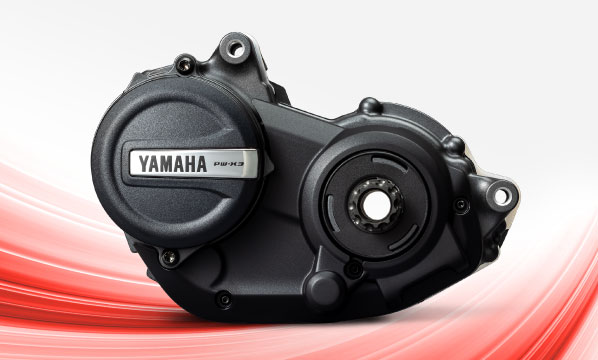
PW-X3 eMTB motor
Yamaha PW-X3 drive unit (official Yamaha Motor product image)
02505007506080100120682 Wcadence (rpm) →power (W)

Builds smoothly with rider input, peaks in the 70–75 rpm band (Velomotion's measured 682 W point at 250 W input) then tapers gently rather than falling off a cliff.

The verdict

Yamaha PW-X3 was the brand's 2022 reset: 20% smaller and roughly 10% lighter than the PW-X2, down to 2.75 kg, with peak torque lifted to 85 Nm to sit alongside the Bosch Performance Line CX and Shimano EP8. On paper it reads like a class benchmark. On the dyno it reads differently — Velomotion measured a peak of 682 W (at 70–75 rpm with 250 W of rider input), which puts it at the lower end of a field where the strongest rivals push past 800 W. This is not the motor for chasing a power number.

What it does superbly is feel natural. The PW-X3 needs real rider input before it commits, then meters out a smooth, progressive shove with very little of the surge or rattle that defines some competitors. Crucially it is one of the quieter units in its class — Velomotion rated it noticeably quieter on the climbs than a Shimano EP8 or a Bosch CX, and praised the complete absence of rattle on the descents. The honest catch Velomotion also flagged is efficiency: on the flat the PW-X3 draws significantly more than most of the competition, and only came good once the gradient kicked up.

The trade-off is clear: a quiet, refined, low-weight drive that rewards a cadence-led, spin-it style over brute lugging, but one that is neither the most powerful nor the most frugal on rolling terrain. Against the current class — Bosch CX Gen 5 (still 85 Nm / 600 W) and Shimano EP801 (85 Nm) on torque, and the lighter, far punchier DJI Avinox (2.52 kg, 105 Nm, 850 W) that now sets the benchmark — the PW-X3's case rests on quietness and feel rather than headline output.

“Not the biggest number on the dyno, but one of the quietest, most natural motors you can pedal.”

Character

Rider input
Yamaha does not publish a support ratio for the PW-X3. It runs four named levels — Eco, Standard and High, plus an Automatic mode that picks between them by reading rider effort and terrain. Whichever level you choose, it expects genuine rider input before delivering full output: a pedaller's motor, not an on-off switch.
On the trail
Smooth, natural and progressive — it meters power to match your input rather than surging, which keeps traction clean on loose, technical ground.
Noise
No independent dBA figure has been published, but Velomotion explicitly rated the PW-X3 quieter on the climbs than a Shimano EP8 or a Bosch CX, and noted a complete absence of rattle on the descents — the quietness is its standout trait, even if it hasn't been put to a decibel meter.
Efficiency
Not its strong suit on rolling ground. Velomotion found the PW-X3 draws significantly more on the flat than most of the competition — only one drive in their 2022 field was thirstier — and it only looked efficient once the gradient steepened. Low system weight helps overall range, but don't expect class-leading flat-ground economy.

The case for and against

Strengths

  • Light and compact at 2.75 kg
  • 85 Nm torque on par with Bosch CX (Gen 5) and Shimano EP801
  • Notably quiet — Velomotion rated it quieter on the climbs than EP8 or Bosch CX
  • Smooth, natural, input-matched delivery with no descent rattle

Compromises

  • Measured peak power (682 W) is at the lower end of the class
  • Draws significantly more than most rivals on the flat (Velomotion)
  • Rewards a spinning style over slow, brute-force lugging
  • No independent published thermal de-rate data; now outclassed on power/weight by DJI Avinox

How it stacks up

On torque it matches the headline 85 Nm of the Bosch Performance Line CX (still 85 Nm / 600 W in its current Gen 5 form) and the Shimano EP801, and at 2.75 kg it undercuts most full-power rivals on weight. But its measured 682 W peak sits below the strongest drives in the class, and the bar has since moved: the DJI Avinox (2.52 kg, 105 Nm, 850 W) is both lighter and far punchier. The PW-X3's case is refinement, quietness and a compact package rather than outright dyno power or flat-ground efficiency.
OWNER INTELLIGENCE
Most owners report no problems · 4,536 posts from 668 members analysed.
66Bearings and water: the repairer's verdict on the PW-X generation · typical onset: Bearing complaints from ~2,000-7,000 km; water deaths are seasonal (after…
29Speed-sensor and wiring faults misdiagnosed as motor failures · typical onset: Any time; often after assembly or wheel/rotor work.
24Noise: high-cadence squeal, clicking, knocking (common but not normal) · typical onset: From new to ~650 miles; mostly stable rather than progressive.
18,953 miles on a 2016 Haibike Full FatSix's original, never-opened Yamaha PW motor - original everything except consumables
Read the full owner report →
Back
Top