HPR60
TQ's second-generation whisper motor adds torque and power without losing the plot: still the smallest, lightest and quietest mid-drive in eMTB, now with a wider usable power band and the thermal stamina its predecessor lacked.
TQ quotes full 350 W peak from around 55 rpm; in testing the delivery stays strong and even through the mid-cadence range rather than spiking. This is TQ's claimed delivery shape, not an independent dyno trace.
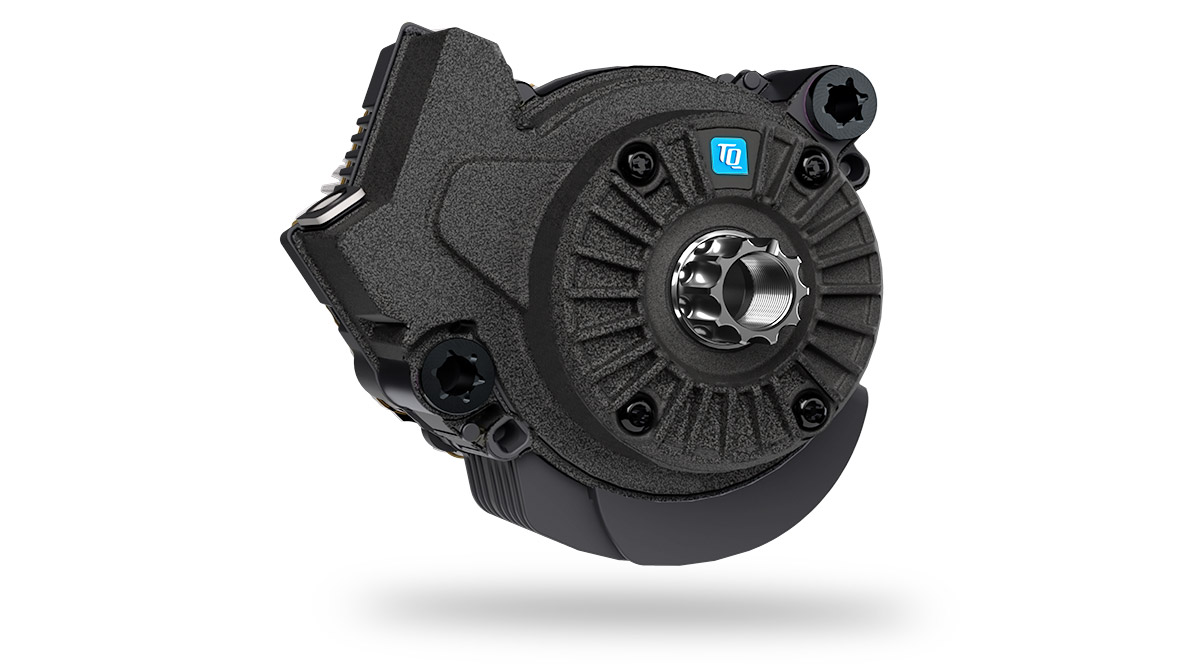
TQ HPR60 is not a power play — it is a refinement. TQ has nudged peak torque from 50 to 60 Nm and peak output from 300 to 350 watts, for a measured 124 g penalty over the HPR50 (1,924 g vs 1,800 g), yet the character is unchanged: a discreet, beautifully natural shove that feels less like a motor and more like a permanent tailwind. The patented Harmonic Pin-Ring gearbox still does the heavy lifting, its elliptical wave generator meshing with a flex spline to drop motor speed to chainring speed in one near-silent, backlash-free stage.
What has genuinely changed is the usable power band and the thermals. TQ quotes the full 350 W as available from around 55 rpm, and on test the motor never feels peaky or strained however you spin it — it pulls cleanly through the mid-cadence range rather than spiking and fading. Larger external cooling fins are the bigger story: Velomotion drained a battery flat on sustained climbs and found the housing only lukewarm with no derating. That thermal fade was the HPR50's Achilles heel, and it is gone. The system also gains TQ's updated colour display and top-tube remote, with assist tuning and over-the-air firmware handled through the host bike's app rather than fixed modes.
It will not out-punch a Bosch CX Gen 5 or a DJI Avinox, and it does not try to — it gives away 40 Nm and 400 W of peak to the current 100 Nm / 750 W Bosch. The HPR60 is for riders who want a bike that rides like an analogue trail bike with a quiet helping hand. If your local trails are long, steep fire-road grinds where you live in the highest assist mode, buy a full-fat motor instead; if you want the lightest, quietest natural-feeling drive in eMTB, nothing else comes close.
Sustained power & heat
How long the headline number actually lasts under sustained climbing load.
Velomotion drained the smallest 290 Wh pack flat on a sustained climb with no overheating or power drop (roughly 1,000 m of ascent). Qualitative observation, not an instrumented watt/temperature measurement.
Character
The case for and against
Strengths
- Class-leading low weight (1,924 g measured)
- Effectively inaudible on the trail (no published dBA, but quieter than rivals in testing)
- Strong, even 350 W delivery from ~55 rpm — never feels peaky
- Vastly improved thermals — Velomotion saw no derating on long climbs
- Beautifully natural, lag-free pin-ring delivery; app-tunable assist and new display
Compromises
- Modest outright power vs full-fat rivals (350 W / 60 Nm)
- 200% support cap means it won't haul you up the steepest grinds
- 124 g heavier than the HPR50 it replaces
- Premium system pricing; dealer-only service
How it stacks up
Bikes running this motor · 25