
Navigation
Install the app
How to install the app on iOS
Follow along with the video below to see how to install our site as a web app on your home screen.
Note: This feature may not be available in some browsers.
More options
Style variation
You are using an out of date browser. It may not display this or other websites correctly.
You should upgrade or use an alternative browser.
You should upgrade or use an alternative browser.
Bosch Range Tests - Comparisons
a
- Thread starter Suns_PSD
- Start date

⚡ EMTB PRO
25% off e*thirteen, Peaty’s & more with PRO
Member-only deals from e*thirteen, Peaty’s, PEMBREE and Magicshine · ad-free browsing · PRO badge · Living Intelligence Reports
See the deals →
From £1.99/month

Plummet
Flash Git
Are you talking the 100nm update?@Suns_PSD is a gen 5 with the update less efficient than a stock gen5?
If yes, then no, it's the same efficiency. Ie when you have the bikr set at the same settings you get the same range.
But if you blaze 100nm then you will be burning battery faster.
Thats now a loss of efficiency its a higher output used.

- Thread starter
- #123
I'm not retarded dude.@Suns_PSD is a gen 5 with the update less efficient than a stock gen5?
The fact is that there's are reviews where they have normalized for speed and the results are the same.
What do you think happens to the Avinox drag when the motor turns on? Does it suddenly not exist or is the motor just overcoming it?
Anyways, efficiency is just one part of the equation, for me.
sethimus
😠 Temu Gary 😠
you‘re so close. find some where they normalize for input power.normalized for speed
- Thread starter
- #125
you‘re so close. find some where they normalize for input power.
Seth, I don't care.
bmwpowere36m3
Member
Here's another datapoint: Transition Regulator CX REVIEW - The Vantastic Life
Regulator CX, 600wH
Regulator CX, 600wH
- Rider 195 lbs
- 23.7 miles
- 4,429ft (climbing forest service road in Galbraith)
- Power Mode: Purple and Red (mostly) while climbing and Blue on descents.
- Less than 15% battery at end of ride
- Thread starter
- #127
I'll keep it to this thread 'cause there have been a lot of hurt feelings when I bring it up in other threads, but it's obvious that the Bosch is somewhere between 10-20% more efficient than the current Avinox.
Although perfect range tests don't exist, literally dozens of reviews and personal antidotal posts have shown this to be the case with only a handful indicating that they are approximately equal.
I don't care if the Avinox provides more assistance, people have tried adjusting it down, and they ride together or the same routes as they rode on the Bosch, and 95% of the reports are that the Avinox uses its battery up more quickly than the Bosch.
Furthermore, Avinox motors have had running changes for noise, so some might make noise, some might be more efficient, so one single individual result really is just a data point.
Look at how many reviews of the Bosch say they prefer the 600w battery and it's plenty, where-as every review of a 600w Avinox says 'it needs/ they'd prefer the 800w'.
Anyways, the Bosch is the better motor in terms of efficiency, noise, reliability, serviceability and power delivery from a stop (where-as the Avinox seems better once already rolling at higher speeds). The Bosch is also technically lighter when you consider the efficiency part of the equation and that you need more battery with the Avinox.
I LOVE the Rogue bike but consider the M1 motor a liability. However, some things have been shared with me regarding the updated M2. If Avinox acknowledges that noise and efficiency have been improved, I intend to buy the Rogue with an M2. If all the M2 does is increase power, I'll go with a Regulator or the LTe to get the Bosch.
It just SUCKS that no one offers a frame only, Bosch CX-R 600w only proper bike.
PS. As far as why I don't just buy a Norco VLT Range to get the Bosch as it's very similar to the Rogue, primarily it's the CX motor instead of the CX-R, it's an entire bike instead of a frame, the 800w battery which would literally last me 2 days, the fat downtube & the bit weird geo that is in-between sizes.
Although perfect range tests don't exist, literally dozens of reviews and personal antidotal posts have shown this to be the case with only a handful indicating that they are approximately equal.
I don't care if the Avinox provides more assistance, people have tried adjusting it down, and they ride together or the same routes as they rode on the Bosch, and 95% of the reports are that the Avinox uses its battery up more quickly than the Bosch.
Furthermore, Avinox motors have had running changes for noise, so some might make noise, some might be more efficient, so one single individual result really is just a data point.
Look at how many reviews of the Bosch say they prefer the 600w battery and it's plenty, where-as every review of a 600w Avinox says 'it needs/ they'd prefer the 800w'.
Anyways, the Bosch is the better motor in terms of efficiency, noise, reliability, serviceability and power delivery from a stop (where-as the Avinox seems better once already rolling at higher speeds). The Bosch is also technically lighter when you consider the efficiency part of the equation and that you need more battery with the Avinox.
I LOVE the Rogue bike but consider the M1 motor a liability. However, some things have been shared with me regarding the updated M2. If Avinox acknowledges that noise and efficiency have been improved, I intend to buy the Rogue with an M2. If all the M2 does is increase power, I'll go with a Regulator or the LTe to get the Bosch.
It just SUCKS that no one offers a frame only, Bosch CX-R 600w only proper bike.
PS. As far as why I don't just buy a Norco VLT Range to get the Bosch as it's very similar to the Rogue, primarily it's the CX motor instead of the CX-R, it's an entire bike instead of a frame, the 800w battery which would literally last me 2 days, the fat downtube & the bit weird geo that is in-between sizes.
Last edited:
Plummet
Flash Git
Your wrong about dji. It's not 10-20 less efficient than bosch.I'll keep it to this thread 'cause there have been a lot of hurt feelings when I bring it up in other threads, but it's obvious that the Bosch is somewhere between 10-20% more efficient than the current Avinox.
Although perfect range tests don't exist, literally dozens of reviews and personal antidotal posts have shown this to be the case with only a handful indicating that they are approximately equal.
I don't care if the Avinox provides more assistance, people have tried adjusting it down, and they ride together or the same routes as they rode on the Bosch, and 95% of the reports are that the Avinox uses its battery up more quickly than the Bosch.
Furthermore, Avinox motors have had running changes for noise, so some might make noise, some might be more efficient, so one single individual result really is just a data point.
Look at how many reviews of the Bosch say they prefer the 600w battery and it's plenty, where-as every review of a 600w Avinox says 'it needs/ they'd prefer the 800w'.
Anyways, the Bosch is the better motor in terms of efficiency, noise, reliability, serviceability and power delivery from a stop (where-as the Avinox seems better once already rolling at higher speeds). The Bosch is also technically lighter when you consider the efficiency part of the equation and that you need more battery with the Avinox.
I LOVE the Rogue bike but consider the M1 motor a liability. However, some things have been shared with me regarding the updated M2. If Avinox acknowledges that noise and efficiency have been improved, I intend to buy the Rogue with an M2. If all the M2 does is increase power, I'll go with a Regulator or the LTe to get the Bosch.
It just SUCKS that no one offers a frame only, Bosch CX-R 600w only proper bike.
PS. As far as why I don't just buy a Norco VLT Range to get the Bosch as it's very similar to the Rogue, primarily it's the CX motor instead of the CX-R, it's an entire bike instead of a frame, the 800w battery which would literally last me 2 days, the fat downtube & the bit weird geo that is in-between sizes.
In the stock settings the algorithm is set for max assistance with sweet FA pedal input. That is where the "less efficiency" claims come from.
Back the power and assistance settings back to similar to bosch and you get similar output.
I did a back to back test with a mate on a rogue and me on gen 5 cestline. We matched the settings as close as we could and rode in those similar settings as close as we could. I used 408wh and he used 392wh. I'm about 3kg heavier than he is. If we adjust for weight a few wh thats bang on the the same efficiency.
So really you can't call the dji as being inefficient. The jury is still out on long term reliability and whether you have local support of dji is another issue. The only thing left is the lucky dip of if you get a slight motor rattle or not.
PS I have DJI and Gen5 bosch in my garage .......
- Thread starter
- #129
You have one DJI Plummet. Like I said, there are different iterations of it.
There are testers that have went through many. For instance, PB had 2 different DJI's in their test and had the same conclusion. Never mind that Avinox acknowledged the rattle and drag to Francis...
Also, you are more fat than your kid. LOL
There are testers that have went through many. For instance, PB had 2 different DJI's in their test and had the same conclusion. Never mind that Avinox acknowledged the rattle and drag to Francis...
Also, you are more fat than your kid. LOL
sethimus
😠 Temu Gary 😠
ffs, please, learn the difference in power output and what efficiency really means. thanks. i even annotated these two diagrams for your, and marked the difference in output for your, i even translated the bad german words in easy english:
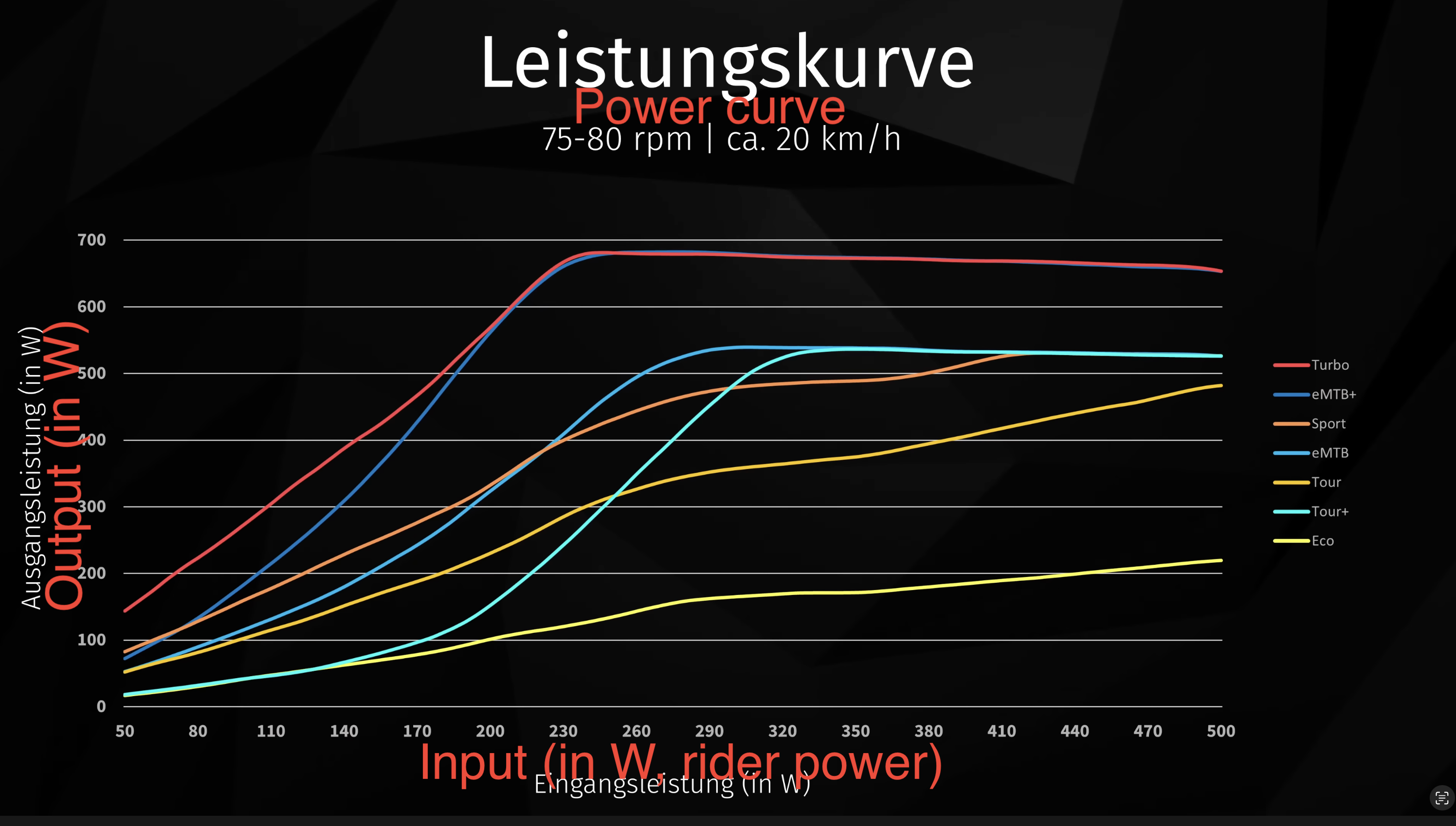
the first diagram shows you the power output of the bosch, in the different modes (x axis shows rider input, y axis how much power the motor puts out, at the wheel, at the same rpm:
now the power curve of the avinox motor, after the software update where they also increased the power. you can clearly see, that for the same rider input, you get out a lot more power in the higher assistance modes, than on the bosch. BUT THAT DOESN'T MEAN IT'S LESS EFFICIENT. efficiency is IN the motor, how much loss there is in the different gears. that is probably there, but that's not much. how much? this we will know at the latest in february, when all parts of ebike-mtb's motor test are released, as they announced they have tested that with the help of DEKRA Stuttgart.
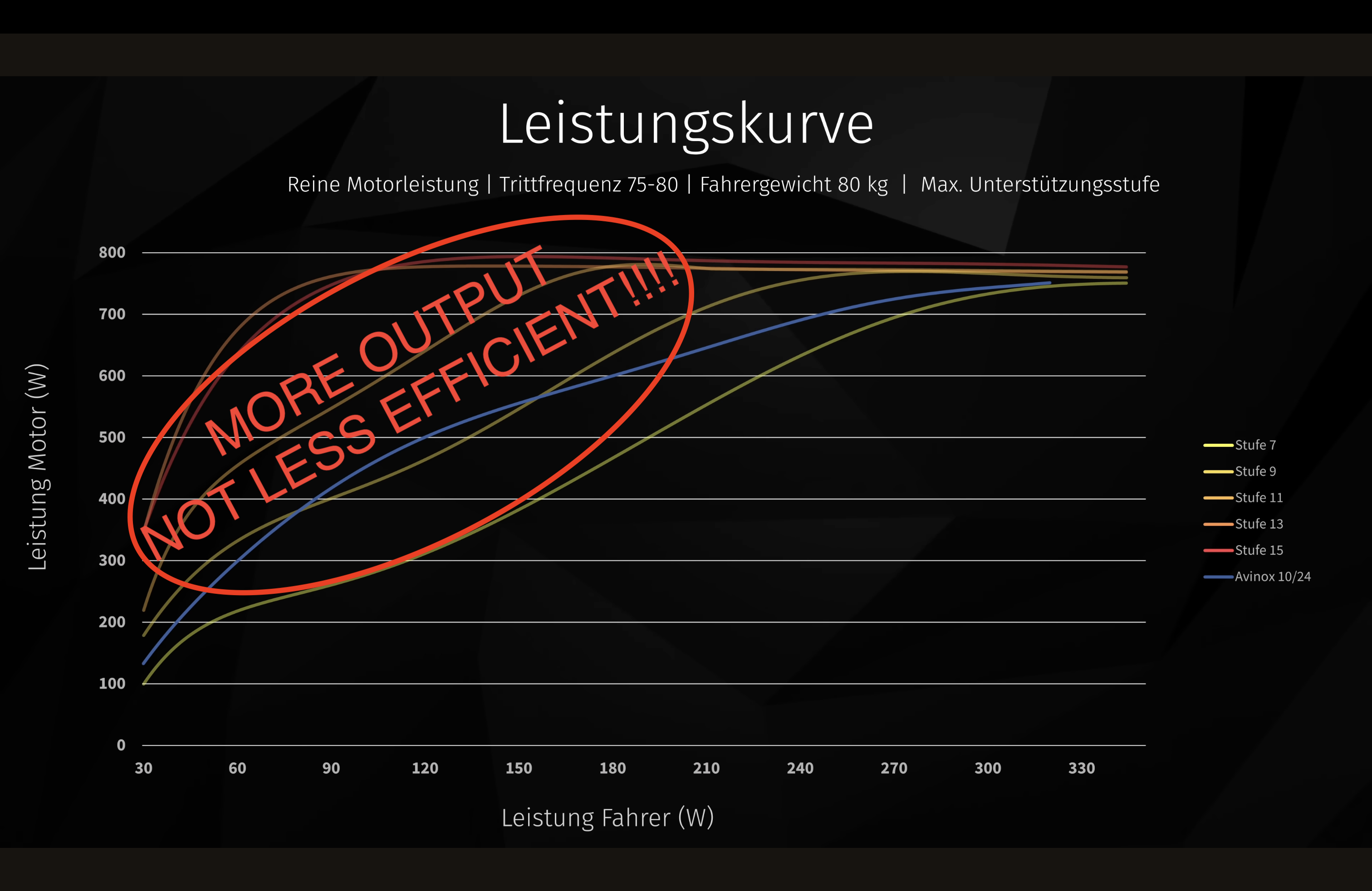
see that BIG FAT RED circle? that's the higher output. when you turn down assistance to lvl 7, than you have a similar power curve than Bosch's EMTB+ mode, everything above that, the motor uses more battery but gives you more power = less rider work. and that's most probably the area most testers are usually riding in, hence why they use more battery. they didn't test how much less input they needed to put in to get that amount of power.
hope that finally helps you understand the difference, @Suns_PSD. but please, for the love of everything, stop calling it less efficient, because it isn't.
thx.
rant over
the first diagram shows you the power output of the bosch, in the different modes (x axis shows rider input, y axis how much power the motor puts out, at the wheel, at the same rpm:
now the power curve of the avinox motor, after the software update where they also increased the power. you can clearly see, that for the same rider input, you get out a lot more power in the higher assistance modes, than on the bosch. BUT THAT DOESN'T MEAN IT'S LESS EFFICIENT. efficiency is IN the motor, how much loss there is in the different gears. that is probably there, but that's not much. how much? this we will know at the latest in february, when all parts of ebike-mtb's motor test are released, as they announced they have tested that with the help of DEKRA Stuttgart.
see that BIG FAT RED circle? that's the higher output. when you turn down assistance to lvl 7, than you have a similar power curve than Bosch's EMTB+ mode, everything above that, the motor uses more battery but gives you more power = less rider work. and that's most probably the area most testers are usually riding in, hence why they use more battery. they didn't test how much less input they needed to put in to get that amount of power.
hope that finally helps you understand the difference, @Suns_PSD. but please, for the love of everything, stop calling it less efficient, because it isn't.
thx.
rant over
Last edited:
- Thread starter
- #131
Hey, I just genuinely appreciate you not being nearly as passive aggressive and just providing info. You only slipped up with your 'finally' as if I'm dense or something and don't understand all of these points already. So thank you.
I understand and follow your point. Furthermore, I'll ONLY discuss this topic in this particular thread moving forward so as not to mess up other threads.
From where I sit, too many testers have stated that they turned down the Avinox power to feel similar to the Bosch, and they still experienced lower efficiency. Including PB.
But really, if 2 guys ride together all day, go the same pace, feel the same tired at the end of the day, and one motor system went less far, isn't that enough ultimately? I mean are you going to say 'but really I worked less hard even though we did the same thing the entire day...' when explaining why your ride was done sooner?
Ultimately, we can have different opinions on this topic, and that's fine.
One thing is clear though: Nearly all Bosch riders and testers state that the 600w fixed battery is plenty adequate. Nearly every test of the Avinox with a 600w states that it needs the 800w. I think that is very telling. Fear not however, the Avinox update will be public within weeks and we'll know all of the details by March and have real world reports by April-May.
I understand and follow your point. Furthermore, I'll ONLY discuss this topic in this particular thread moving forward so as not to mess up other threads.
From where I sit, too many testers have stated that they turned down the Avinox power to feel similar to the Bosch, and they still experienced lower efficiency. Including PB.
But really, if 2 guys ride together all day, go the same pace, feel the same tired at the end of the day, and one motor system went less far, isn't that enough ultimately? I mean are you going to say 'but really I worked less hard even though we did the same thing the entire day...' when explaining why your ride was done sooner?
Ultimately, we can have different opinions on this topic, and that's fine.
One thing is clear though: Nearly all Bosch riders and testers state that the 600w fixed battery is plenty adequate. Nearly every test of the Avinox with a 600w states that it needs the 800w. I think that is very telling. Fear not however, the Avinox update will be public within weeks and we'll know all of the details by March and have real world reports by April-May.
Plummet
Flash Git
The test i did was with a mate who is 3kg lighter than me max. offset that by my bike is 1kg lighter, total difference 2kg.You have one DJI Plummet. Like I said, there are different iterations of it.
There are testers that have went through many. For instance, PB had 2 different DJI's in their test and had the same conclusion. Never mind that Avinox acknowledged the rattle and drag to Francis...
Also, you are more fat than your kid. LOL
The motor isnt less efficient. it just has more power and as standard an algorithm that uses more power. Dial it back and you get similar range for similar weight riders.
PS In my group of riders theres 2 x amflows, 3 x teewings and 2 x rogues. What's consistent is once the power settings are backed off the dji's are getting similar range and if the riders are smashing high powered settings they burn battery fast....
- Thread starter
- #133
I'll admit you have the most trusted argument for ranges being equal.The test i did was with a mate who is 3kg lighter than me max. offset that by my bike is 1kg lighter, total difference 2kg.
The motor isnt less efficient. it just has more power and as standard an algorithm that uses more power. Dial it back and you get similar range for similar weight riders.
PS In my group of riders theres 2 x amflows, 3 x teewings and 2 x rogues. What's consistent is once the power settings are backed off the dji's are getting similar range and if the riders are smashing high powered settings they burn battery fast....
Man, what a selection of bikes in your region! I guess just being so close to Asia does that.
Have you shredded the Rogue yet? If choosing today, would you choose your current Crestie, the new Crestie, or the Rogue?
Thx.
Plummet
Flash Git
I've only done a parking lot test on the Rogue. But have done some solid tech climbing and descending miles next to a mate riding one. What i can say is that both bikes are freaken similar in capability if we disregard motor differences. I would not be displeased with either bike far as capability is concerned.I'll admit you have the most trusted argument for ranges being equal.
Man, what a selection of bikes in your region! I guess just being so close to Asia does that.
Have you shredded the Rogue yet? If choosing today, would you choose your current Crestie, the new Crestie, or the Rogue?
Thx.
Crestline spec is closer to my spec, IE swappable batteries, 600wh battery compatible. 180mm rear travel, so that wins the battle if money was no object.
In reality the crestline for me is almost double the cost, plus I know the velduro guys and would likely support local rather than import the twice the price frame. I'm not upgrading anytime soon however. I still love the S180 and every time i have that 400wh its just such a fun balanced bike. It feels like a really capable solid mtb. Like a super enduro rig with weights rather than a emtb with heavy front weight bias.
I jump on a 800wh dji bike and sure the power is thrilling but I can feel that front weight bias of the long skinny heavy 800wh battery. Its definitely more on ebike experience than a heavier mtb experience. Even riding the 600wh battery on my s180 isnt as enjoyable to me. If i had to change to a 800wh battery bike i'd have to go through the 5 stages of mourning the loss of a more balanced small battery e-bike..
On the other side of that. On big days riding with my mates with big batteries, i'm running out sooner with my smaller batteries and that is a pain in the arse.
sethimus
😠 Temu Gary 😠
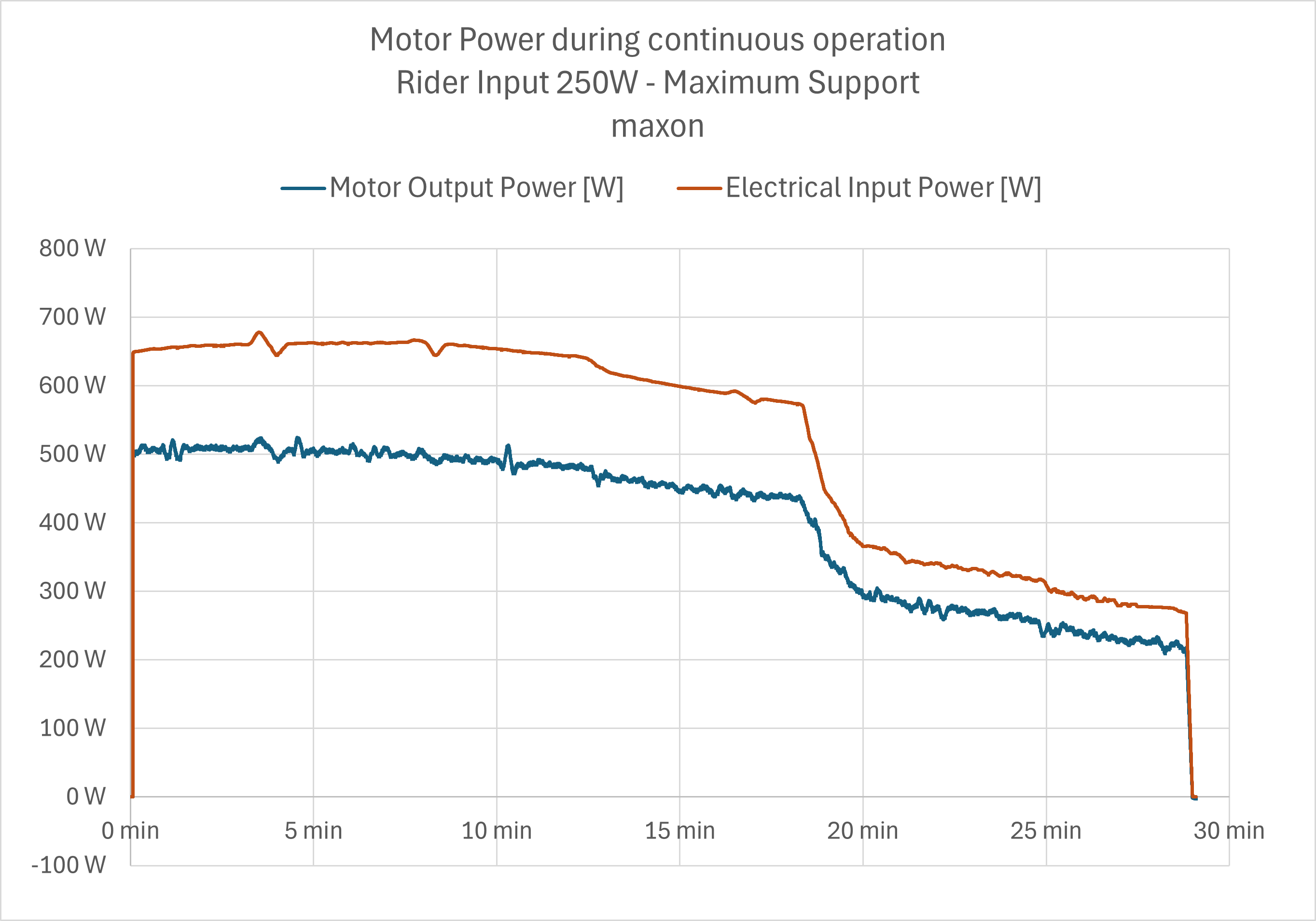
btw, just reading the emtb-mag test of the Maxon S, that's how efficiency looks like:
and that we will have soon for both of the big ones too...
and that we will have soon for both of the big ones too...

Interesting. I have not read that test yet, but will check it out.btw, just reading the emtb-mag test of the Maxon S, that's how efficiency looks like:
View attachment 173310
and that we will have soon for both of the big ones too...
Do we know how they are measuring efficiency? There is a difference between Electrical Input>Rear Wheel output (taking into account drivetrain, chainline, tyre etc.... ) and Motor Electrical>Motor Mechanical output.
- Thread starter
- #137
btw, just reading the emtb-mag test of the Maxon S, that's how efficiency looks like:
View attachment 173310
and that we will have soon for both of the big ones too...
For sure, that's cool stuff and I look forward to seeing the results.
From my reading the Maxon is about 76% (500/ 660) efficient. So that's a good baseline.
sethimus
😠 Temu Gary 😠
dunno, there are videos in the test i haven't watched yet, maybe they explain the test environment there, or that's in one the follow ups in 26:Interesting. I have not read that test yet, but will check it out.
Do we know how they are measuring efficiency? There is a difference between Electrical Input>Rear Wheel output (taking into account drivetrain, chainline, tyre etc.... ) and Motor Electrical>Motor Mechanical output.
| E-Bike Motor Test: 4 In-Depth Analyses | Date |
|---|---|
| 1. Climbing Power, Range & Efficiency – Which motor gets the most out of every watt-hour? | 23 January 2026 |
| 2. The Myth of Motor Noise – What really matters? | 30 January 2026 |
| 3. Juice Bar: The Battery Size Myth & the Fast-Charging Trend – how much energy is actually in your battery, and how quickly are you back in the adventure? | 6 February 2026 |
| 4. What does 1,000 W of peak power really deliver? What are the downsides, and how does the 750-W regulation come into play? | 13 February 2026 |
- Thread starter
- #139
They posted the reviews on the Pinion thing and the new Maxon motor. I didn't read the reviews as the only 2 motors I'd consider are the Bosch and Avinox. But I skimmed them and read the efficiency results.
These percents efficiency are not exact as I'm just holding up a piece of paper to create a straight line on the graph to get the averages.
Anyways the Pinion is showing 75% efficiency (doesn't it change in different gears on that motor?) and the Mahle is showing 80% efficiency.
What's not clear to me, is why would they list a Pro of the Maxon as high efficiency, yet it's only 76%, nearly the same as the Pinion. Yet the Mahle has 80% efficiency and that's not listed as a Pro?
Anyways!
These percents efficiency are not exact as I'm just holding up a piece of paper to create a straight line on the graph to get the averages.
Anyways the Pinion is showing 75% efficiency (doesn't it change in different gears on that motor?) and the Mahle is showing 80% efficiency.
What's not clear to me, is why would they list a Pro of the Maxon as high efficiency, yet it's only 76%, nearly the same as the Pinion. Yet the Mahle has 80% efficiency and that's not listed as a Pro?
Anyways!
sethimus
😠 Temu Gary 😠
reading the article helps... (btw, that just shows me that you really just jump too fast to conclusions, my inital impression of you stands)Yet the Mahle has 80% efficiency and that's not listed as a Pro?
- Thread starter
- #141
reading the article helps... (btw, that just shows me that you really just jump too fast to conclusions, my inital impression of you stands)
Not sure why you feel the need to be an *ss all of the time. Are you the same in real life or just on the internet?
I presume that you mean this statement from the article: "On the plus side, the motor scored well for efficiency in the measured areas, placing it right at the top of the field alongside the maxon."
The point that I made, is just as accurate as when I first said it. I know the Mahle's efficiency is a Pro, that's why I expressed surprise that they didn't list is as a Pro. I didn't need to read the article to figure that out as I have critical thinking skills. Damn man, you are seriously dense.
Tops
- Refined response and precise control in tight switchbacks
- Solid average charging time
- Strong climbing power
- Excellent power-to-weight ratio
sethimus
😠 Temu Gary 😠
no, the mahle showed motor errors when they increased rider input > 200w in the test rig. you just compared two different rider input value efficiencies and jumped to conclusions too early, as always. i see now where your issues lie, you only skim through stuff, probably also here, and read only what you want to read ignoring what could shatter your predefined opinions.
- Thread starter
- #143
no, the mahle showed motor errors when they increased rider input > 200w in the test rig. you just compared two different rider input value efficiencies and jumped to conclusions too early, as always. i see now where your issues lie, you only skim through stuff, probably also here, and read only what you want to read ignoring what could shatter your predefined opinions.
You are seriously lacking in critical thinking skills. Which I wouldn't care about if you were just polite about it. Your statement above, is essentially gibberish as what it says doesn't relate to what occurred in the test, like at all. I don't speak Swiss so I guess I can't knock your English.
Your above point has nothing to do with the Mahle's efficiency, as underscored by the Mahle's actual efficiency being the second highest in the test. The motor was 'restrained' and also had a shut down on the bench. Neither effects efficiency at all and the reviewer's conclusions, and a modicum of critical thinking skills, bares that out.
Seriously, just move along.
Last edited:
sethimus
😠 Temu Gary 😠
because the Mahle failed the test at 250w input.What's not clear to me, is why would they list a Pro of the Maxon as high efficiency, yet it's only 76%, nearly the same as the Pinion.
because the Mahle failed the test at 250w input.Yet the Mahle has 80% efficiency and that's not listed as a Pro?
the 200w measurment is there because they couldn't test anything above that input power.
sethimus
😠 Temu Gary 😠
NO. EFFICIENCY IS NOT A STATIC NUMBERYour above point has nothing to do with the Mahle's efficiency, as underscored by the Mahle's actual efficiency being the second highest in the test.
IT. FAILED. THE. TEST.
Last edited:
sethimus
😠 Temu Gary 😠
maybe this helps you:
 islproducts.com
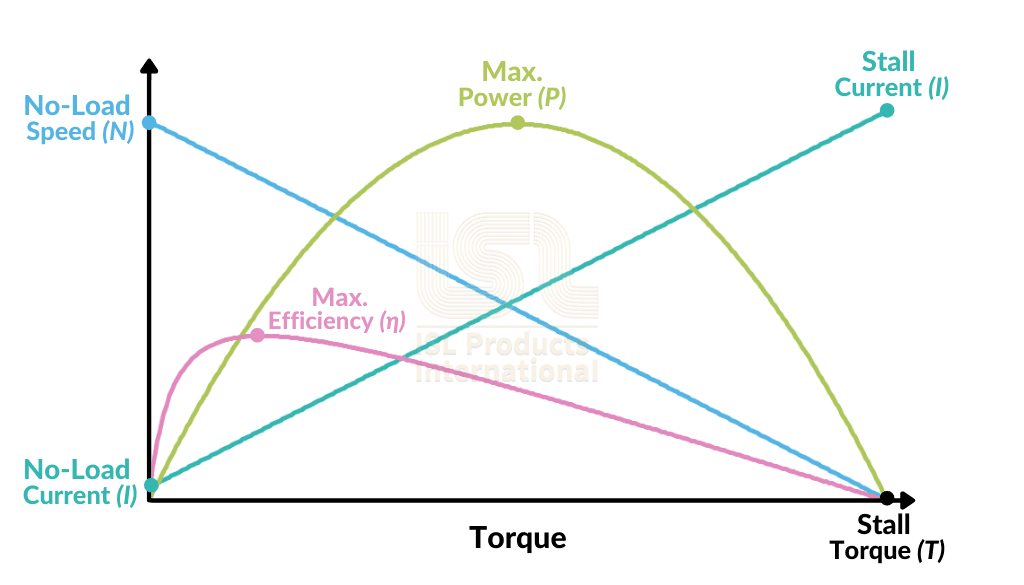
How To Read DC Motor & Gear Motor Performance Curves
Performance curves are a key aspect of any motor specification. Learn what all of this data means to help in your motor selection process.
islproducts.com
now please use your "critical thinking skill" and explain, why YOU think the efficiency at 200W input should be compared to the efficiency of 250w input, when you only have one dataset for the Mahle motor, but not the same dataset for the other motors (and vice versa).Efficiency (η)
Efficiency is a relationship between the input power and output power, given as a percentage (%). This line is more or less parabolic with the vertex more towards the lower torque values (see pink line in example above). It typically peaks early on in the torque range then slowly decreases as the motor gets closer to its stall torque.
Using the motor near it’s peak efficiency ensures optimal motor life and power consumption. It is best practice to use a motor at or near its peak efficiency. The further away a motor gets from max efficiency, its performance becomes less reliable.
sethimus
😠 Temu Gary 😠
it's called swiss german and only exists as a spoken language, their written language is german (my mother tongue, i'm german).I don't speak Swiss
sethimus
😠 Temu Gary 😠
- Thread starter
- #149
78% efficiency is solid. I used 520 watts at the output shaft divided by 670 watts drawn from the battery.
Thanks for posting.
To me one of the most interesting questions that this test will answer is if the CX-R is more efficient than the CX as a result of the ceramic bearings? I've never wanted the CX-R for the extra power, only the weight & possible efficiency advantages. I suspect that they are trying to count down from most efficient to least, but then the Pinion was the exception to this rule already.
Obviously, you and I both want to see if the current Avinox has a lower (or higher) efficiency, but it's sort of irrelevant since: 1) it's documented that the motor has had running changes that effects noise and efficiency and no one knows what they are testing, 2) the motor is changing to the M2 like right now, the M1 is already like the Gen4 Bosch, it's the old one, 3) It's no longer a question if in the real world the Avinox gets less range, it absolutely does for most testers. If it's due to lower efficiency or just sh*tty programming & torque sensing really doesn't matter in the real world.
edited: Just read the article and saw this: "Among all Bosch motors, the CX-R showed the highest efficiency – likely thanks to the reduced friction of the ceramic bearings."
Last edited:

Is it possible you are suffering from confirmation bias?
I think if you tweaked your wording it wouldn't cause any controversey... e.g. The bosch in turbo delivers 20% more range than the avinox in turbo - probably fine. The bosch is 20% more efficient than the avinox.. can only back that up if you cherry pick your sources.
I think if you tweaked your wording it wouldn't cause any controversey... e.g. The bosch in turbo delivers 20% more range than the avinox in turbo - probably fine. The bosch is 20% more efficient than the avinox.. can only back that up if you cherry pick your sources.
Similar Threads


Free account
Join 43,192
eMTB riders
eMTB riders
One tap. No forms. Fewer ads.
or sign up with email
Already a member? Log in