Ride 60
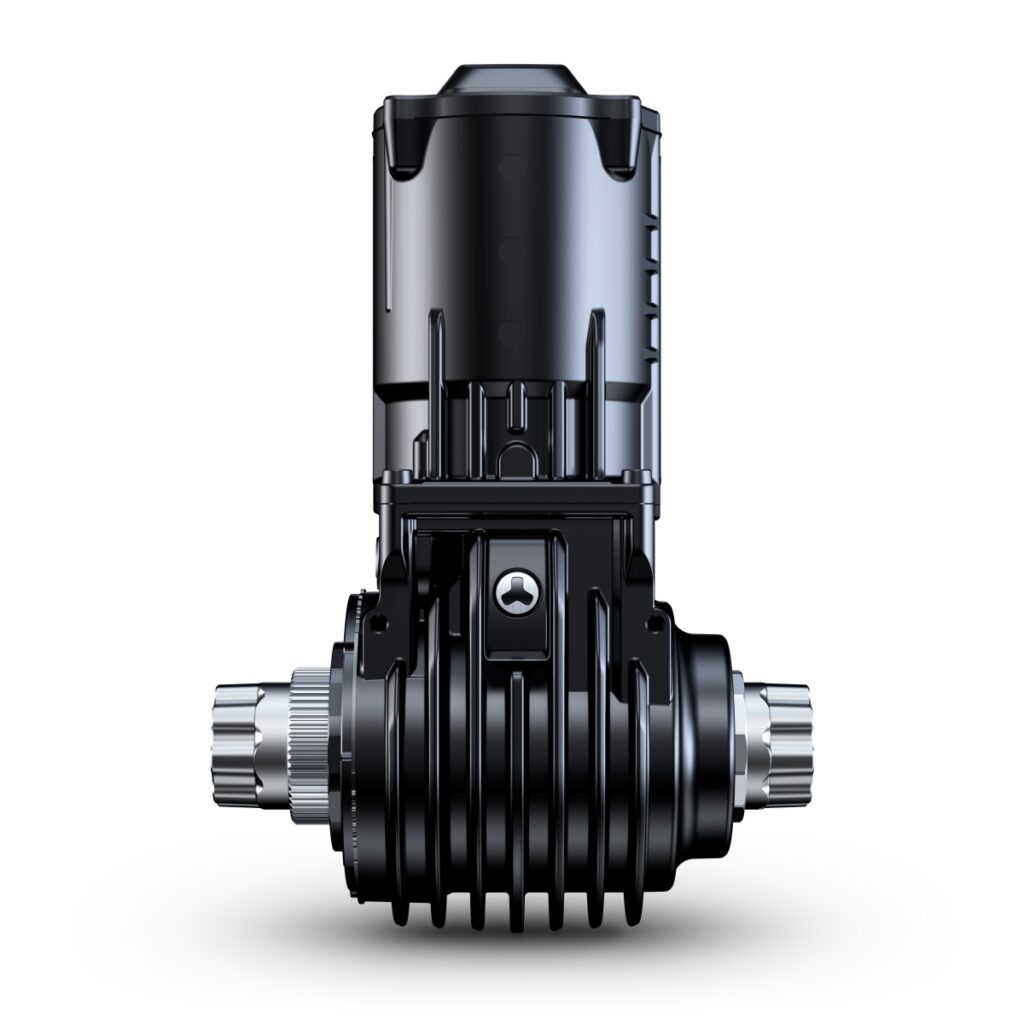
Fazua's Ride 60 is the lightweight-motor benchmark for riders who want most of a full-power feel in a sub-2 kg package: 60 Nm of torque and a measured 525 W ceiling that brushes the bottom of the full-fat class — climbing to roughly 625 W with the time-limited Boost engaged.
Strong, torquey low-cadence pull that builds to a broad plateau of ~525 W around 70-80 rpm (at 250 W rider input) before tapering as the wheel speeds up; Boost lifts the ceiling to ~625 W for 12 s.
Fazua Ride 60 is the motor that finally let Fazua play in the grown-up league. Where the old Evation felt like a gentle range-extender, this is a proper trail drive: 60 Nm claimed, and on Velomotion's dyno it pushed about 525 W of mechanical output at a realistic 250 W rider input (non-Boost), climbing to roughly 625 W with the 12-second Boost engaged. For a 1.96 kg unit that is a genuinely dense power-to-weight figure — just note the headline 525 W is the sustained-mode ceiling and excludes Boost.
The character is the clever part. Velomotion found the Ride 60 puts down the strongest low-cadence pull of the light class — at 100 W rider input it is barely shy of a full-power Bosch Performance CX, and it only gives best to Bosch's Performance Line SX when you really drop the rpm. It needs a genuine shove to wake fully, though: the 525 W peak only appears around 250 W of rider effort, and at a gentle 100 W it is much more modest. Software updates (now nine major releases) have smoothed the delivery and addressed the early-batch reliability wobbles.
It is not a Bosch CX replacement — sustained, all-day full-power climbing still favours heavier full-power units. On range, the 2026 reality has changed: Fazua's long-promised 210 Wh range extender was cancelled after the Porsche takeover and never sold, so don't buy a Ride 60 expecting bolt-on capacity. Instead Fazua upgraded the internal pack from 432 Wh to a 480 Wh Energy 480 (fixed and removable versions, from 2025), a ~10% lift that is the real answer to the range question.
Sustained power & heat
How long the headline number actually lasts under sustained climbing load.
No lab has published a measured sustained-climb temperature or power-fade curve for the Ride 60, so how long the 525 W actually holds on a long, hot climb is untested. Velomotion noted derating on long, hot climbs qualitatively; a real dyno hold-time test remains an open gap.
Character
The case for and against
Strengths
- Near full-power 525 W measured output from a 1.96 kg unit
- 60 Nm with class-leading low-cadence torque
- Now ships with a 480 Wh internal battery (up from 432 Wh)
- Frugal consumption (~19-20 Wh/km at 100 W on the flat)
- Matured well via nine firmware updates
Compromises
- Needs ~250 W rider input to reach the full 525 W; modest at gentle effort
- 525 W peak excludes Boost (~625 W) which is time-limited to 12 s
- Promised 210 Wh range extender was cancelled — no bolt-on capacity option
- Early production batches had reliability teething issues
How it stacks up
Bikes running this motor · 40