Bosch Range Tests - Comparisons

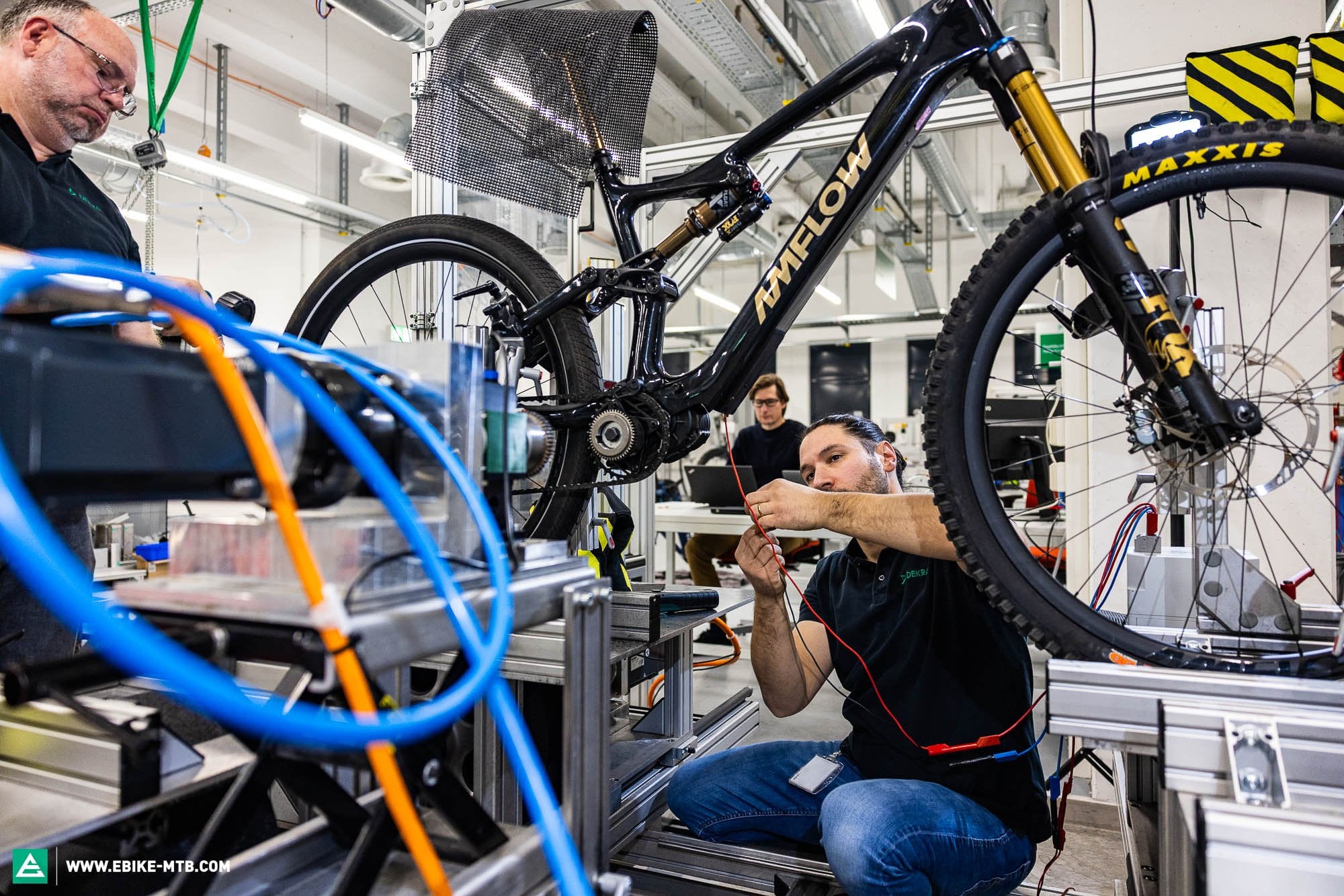
They attached measuring equipment to a fixed bike in a lab and used machines to apply the 250w pedaling input, then measured battery drain and watts output. They also removed the motors from the bikes entirely.
Yeah, just had a quick look. Unless they measure electrical power into the drive unit and mechanical power out of the motor at the crank with the same external load conditions across the different bikes, they are mostly measuring whole bike drivetrain efficiency intertwined into the result... not a pure motor efficiency number.

E-MTB_Motoren_Test_2025_WEB-9771.jpg
 
⚡ EMTB Pro Go Pro — exclusive discounts & ad-free Peaty's 25% off & more · Ad-free browsing · Pro badge See the deals →
They attached measuring equipment to a fixed bike in a lab and used machines to apply the 250w pedaling input, then measured battery drain and watts output.

They also removed the motors from the bikes entirely. That's how they got such accurate weights, etc. as well. Notice the CXR is only 90 grams lighter than the CX, not the claimed 150 for example.

I think the Pinion had high efficiency because they somehow bypassed the built-in transmission or maybe chose an efficient gear. See the note that ChatGPT included. I didn't bother reading that particular review because I would not consider that motor anyways.

View attachment 175445View attachment 175446
I can see lots of cables and wires. Its hard to tell their exact methodology though. Its not disclosed as far as I can see.

Taking a motor out is pretty easy to weigh.

By the way, I'm not knocking them at all - the guys are great. But I'm saying that unless everything is equal in the testing then there will be inaccuracies in the data differences in the results that are introduced by drivetrain / hub / suspension design / chainline etc etc.

It looks to me like they are getting the output from the dyno at the rear wheel.
 
the guys testing are DEKRA, same level as TÜV Süd
DEKRA are legit for sure. But Dekra testing does still not turn a complete bike bench test into a motor only efficiency test. If the device under test is a whole bike, then the result is system efficiency, not purely motor efficiency. The moment mechanical output is measured downstream of the motor, everything after the motor contaminates the number.

On its own, probably not that interesting, but when we are literally comparing motors to the percentage levels like in @Suns_PSD table, then definitely we need to take these variables into account.
 
They measured output power right off the motor. Not at the rear wheel, which frankly wouldn't make any difference anyways if they used the same tire but did it on a bench as long as they didn't use a HP bike.
 
Do they show / explain how?
Well you can see it on the Amflow in your picture. They have a flywheel coming right off the crankshaft of the motor going back to a pulley on the measurement dynometer.

Edited now that I'm not on my phone. I see that they have a road tire so it looks like they are picking up the power reading from the rear wheel.

This doesn't matter, at all. There is no power loss that is specific to the bike chassis when there isn't even a rider on the bike.
 
Last edited:
Well you can see it on the Amflow in your picture. They have a flywheel coming right off the crankshaft of the motor going back to a pulley on the measurement dynometer.
My take on that was that is the input - the machine is putting in ~150w (or whatever) into the motor, and they are measuring the output at the rear wheel?

If not, how are they putting an input into the motor? It needs an input and output.


E-MTB_Motoren_Test_2025_WEB-9771.jpg
 
It looks to me as if it's driven on that gear.
In that photo they don't have the gears touching as they are still setting up the rig. But the drive gear is on like a lathe slider so they can engage it. They have the drive gear off to the left and you can see the driven gear to the right of the photo coming off the motor crankshaft/ crank spindle. There are no cranks installed so obviously they're not peddling it. Then they have a belt that's going back to turn a generator or something to read the output power. They're using the electrical connections to capture how much battery juice is being utilized to compare it to the output watts.
 
Last edited:
Well, you can't be accused of not putting enough due diligence into buying an e bike......

I rushed into my last e-bike purchase and regretted it. Since I already had an e-bike I decided to take my time and pick the right one that will last 3-4 years; maybe until the internal transmission era is upon us!

As you know I picked the Antidote first but I'm pretty sure they went under. I placed a deposit at the beginning of September and haven't heard from them since October. They've been radio silence on social media as well. My credit card company only gave me my money back last month and I lost hundreds of dollars in reselling parts I didn't need after all.

I'm very content with my decision overall with the Wild. The bike commonly wins bike of the year and now I have what I consider to be the best motor (currently) too. Now I just wish it would get here. :(

Of course I'm curious if the M2 Avinox will be much improved over the M1 and maybe I would have preferred that. Even though we will see the M2 in the next 60 days, it could be another year till we really know it's true overall performance and reliability. I'm not very price sensitive, but I did get a solid deal on the Wild and that feels good as I really just wanted the frame and motor anyways as the rest is irrelevant to me. I would have had to pay full price for the new Avinox Wild.
Plus there is the reliability/ serviceability component. There are quite a few reports coming out now about the M1 having significant failures and part shortages. That's unheard of with the Gen 5 Bosch. That matters to me long term.

As I've mentioned a few times before, the extra power of the avinox is totally meaningless where I'm at and to me. Sure we have some proper steep bits but they're also windy single track trails for the most part. I have friends running full power Boschs and they turn them down a bit even on the steepest bits as they mostly say it's just too much.
 
Last edited:
My take on that was that is the input - the machine is putting in ~150w (or whatever) into the motor, and they are measuring the output at the rear wheel?

If not, how are they putting an input into the motor? It needs an input and output.


View attachment 175457
Agree with Rob, hence the road tire and you can make out a drum with mechanism (with round lightening holes) within that 80/20 extrusion below the rear tire. There inputing power via that splined coupling (where the crank arm would be) and measuring the output at the wheel. There also tapping the battery to measure consumption.

I don't think the differences were seeing/measured are really significant... once all the motors are tested we'll see. I wouldn't get too excited unless I saw 20% or more. If you could drop from a 800 to 600 wh battery with the same range/vert... now were talking.
 
I disagree that the differences are insignificant and I have faith in the testing methods. The fact that the power is transmitted through a bike chassis makes not one iota of difference on a bicycle on a fixture.

The Mahle being 80% efficient could travel as far on a 600wh battery as a 60% efficient motor could travel on an 800wh battery. This theoretical low efficiency motor not only makes the Mahle effectively 2#s lighter, but the placement of the weight is much better. And it also has the ability to travel much further overall if you choose to match battery sizes.

The largest gap currently is from 73 to 80%, so only 1/3 of that theoretical difference.

I don't know what the Avinox M1 that they have on hand will test at but at this point I'm certainly curious. Heck it's almost irrelevant considering the running changes and the imminent release of the M2.
 
Well, at least when it comes to this particular example of the Avinox motor, I have to eat my words, as it's one of the MOST efficient.


Avinox250 W rider – max support~960~755≈ 78–79%

It's a great review that cuts through some of the unknowns, imo. That power, sheesh. It's really a monster. I mean, it's spitting out 30% more power than the CXR! That is genuinely not something I'd ever need where I ride but just wow.

In this test, the M1 was both quiet AND efficient while providing best in class traction. Strong praise indeed. I do think that it needs some help in the tuning department to reduce the assistance and stretch the battery it has further. Something that appears to be hard to accomplish with the available settings.

🔝 Efficiency ranking (most → least)​

  1. Mahle M40≈ 80%
  2. Fazua Ride 60≈ 79%
  3. Avinox≈ 78%
  4. Bosch CX-Race≈ 78%
  5. Maxon≈ 77%
  6. Bosch CX≈ 75%
  7. Pinion MGU≈ 75%
  8. Bosch SX≈ 73%
 
Last edited:
Well, at least when it comes to this particular example of the Avinox motor, I have to eat my words, as it's one of the MOST efficient.


Avinox250 W rider – max support~960~755≈ 78–79%

It's a great review that cuts through some of the unknowns, imo.

In this test, the M1 was both quiet AND efficient while providing best in class traction. Strong praise indeed.

🔝 Efficiency ranking (most → least)​


  1. Mahle M40≈ 80%
  2. Fazua Ride 60≈ 79%
  3. Avinox≈ 78%
  4. Bosch CX-Race (CXR)≈ 78%
  5. maxon≈ 77%
  6. Bosch CX≈ 75%
  7. Pinion MGU≈ 75%
  8. Bosch SX≈ 73%
so is that a full retration of the bosch 600wh = 800wh avinox nonsense?

Just to continue the trend of how easy it is to pick holes in all of this testing - if you look at the absolute difference in motor power output and electrical input does your ranking still hold? Why are you picking %?

I do agree with one of the article statements, the avinox is a fun motor

"What truly sets the Avinox M1 apart is the sheer fun it delivers on the trail"
 
If any of the motors truly had a demonstrable efficency advantage it would be all over their advertising and press releases. If you want more range get a bigger battery/extender/lower the power setting.
 
Here is what I actually think, and it's just my best guess. I think some Avinox units rattle, and some are less efficient due to the tight seals, and that the one received for this test had neither of those issues. Will all customers from here on out have this version? I don't know.

As Sethimus pointed out, the same publication just tested a rattling Avinox in their Rogue just last week.

At this point where do I personally rank the motors based on all of this info?

I think the updated Avinox is the superior performing unit. It has more power available, great power delivery, looks better, and the same efficiency as the hard to buy CXR. The Avinox isn't lighter than the CXR once you add the needed bash guard.

I think Bosch holds an advantage in terms of reliability & serviceability, particularly in the future as the bikes age. Performance is so similar as to not matter between the two motor systems, as long as you are content with 400% multiplication and a max of about 700w. If you want more, the Bosch isn't it.

I can still change my Wild order to the Avinox, but I'm sticking with the Bosch CXR, which come resale time I might regret. But I'll have it months sooner and a bit cheaper. It just comes down to my trails and needs. I can climb everything on my Fazua60. Sometimes it really sucks and I wish I had more power, but I can do it. I still want to navigate the single track and not just zap it out of the way. My riding buddy just hit a bunch of top 10s on our trails, with his Bosch only set at 65 NM. The extra power just isn't useful here. But long-term reliability and parts accessibility is in fact quite important to me.

That said, Bosch better make some upgrades to their package, or they are going to lose more market share. I'd suggest: Making the CXR the standard, upping power to an actual 750w instead of the current 680ish, and some really trick ahead of the curve denser battery that can be retrofitted in place of the current 600wh so that it fits all Bosch bikes. They probably should improve their speed pickup as well.
 
I rushed into my last e-bike purchase and regretted it. Since I already had an e-bike I decided to take my time and pick the right one that will last 3-4 years; maybe until the internal transmission era is upon us!

As you know I picked the Antidote first but I'm pretty sure they went under. I placed a deposit at the beginning of September and haven't heard from them since October. They've been radio silence on social media as well. My credit card company only gave me my money back last month and I lost hundreds of dollars in reselling parts I didn't need after all.

I'm very content with my decision overall with the Wild. The bike commonly wins bike of the year and now I have what I consider to be the best motor (currently) too. Now I just wish it would get here. :(

Of course I'm curious if the M2 Avinox will be much improved over the M1 and maybe I would have preferred that. Even though we will see the M2 in the next 60 days, it could be another year till we really know it's true overall performance and reliability. I'm not very price sensitive, but I did get a solid deal on the Wild and that feels good as I really just wanted the frame and motor anyways as the rest is irrelevant to me. I would have had to pay full price for the new Avinox Wild.
Plus there is the reliability/ serviceability component. There are quite a few reports coming out now about the M1 having significant failures and part shortages. That's unheard of with the Gen 5 Bosch. That matters to me long term.

As I've mentioned a few times before, the extra power of the avinox is totally meaningless where I'm at and to me. Sure we have some proper steep bits but they're also windy single track trails for the most part. I have friends running full power Boschs and they turn them down a bit even on the steepest bits as they mostly say it's just too much.
Yeah, I dont need the avinox either.

The only time really is during racing and its mainly around the 45kph cut out they have. The 45kph avinox rider has a clear advantage over 32kph cut out rider. But i'm racing for shits and giggles because my boy is racing so i dont really care.
 
even more strange: if you watch the video, the motor they show in there on the amflow is dji branded. so they must have had more than one motor in this test and had them switched at one point. the question is why?
 
even more strange: if you watch the video, the motor they show in there on the amflow is dji branded. so they must have had more than one motor in this test and had them switched at one point. the question is why?
i asked them about that btw, they claimed it was the same motor all the time, but they changed the cover. they didn’t follow up on the discrepancy with the rattle on the velduro.

and their specialized motor test dropped today. @Suns_PSD do your thing!
 

Efficiency ranking (most → least)​


  1. Mahle M40 — ≈ 80%
  2. Fazua Ride 60 — ≈ 79%
  3. Avinox — ≈ 78–79%
  4. Bosch CX-Race (CXR) — ≈ 78%
  5. maxon — ≈ 77%
  6. Bosch CX — ≈ 75–76%
  7. Pinion MGU — ≈ 75%
  8. Bosch SX — ≈ 73%
  9. S-Works 3.1 — ≈ 71%


Mechanical Wh=800×efficiency
MotorEfficiencyMechanical Wh from 800 Wh
Mahle M4080%640 Wh
Fazua Ride 6079%632 Wh
Avinox78.5%628 Wh
Bosch CX-R78%624 Wh
maxon77%616 Wh
Bosch CX75.5%604 Wh
Pinion MGU75%600 Wh
Bosch SX73%584 Wh
S-Works 3.171%568 Wh


What this actually means​


With the same 800 Wh battery:


  • Avinox vs Mahle difference ≈ 1.9% range
  • CX-R vs Mahle ≈ 2.5%
  • Bosch CX ≈ 5.6% shorter
  • S-Works 3.1 ≈ 11% shorter
 
Am I right in thinking that these efficiency numbers are based on max assistance? If so that seems a somewhat narrow test and result. What I would like to know is which will be most efficient at a medium-low/trail support level as this is where I would want to be for a longish ride and be most bothered about maximising efficiency. If I am blasting out quick laps in full power then it seems unlikely I am looking to maximise range.
 
Comparing percentages can be confusing and misleading.

From ChatGPT -

When comparing percentage efficiencies, the key is to be clear about what kind of difference you’re measuring:


There are two main ways to compare them:

1️⃣ Absolute (percentage point) difference​


Just subtract:

80%−75%=5 percentage points

So you would say:

The 80% motor is 5 percentage points more efficient than the 75% motor.

This is the simplest and most common comparison.


2️⃣ Relative (percent) difference​


Here you compare the improvement relative to the original (usually the lower value):

80−75/75=5/75=0.0667=6.67%

So you would say:

The 80% motor is 6.7% more efficient relative to the 75% motor.


Which is better to use?​


  • Use percentage points when comparing efficiencies directly (engineering specs, technical comparison).
  • Use relative percent increase when discussing performance improvement or gains.

In engineering contexts, percentage points is usually clearer because it avoids confusion.


⚡ Important: Compare power losses too​


Sometimes it’s more meaningful to compare losses, not efficiencies.


If input power is 1000 W:


  • 80% efficient motor → 200 W lost
  • 75% efficient motor → 250 W lost

Now compare losses:

250−200/250=20%

The 80% motor reduces losses by 20%, even though efficiency only increased by 5 percentage points.

This is why small efficiency increases can matter a lot.


✅ Summary​


  • Difference in efficiency: 5 percentage points
  • Relative improvement: 6.7%
  • Reduction in losses: 20%
For technical comparisons → use percentage points.
For performance impact → consider loss reduction, which often tells a more meaningful story.
 
read those graphs again and try to understand them this time
Was this in reply to me? If so it seems a somewhat rude way of phrasing it.
The "graphs" (at least those on the last link posted) do indeed state that it is maximum assistance, so my point stands. Efficiency at max assistance is a very narrow criteria. I don't know anyone, even those who love the DJI power levels, who runs in full assistance all the time, and particularly not on a "big" day out when efficiency is important.
 
It would actually seem that efficiency (not range!) might be improved at max power levels. Probably because internal drag remains constant and therefore becomes a smaller overall percent of the power used.

Which is an interesting point when considering the high-power levels of the Avinox motor and the seal drag that some report. It would have been cool to test all of these motors additionally in some sort of 'trail' power mode that is more realistic.

Oh well.
 
Was this in reply to me? If so it seems a somewhat rude way of phrasing it.
The "graphs" (at least those on the last link posted) do indeed state that it is maximum assistance, so my point stands. Efficiency at max assistance is a very narrow criteria. I don't know anyone, even those who love the DJI power levels, who runs in full assistance all the time, and particularly not on a "big" day out when efficiency is important.
max power, fixed rider input. how else do you want to compare different motors? every other mode is not comparable, as they all mean different things in different motors. therefore, max power as it is the only setting that means the same thing on every motor so you have base line
 
max power, fixed rider input. how else do you want to compare different motors? every other mode is not comparable, as they all mean different things in different motors. therefore, max power as it is the only setting that means the same thing on every motor so you have base line
"Trail" mode, ie the mode that the manufacturer has the bike start at by default and assumes you will spend most of your time in. The max power modes are all different too, we aren't looking for a "range" figure here, but efficiency. The motor will have a relatively narrow band in which it is most efficient so the manufacturer ought to tailor their main general purpose mode to this band.
All these manufacturers ought to be trying to follow the regulations which stipulate much lower power outputs for continuous use, so tailoring their motor to be most efficient at a level way above the law is arguably a flagrant abuse.
 
Keep reading
    Browse all

    Similar Threads

    Community Stats

    Since 2018
    668K
    Messages
    40,737
    Members
    Join 30,000+ Riders, it's free!
    Back
    Top