So ... any rumors on when CX Gen 5 Pivot Shuttle AM will come out?

⚡ EMTB Pro Go Pro — Living Intelligence Reports, exclusive discounts & ad-free Up to 25% off Peaty's, PEMBREE, Magicshine & more · Ad-free browsing · Pro badge See the deals →
... they are one of the nicest bikes out there... the fit and finish is 2nd to none, and the geo is spot on. I put Pivot and Santa Cruz in the same category. MAYBE Yeti...
All these frames are manufactured in the same factory... VIP Composites. Same as tons of other brands (Forbidden, Trek, Spesh, Crestline etc etc etc!)

 
You can message me direct and I'll be happy to answer your questions. I don't have time to debate Pivot vs Amflow with everyone. I

Bwahahahaha! You don't have time.? Whenever anyone mentions a bike, you change the subject and try to convince everyone how much better Amflow is. If you want a great bike for the streets and bridle trails, go with the Amflow. If you want to ride high-level trails, look elsewhere.

😉🚲🤣
 
All these frames are manufactured in the same factory... VIP Composites. Same as tons of other brands (Forbidden, Trek, Spesh, Crestline etc etc etc!)


Does that mean they're all using the same materials though?
 
All these frames are manufactured in the same factory... VIP Composites. Same as tons of other brands (Forbidden, Trek, Spesh, Crestline etc etc etc!)

...my understanding Rob, and you would certainly know more about this than I would, is that when Pivot specs a Carbon frame, it's a higher grade of Carbon, and 100% carbon, where other manufacturers use a blend of carbon and other materials to keep costs down...

Is there any truth in that? Or is someone pissing on my leg and telling me it's raining?!?!

Look forward to your thoughts!
 
My understanding is you can select t700, bladder fill with vacuum, etc etc., and there are definitely different levels of quality you can select. For example you can see that Santa Cruz has two different qualities of frame. So there's some proof right there.
Paint quality is obviously another option. I mean have you seen how cheap the paint is on a Transition?
 
Last edited:
...my understanding Rob, and you would certainly know more about this than I would, is that when Pivot specs a Carbon frame, it's a higher grade of Carbon, and 100% carbon, where other manufacturers use a blend of carbon and other materials to keep costs down...

Is there any truth in that? Or is someone pissing on my leg and telling me it's raining?!?!

Look forward to your thoughts!
Nah mate, that’s a bit of a fairy tale. Pivot aren’t using some magical pure carbon while everyone else is sprinkling in dust and filler. All those frames, Pivot, Spesh, Trek, Forbidden, Crestline, Ibis, Intense Orbea and anything else coming out of VIP Composites in Vietnam. Same factory floor, same Toray sheets of fibre, same toughened epoxy resins. Same guy or girl laying up the carbon.

What might differ is how the layup is decided:
  • Big established brands like Trek, Spesh, Pivot, Yeti have may have a composites engineer. They’ll supply VIP with a ply book to show where to beef up certain areas for stiffness (can literally be layer by instructions and VIP just executes it.)
  • Smaller/newer brands like Crestline don’t have an in house composites department. They give VIP the geometry and the performance targets (weight, strength, stiffness) and rely on VIP’s engineers to design the layup. Crestline are totally open about this … they just said “give us your highest end modulus carbon and best process” and VIP delivered.
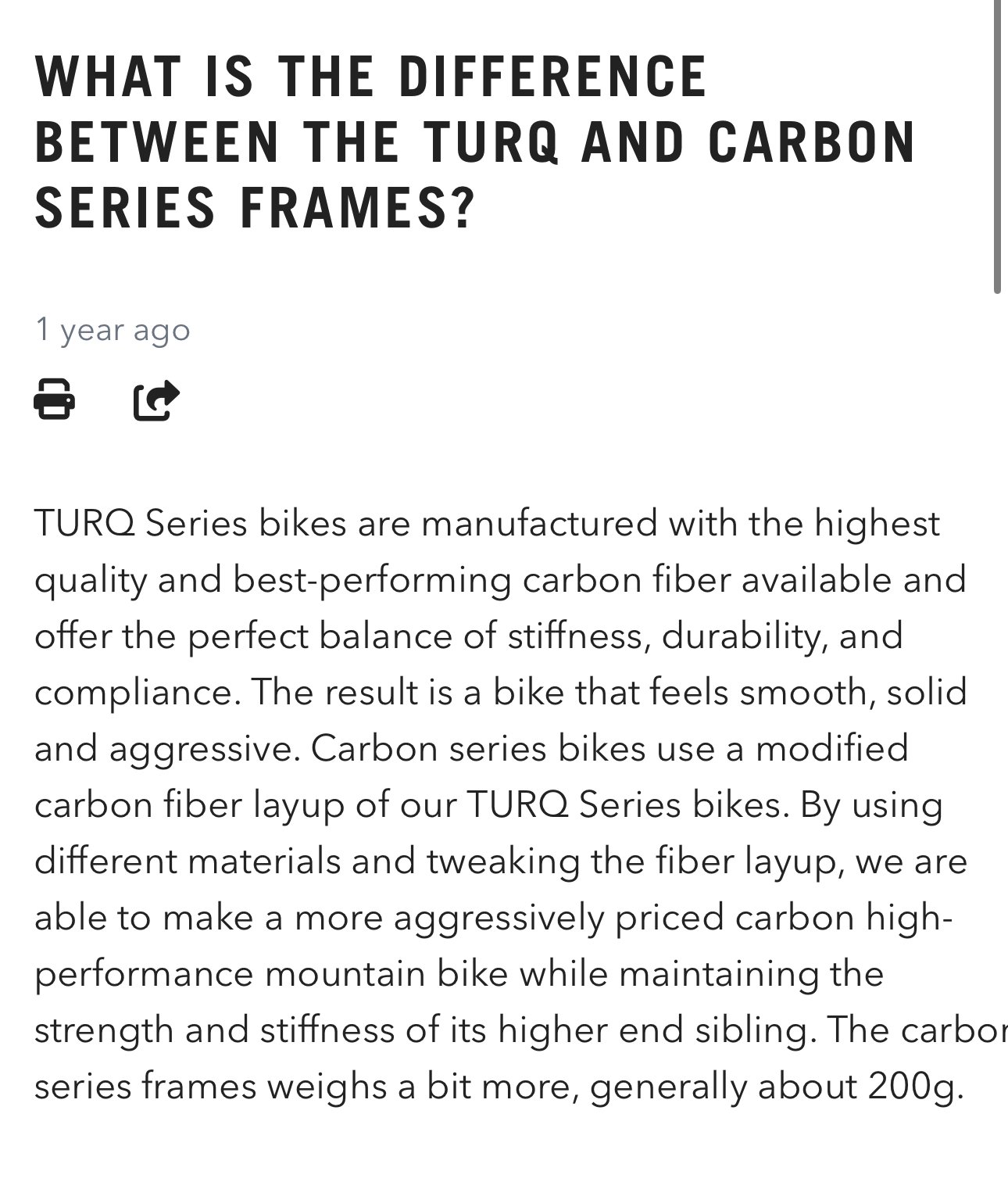
So yes, brands can choose to spend more on higher modulus fibre in certain models but everyone has access to it. And it’s likely that nearly all VIP customers use it, but then "down spec" to lower grade for cheaper models (like Yeti, who say their more basic carbon frame is about 200g heavier than their “TURQ” frame which, will be the equivalent of Pivots high grade frame.

Funnily enough Yeti say the lower grade carbon frame rides no different, but is just slightly heavier.

There’s no exclusive grade of carbon reserved for Pivot. And none of the brands are secretly blending in glass fibre or plastic to cut costs that’s total marketing bs (certainly not at a manufacturer like VIP anyway)

At the end of the day, the big differences are geometry, suspension layout, and the layup philosophy each brand chooses.

Orbea frame and a Pivot frame don’t ride differently because of the carbon fibre itself, but because of things like geometry and suspension kinematics.

Some brands might want a stiffer BB (more carbon) others may want a flexier chainstay (less carbon). The materials are all coming off the same rolls in the same factory. it’s just a question of how much high-mod you want to pay for and where you put it.

So while the marketing terms differ, Ultra High Modulus, FACT, OCLV, TURQ, Hollow Core, Smoothwall, CC etc they’re all describing variations on the same thing: a carbon frame built from Toray fibres and epoxy resin, hand laid and cured in VIP’s factory.

IMG_7365.jpeg
 
Last edited:
Best sign of frame quality is lifetime warranty. And measure of premium brand is how the warranty cases or ny other trouble is handled. Anyone can add kashima parts to a frame but it doesn't make it premium...or even a good bike.
 
Nah mate, that’s a bit of a fairy tale. Pivot aren’t using some magical pure carbon while everyone else is sprinkling in dust and filler. All those frames, Pivot, Spesh, Trek, Forbidden, Crestline, Ibis, Intense Orbea and anything else coming out of VIP Composites in Vietnam. Same factory floor, same Toray sheets of fibre, same toughened epoxy resins. Same guy or girl laying up the carbon.

What might differ is how the layup is decided:
  • Big established brands like Trek, Spesh, Pivot, Yeti have may have a composites engineer. They’ll supply VIP with a ply book to show where to beef up certain areas for stiffness (can literally be layer by instructions and VIP just executes it.)
  • Smaller/newer brands like Crestline don’t have an in house composites department. They give VIP the geometry and the performance targets (weight, strength, stiffness) and rely on VIP’s engineers to design the layup. Crestline are totally open about this … they just said “give us your highest end modulus carbon and best process” and VIP delivered.
So yes, brands can choose to spend more on higher modulus fibre in certain models but everyone has access to it. And it’s likely that nearly all VIP customers use it, but then "down spec" to lower grade for cheaper models (like Yeti, who say their more basic carbon frame is about 200g heavier than their “TURQ” frame which, will be the equivalent of Pivots high grade frame.

Funnily enough Yeti say the lower grade carbon frame rides no different, but is just slightly heavier.

There’s no exclusive grade of carbon reserved for Pivot. And none of the brands are secretly blending in glass fibre or plastic to cut costs that’s total marketing bs (certainly not at a manufacturer like VIP anyway)

At the end of the day, the big differences are geometry, suspension layout, and the layup philosophy each brand chooses.

Orbea frame and a Pivot frame don’t ride differently because of the carbon fibre itself, but because of things like geometry and suspension kinematics.

Some brands might want a stiffer BB (more carbon) others may want a flexier chainstay (less carbon). The materials are all coming off the same rolls in the same factory. it’s just a question of how much high-mod you want to pay for and where you put it.

So while the marketing terms differ, Ultra High Modulus, FACT, OCLV, TURQ, Hollow Core, Smoothwall, CC etc they’re all describing variations on the same thing: a carbon frame built from Toray fibres and epoxy resin, hand laid and cured in VIP’s factory.
It's a bit more than just layup strategy though (and of course that can have a HUGE impact on frame performance and reliability). Modern CAD systems allow frame and bike designers to extensively simulate the behavior of different designs prior to even building a test rig. Other design considerations include whether the frame/battery is a structural member, routing, storage, etc.
 
Modern CAD systems allow frame and bike designers to extensively simulate the behavior of different designs prior to even building a test rig.
Sure. I guess ny question is which brands even stretch that far anymore in house, or leave it down to VIP to do in collaboration with a brand.

Carbon frame manufacturing is now very matured and there’s only so much to be squeezed out of it from here.
 
Best sign of frame quality is lifetime warranty. And measure of premium brand is how the warranty cases or ny other trouble is handled. Anyone can add kashima parts to a frame but it doesn't make it premium...or even a good bike.
When charging a premium price it is much easier to absorb the cost of the random frame warranty down the road. How long does a person actually keep a bike with technology constantly evolving? The real deal is if they extend some coverage to subsequent owners.
 
Nah mate, that’s a bit of a fairy tale. Pivot aren’t using some magical pure carbon while everyone else is sprinkling in dust and filler. All those frames, Pivot, Spesh, Trek, Forbidden, Crestline, Ibis, Intense Orbea and anything else coming out of VIP Composites in Vietnam. Same factory floor, same Toray sheets of fibre, same toughened epoxy resins. Same guy or girl laying up the carbon.

What might differ is how the layup is decided:
  • Big established brands like Trek, Spesh, Pivot, Yeti have may have a composites engineer. They’ll supply VIP with a ply book to show where to beef up certain areas for stiffness (can literally be layer by instructions and VIP just executes it.)
  • Smaller/newer brands like Crestline don’t have an in house composites department. They give VIP the geometry and the performance targets (weight, strength, stiffness) and rely on VIP’s engineers to design the layup. Crestline are totally open about this … they just said “give us your highest end modulus carbon and best process” and VIP delivered.
So yes, brands can choose to spend more on higher modulus fibre in certain models but everyone has access to it. And it’s likely that nearly all VIP customers use it, but then "down spec" to lower grade for cheaper models (like Yeti, who say their more basic carbon frame is about 200g heavier than their “TURQ” frame which, will be the equivalent of Pivots high grade frame.

Funnily enough Yeti say the lower grade carbon frame rides no different, but is just slightly heavier.

There’s no exclusive grade of carbon reserved for Pivot. And none of the brands are secretly blending in glass fibre or plastic to cut costs that’s total marketing bs (certainly not at a manufacturer like VIP anyway)

At the end of the day, the big differences are geometry, suspension layout, and the layup philosophy each brand chooses.

Orbea frame and a Pivot frame don’t ride differently because of the carbon fibre itself, but because of things like geometry and suspension kinematics.

Some brands might want a stiffer BB (more carbon) others may want a flexier chainstay (less carbon). The materials are all coming off the same rolls in the same factory. it’s just a question of how much high-mod you want to pay for and where you put it.

So while the marketing terms differ, Ultra High Modulus, FACT, OCLV, TURQ, Hollow Core, Smoothwall, CC etc they’re all describing variations on the same thing: a carbon frame built from Toray fibres and epoxy resin, hand laid and cured in VIP’s factory.

View attachment 167088
You should do an in depth video visiting the factory Rob, would be very interesting👍
 
You should do an in depth video visiting the factory Rob, would be very interesting👍
I’ve tried. No one will be willing to do it. No one wants to show behind the magic curtain.

I’ve heard many stories though. Visitors report seeing multiple brands frames moving through the production lines.

The bike industry creates a nice story and a brand narrative that gets built around their frames. It’s clever marketing because it gives riders the feeling they’re buying into something unique.

The story is there to sell bikes 😊
 
It clear that marketing overcomes the real story but even if we knot the actual truth, who would honestly want to know the story if not a handmade, unique thing made in the western parts.

But one thing as Rob mentioned : the geometry and kinematics of the bike is making a huge impact compared to everything else. There is no perfect bike because you can't have the perfect anti squat, anti rise, leverage etc., it's a sum of things that bike brands try to make it work and feel the best for the largest public out there. What good that there are still companies out there that are still trying to push the boundaries on some aspects that can eventually drive the industry into one direction or another.
 
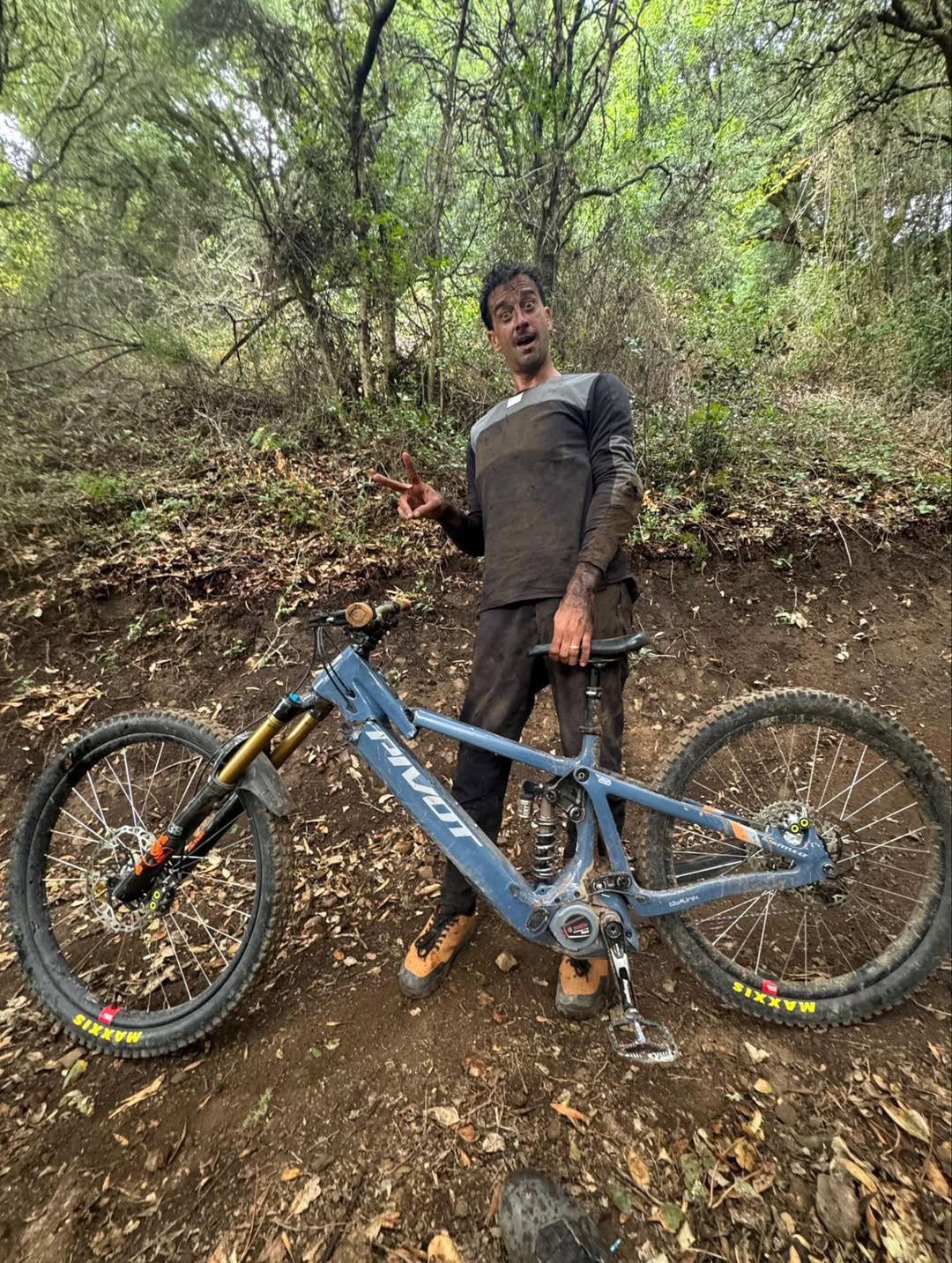
I don't know the story behind this Shuttle LT. Is this common?

Image.jpeg
 
After some Haibikes, Levo 2, Reign, Levo3 and Strive On: CFR Ltd. I was interested in the new Dji Motor.
I was out to a bikeshop to do a testride on an Amflow.
The bikeshop offers test rides on real trails for hours if you like to. So i went with an Amflow and it was impressive. But i didn't like the feeling of the frame and the suspension it felt a little harsh not bad but not so that i want to give up the strive.
After talking to one of the owners of the shop he asked me if i've ever tried a Pivot. And i didn't. So he called a guy of his stuff who races enduro with the Shuttle LT and asked him to come over so i can try his racing bike. After trying this bike i loved the DW Link and the feeling. When i talked to the owner again he recommend me to wait to the end of August because the new Shuttle AM with the Bosch Gen 5 Race Motor will come (and ilked the Gen4 in my Strive:On a lot). At the 27th i called him and made a new testride date for the 29.th of August.
I wasn't a Fanboy of the Brand, not even knowed them right, but i fall absolut in love with that bike. It suites all what i wanted. Plush and playfull never had something like that. And yes it is expensive, but i gave it to me as a birthday present to my 60th. Live is to short to think about it, if you have the money. And i'm realy happy that i've done that!
 
Last edited:
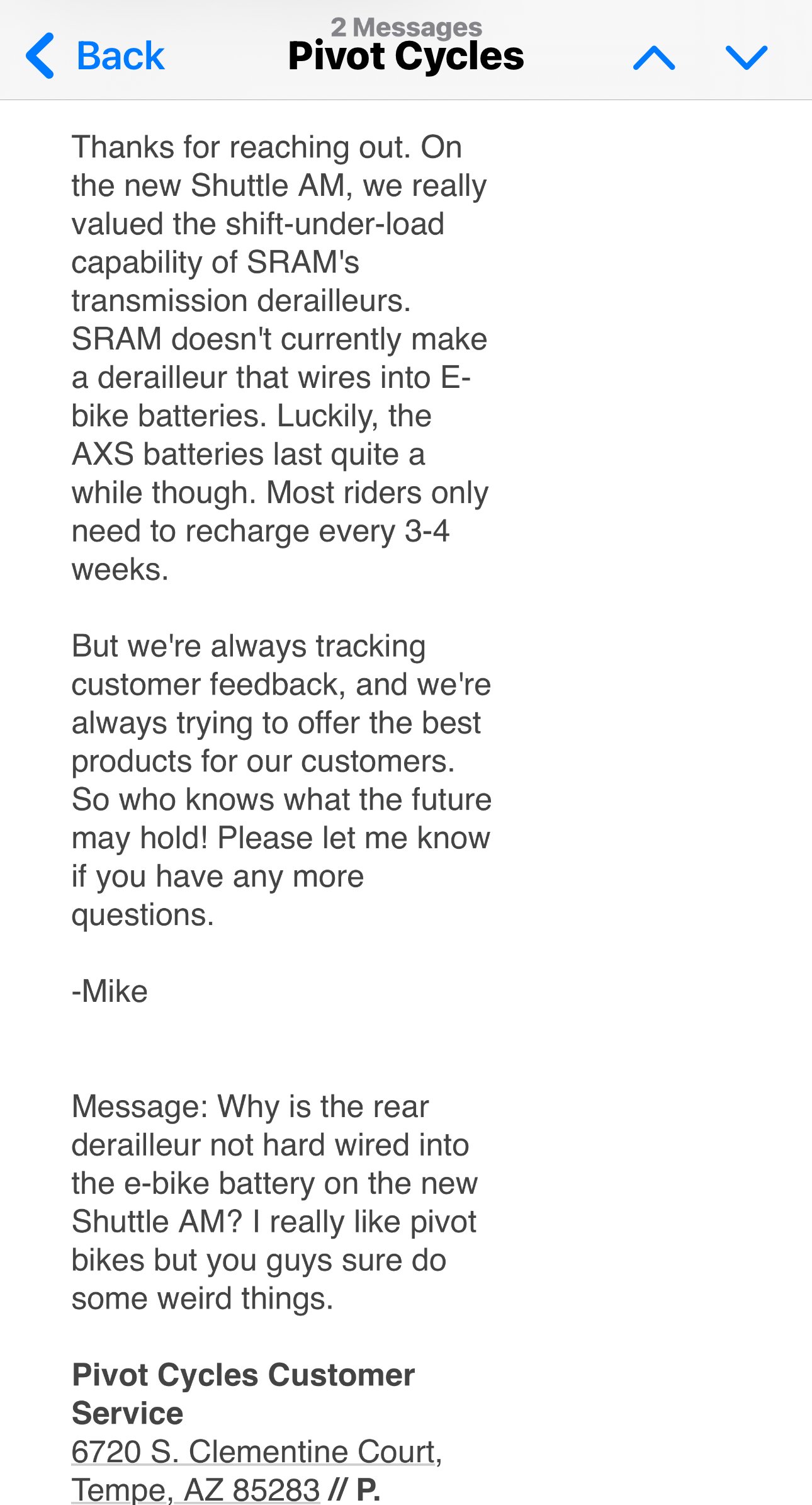
I asked Pivot why they didn't hardwire the AXS T-type derailleur. This is what they sent me. lol.

IMG_4180.jpeg
 
FYI Pivot. SRAM AXS has a wired battery that wires into an Ebike motors though.
Although I prefer a cleaner look and not having a wire, so I have no interest in the wired battery like Mike does.
 
FYI Pivot. SRAM AXS has a wired battery that wires into an Ebike motors though.
Although I prefer a cleaner look and not having a wire, so I have no interest in the wired battery like Mike does.
Isn't it called hot shoe?
 
Last edited:
I'm not sure what it's called, but it looks like OE only and cant be purchased separately.
Lots of bikes have the AXS t-type derailleurs hardwired. The new levo and rail+ both have wired AXS. There are others. Pivot never got back to me after they told me it cant be done.
 
Keep reading
    Browse all

    Similar Threads

    Community Stats

    Since 2018
    672K
    Messages
    41,497
    Members
    Join 30,000+ Riders, it's free!
    Back
    Top