
That’s not true. You don’t lose air when you disconnect the pump. You only lose it when you reconnect it because the air from the shock goes to the hose.if you don't have a really good shock pump you're going to lose at least 30 to 50psi when removing the pump at those high pressures. I usually pump 30psi over my target to get the perfect psi
Navigation
Install the app
How to install the app on iOS
Follow along with the video below to see how to install our site as a web app on your home screen.
Note: This feature may not be available in some browsers.
More options
Style variation
You are using an out of date browser. It may not display this or other websites correctly.
You should upgrade or use an alternative browser.
You should upgrade or use an alternative browser.
Levo Gen 4 Specialized Gen 4 Levo - Official Thread
a
- Thread starter Rob Rides EMTB
- Start date

⚡ EMTB PRO
25% off e*thirteen, Peaty’s & more with PRO
Member-only deals from e*thirteen, Peaty’s, PEMBREE and Magicshine · ad-free browsing · PRO badge · Living Intelligence Reports
See the deals →
From £1.99/month

If 20/100 is a useable tune for most of an offroad ride either Specialized have seriously set the torque/cadence algorithm wrong or the mount of rider torque required is putting a lot of stress and wear on the drivetrain (or it's a very mellow trail).You could save even more power. When tuning convention of the gen4 (AA/BB), the A represents "Ease "of access to power (how hard you have to pedal to access the motor power), and the BB represents motor power (so 100 = 100% of power), if you tune the bike down to some like 25/25 or lower it use even less power. At 20/100 you still had access to 100% of the bikes power, you just needed to pedal harder to access it all.
But your correct ppl complaining about its power use are riding with a ton of assist.
I have trail set at 60/100 on my gen 3 and its the only mode I ever use. Range is c 40 miles which I could easily extend if needed by using eco on flat sections. (35/60) but most of my rides are a max of 20 miles so no need.

DuncanDoughnuts
Active member
That’s high.If 20/100 is a useable tune for most of an offroad ride either Specialized have seriously set the torque/cadence algorithm wrong or the mount of rider torque required is putting a lot of stress and wear on the drivetrain (or it's a very mellow trail).
I have trail set at 60/100 on my gen 3 and its the only mode I ever use. Range is c 40 miles which I could easily extend if needed by using eco on flat sections. (35/60) but most of my rides are a max of 20 miles so no need.
On my gen 3 60/100 is my turbo 40/70 trail and 25/50 eco
More than enough for what I need and most rides about 1200m elevation
DuncanDoughnuts
Active member
Levo gen 5 will have that.Read in another thread that DJI offers coast shift with SRAM. Why not the Levo?

He he....I intended making it a bit lower but the stupid graphic tuning tool on MC is not that easy to be accurate especially when the graphics overlay on themselves. I could only see on the mastermind what I ended up with so just left it! It was good!!That’s high.
On my gen 3 60/100 is my turbo 40/70 trail and 25/50 eco
More than enough for what I need and most rides about 1200m elevation
I probably have a few years on you!! Based on your settings you would be down to about 5/15 on trail mode if you shelled out for a gen 4!! Regardless both for you and me there is no value in a more powerful motor.That’s high.
On my gen 3 60/100 is my turbo 40/70 trail and 25/50 eco
More than enough for what I need and most rides about 1200m elevation
Ps.....I have always wondered whether the pedal assist/ max tuning settings give absolute control over the modes or whether regardless what settings you choose each of the modes still have pre determined limits or torque curves.
DuncanDoughnuts
Active member
Not sure about torque curves... but looking at my screen I can see the mechanical motor watts go up way higher when I adjust the Motor support between 70 and 100Ps.....I have always wondered whether the pedal assist/ max tuning settings give absolute control over the modes or whether regardless what settings you choose each of the modes still have pre determined limits or torque curves.
DuncanDoughnuts
Active member
Im am really curious to see that..... means I can be out all day with the 800 battery.I probably have a few years on you!! Based on your settings you would be down to about 5/15 on trail mode if you shelled out for a gen 4!! Regardless both for you and me there is no value in a more powerful motor.
I know in my gen 2 I can run lower settings. for some reason my gen2 is more powerful than my gen3 ... could be the firmware. or the 29wheels that make it feel faster

DirkWisely
Well-known member
Good to know. I liked having access to 100% of the power if I needed it.You could save even more power. When tuning convention of the gen4 (AA/BB), the A represents "Ease "of access to power (how hard you have to pedal to access the motor power), and the BB represents motor power (so 100 = 100% of power), if you tune the bike down to some like 25/25 or lower it use even less power. At 20/100 you still had access to 100% of the bikes power, you just needed to pedal harder to access it all.
But your correct ppl complaining about its power use are riding with a ton of assist.
There was firmware update ages ago that was supposedly to prevent freak peaks of watts.......more likely in my opinion it restricted peak watts across the board. Whereas before the update most folk I reckon had "acceleration" at zero, you had to up it to 40+ % to make the bike feel as powerful as before the update.Im am really curious to see that..... means I can be out all day with the 800 battery.
I know in my gen 2 I can run lower settings. for some reason my gen2 is more powerful than my gen3 ... could be the firmware. or the 29wheels that make it feel faster
But there is the rub.......a lower setting on gen 4 is the same as a higher setting on gen 3........so you end up using the same amount of battery.....and the weight difference between gen 3 and gen4 probably nullifies the extra 100 w/h battery capacity. The power increases of the newer bikes only really benefit those that use all the power on offer.Im am really curious to see that..... means I can be out all day with the 800 battery.
I know in my gen 2 I can run lower settings. for some reason my gen2 is more powerful than my gen3 ... could be the firmware. or the 29wheels that make it feel faster
Power1tobe
Active member
It can be both true and untrue it depends on the quality of the pump and the length of the pin. The high quality pumps will have a ability to unscrew the connector in the middle which effectively backs the pin out. They can also have a pressure relief value to let the remaining line air out to watch the pump zero before removing from the shock. I have a small portable pump that will absolutely lose pressure when you unthread it.That’s not true. You don’t lose air when you disconnect the pump. You only lose it when you reconnect it because the air from the shock goes to the hose.
DirkWisely
Well-known member
The motor also just feels better (IMO). You can also only use the peak power when you really need it and you'll get benefits from it while using barely any extra battery.But there is the rub.......a lower setting on gen 4 is the same as a higher setting on gen 3........so you end up using the same amount of battery.....and the weight difference between gen 3 and gen4 probably nullifies the extra 100 w/h battery capacity. The power increases of the newer bikes only really benefit those that use all the power on offer.
Power1tobe
Active member
Ps.....I have always wondered whether the pedal assist/ max tuning settings give absolute control over the modes or whether regardless what settings you choose each of the modes still have pre determined limits or torque curves.
Been reading all these posts and I think you may be looking at it wrong. First the the Levo Gen3 use a 39v nominal battery vs. the Gen4 using a 59v to fuel the more powerful motor (higher current draw). I think this is why there is so much confusion about millage between the two bikes, as your comparing apples and oranges. Peak power / or max current to the motor happens based off cadence, further complicated by the tune feature defined as "percentage for Ease". The manual defines the tuning as XX/YY where xx = percentage for Ease and YY = Motor Power (the easy one to calculate). When we dig more "percentage for Ease" is also defined as "how much motor support you get relative to your input force". So at 100/100 how much input force is required to access MAX current? You have to pedal so there is some measure of force required, testing showed near-flat power and torque curve from about 70–120 rpm (@~170w 80kg rider) to obtain the 655w max (s-works) set @100/100. So the real question is how much additional input power is required from the rider when you bump down to so 60/100 (if anyone knows please tell us)? But I can tell you this for fact, if you are riding say 60/100 and you can maintain the power required to stay in the 70–120 rpm range then you will draw the max current to that motor. And this is why everyone complains about the Gen4 using more power, because they are riding some combo of the setting XX/100 and riding in that cadence range (effectively smoking that battery). But regardless even at XX/50 holding at 70–120 rpm you are producing near 327 constant watts of power.The motor also just feels better (IMO). You can also only use the peak power when you really need it and you'll get benefits from it while using barely any extra battery.
So my eco setting is like 25/25 which still feels strong on flats, but when I hit the hills.... you really feel that bikes weight and your working.
Only dyno video I have ever seen and its at 100/100
Last edited:
DuncanDoughnuts
Active member
I thought the s-works is 720w max and 666 for the? You have to pedal so there is some measure of force required, testing showed near-flat power and torque curve from about 70–120 rpm (@~170w 80kg rider) to obtain the 655w max (s-works) set @100/100.
Last edited:
yes but what you are describing fails to take account of how the software engineers take 2 main sensor inputs ( cadence and rider torque...and to an extent bike speed/ on some bikes even elevation) to create an algorithm in order to convert the raw output torque response of the motor to a more natural and progressive nature. It is that algorithm that largely dictates the "character" of the motor, maintains traction and control. There is clearly on most motors an assumption of the average torque input of a reasonably fit rider......probably a long way below that of a pro rider or even a fitness fanatic. I ride both Bosch Gen 4 motors and Spesh Gen 3 ( previously gen2), and in stock tune it is easy to feel the difference. Spesh has in my experience always delivered more power at lower cadence than the Bosch motors. What i was suggesting was that from the feedback I have seen Spesh have over egged power delivery within that algorithm on the new bike and maybe needs more modes to get a more even spread.Been reading all these posts and I think you may be looking at it wrong. First the the Levo Gen3 use a 39v nominal battery vs. the Gen4 using a 59v to fuel the more powerful motor (higher current draw). I think this is why there is so much confusion about millage between the two bikes, as your comparing apples and oranges. Peak power / or max current to the motor happens based off cadence, further complicated by the tune feature defined as "percentage for Ease". The manual defines the tuning as XX/YY where xx = percentage for Ease and YY = Motor Power (the easy one to calculate). When we dig more "percentage for Ease" is also defined as "how much motor support you get relative to your input force". So at 100/100 how much input force is required to access MAX current? You have to pedal so there is some measure of force required, testing showed near-flat power and torque curve from about 70–120 rpm (@~170w 80kg rider) to obtain the 655w max (s-works) set @100/100. So the real question is how much additional input power is required from the rider when you bump down to so 60/100 (if anyone knows please tell us)? But I can tell you this for fact, if you are riding say 60/100 and you can maintain the power required to stay in the 70–120 rpm range then you will draw the max current to that motor. And this is why everyone complains about the Gen4 using more power, because they are riding some combo of the setting XX/100 and riding in that cadence range (effectively smoking that battery). But regardless even at XX/50 holding at 70–120 rpm you are producing near 327 constant watts of power.
So my eco setting is like 25/25 which still feels strong on flats, but when I hit the hills.... you really feel that bikes weight and your working.
Only dyno video I have ever seen and its at 100/100
If you have essentially 3 modes, ECO, trail and Turbo with the ability to set each for different motor support to meet different riding requirements on a ride, you would expect to set ECO at about 35% as a battery saving mode, trail at 50 or 60 as a "do most things" mode and turbo at 100% for extreme climbs. Otherwise what is the point of the extra power?? If in fact trail is plenty powerful enough at only 20%, and to go beyond that uses too much battery, it just suggests that the system overall is more powerful that most people need. More power which ever way you cut it equals more battery use, more heat and more wear and tear.
DirkWisely
Well-known member
I think Turbo is 100% more than you need for regular riding, but I found it nice to power up long boring road inclines. I'd never use it for single track or technical climbing.yes but what you are describing fails to take account of how the software engineers take 2 main sensor inputs ( cadence and rider torque...and to an extent bike speed/ on some bikes even elevation) to create an algorithm in order to convert the raw output torque response of the motor to a more natural and progressive nature. It is that algorithm that largely dictates the "character" of the motor, maintains traction and control. There is clearly on most motors an assumption of the average torque input of a reasonably fit rider......probably a long way below that of a pro rider or even a fitness fanatic. I ride both Bosch Gen 4 motors and Spesh Gen 3 ( previously gen2), and in stock tune it is easy to feel the difference. Spesh has in my experience always delivered more power at lower cadence than the Bosch motors. What i was suggesting was that from the feedback I have seen Spesh have over egged power delivery within that algorithm on the new bike and maybe needs more modes to get a more even spread.
If you have essentially 3 modes, ECO, trail and Turbo with the ability to set each for different motor support to meet different riding requirements on a ride, you would expect to set ECO at about 35% as a battery saving mode, trail at 50 or 60 as a "do most things" mode and turbo at 100% for extreme climbs. Otherwise what is the point of the extra power?? If in fact trail is plenty powerful enough at only 20%, and to go beyond that uses too much battery, it just suggests that the system overall is more powerful that most people need. More power which ever way you cut it equals more battery use, more heat and more wear and tear.
Power1tobe
Active member
Watch the video. Interesting thing about power claims is where you measure the output. Typically its measured where the rubber meets the road.I thought the s-works is 720w max and 666 for theplebsworking class ?
Power1tobe
Active member
Ummmm no I really didn't. Did you watch the video? From a algorithm point I wasn't talking about the the progressive ride feel, I was pointing out its very easy to understand how the bike set at 100/100 (turbo) works. You basically input 170watts power (torque) at a cadence of 70–120 rpm and get max motor output. I want to understand the "% of Ease" number, so if instead you set the bike at 50/100 what input power must the rider hold to at a cadence of 70–120 rpm to get the same max power output. If you watch the video you can see the dyno was done only at max, so there is no data to work with to understand how it works along the curve.yes but what you are describing fails to take account of how the software engineers take 2 main sensor inputs ( cadence and rider torque...
My other point was the fact I see so many ppl saying they are riding at some xx/100 setting to save power and then complaining about power usage. When in reality any setting of XX/100 is tapping near 100% of the motors output power. If you want to save power then ride in -auto or some setting like 25/25, then you are only using 25% of the motors possible output.
DuncanDoughnuts
Active member
I think Turbo is 100% more than you need for regular riding, but I found it nice to power up long boring road inclines. I'd never use it for
Could be wrong ...Ummmm no I really didn't. Did you watch the video? From a algorithm point I wasn't talking about the the progressive ride feel, I was pointing out its very easy to understand how the bike set at 100/100 (turbo) works. You basically input 170watts power (torque) at a cadence of 70–120 rpm and get max motor output. I want to understand the "% of Ease" number, so if instead you set the bike at 50/100 what input power must the rider hold to at a cadence of 70–120 rpm to get the same max power output. If you watch the video you can see the dyno was done only at max, so there is no data to work with to understand how it works along the curve.
My other point was the fact I see so many ppl saying they are riding at some xx/100 setting to save power and then complaining about power usage. When in reality any setting of XX/100 is tapping near 100% of the motors output power. If you want to save power then ride in -auto or some setting like 25/25, then you are only using 25% of the motors possible output.
is the first number not the % of total motor support you get based on your input? so if I put 100w I get a extra 20% of that... 100 + (20% of 100) = 100 + 20 = 120 watts.
And if I put down 170w ( 170 + (20% of 170) = 170 + 34 = 204 watts.) up to the motor max.
if I say have it at 50/50
I will get 150w total if I put in 100w - until I reach 1/2 of the max power the motor can give ?
that's how I always understood it. I could be totally wrong, but that kind of how I see it working in my head.
DuncanDoughnuts
Active member
I remember when the Gen1 came out, someone posted some graphs and tables showing rider input and the input from the motor and at which support setting would get you up the full motor support ... would be great if someone could do that again ?

I also have the same problem, those brakes are way too powerful for technical terrain where you need to precisely modulate your braking. These are basically ON-OFF brakes. On my bike, I substituted the original front 220mm rotor with a 180mm, and now the front is very controllable and still powerful enough to lock the wheel if you want.I'm not sure I dislike all SRAM brakes, but so far I am not liking the Mavens. They squeak easily and are way too grabby - it's easy to accidentally lock the wheels. Is it possible to change pads?
However, the problem is that at the rear, the brake caliper cannot be moved closer to match a smaller rotor, as it is already mounted direct to the frame , without adapter. What a stupid design, Specialized!
Power1tobe
Active member
Again, a lot of confusion about the tuning. The manual defines the tuning as XX/YY where XX = "percentage for Ease" and YY = Motor output Power. So if you watch the video the s-works in turbo (100/100), with ~170w input power from rider @70–120 rpm and get max motor output 655w (motor assist).Could be wrong ...
So the first number is how hard the rider must pedal to access (the higher the number the easier), second number is motor output power (you have access to... if you pedal hard and at a fast enough cadence). So turbo is 100/100 = input power lowest required / to access 100% motor output power. 50/50 = pedal harder than at 100/ to access 50% max power output.
I mean I may have this wrong as I am not an engineer for Specialized, but I am a mech engineer.
Power1tobe
Active member
I agree the brakes are extremely powerful and touchy. I set my brakes so that they require very little pull to start engagement. This way I know I need to only apply slight pressure to get braking which adds in the modulation for controlled braking. But not all ppl like their brakes set this way, but once your use to it you can bake according with 1-2 fingers removing most of the issue.I also have the same problem, those brakes are way too powerful for technical terrain where you need to precisely modulate your braking. These are basically ON-OFF brakes. On my bike, I substituted the original front 220mm rotor with a 180mm, and now the front is very controllable and still powerful enough to lock the wheel if you want.
However, the problem is that at the rear, the brake caliper cannot be moved closer to match a smaller rotor, as it is already mounted direct to the frame , without adapter. What a stupid design, Specialized!
Eduardoramundo
E*POWAH Master
Does anyone know what the orange spacer is for? I can’t find it in the manual.
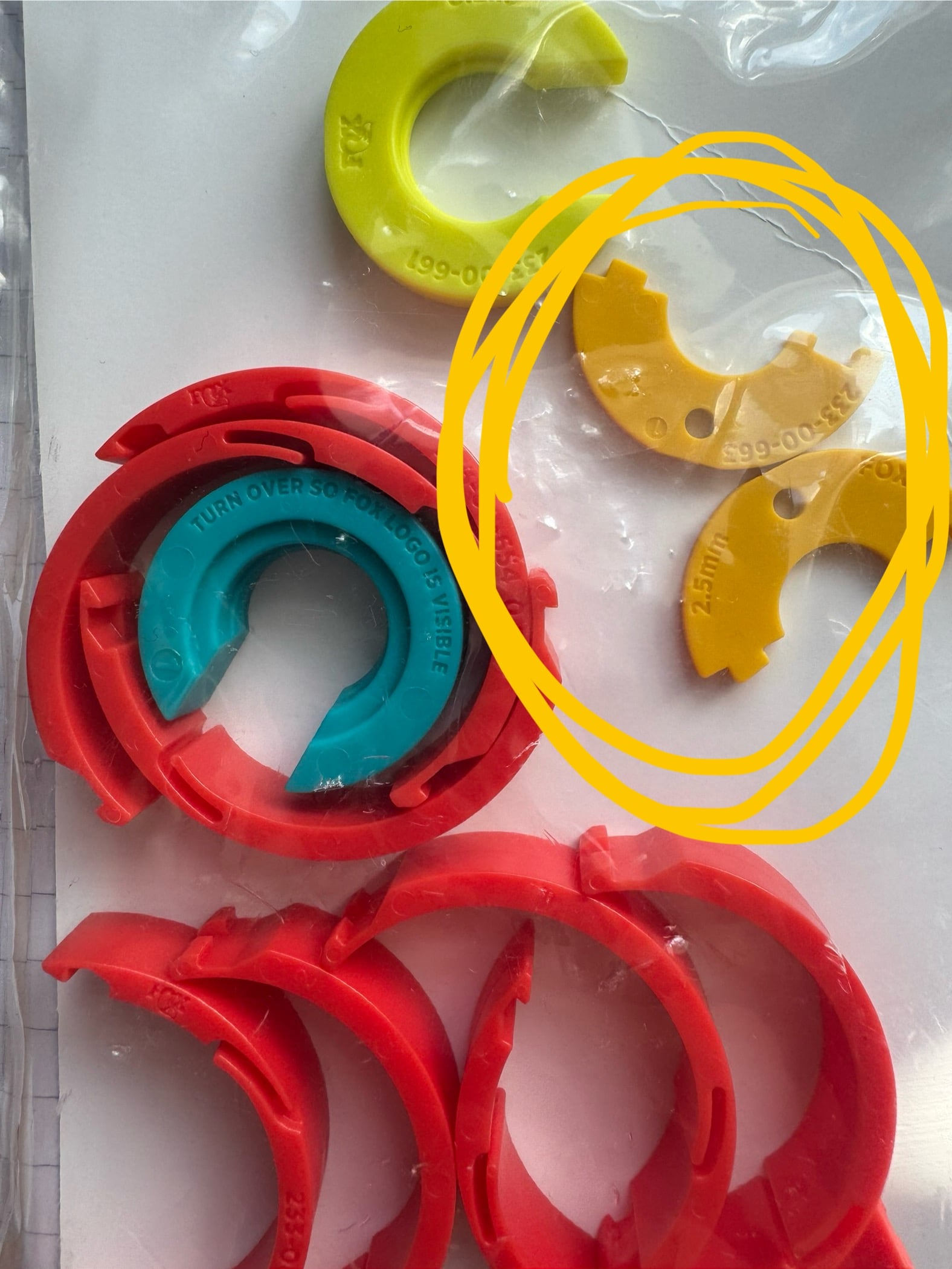
DuncanDoughnuts
Active member
Travel Reducer ..... to take the Shox to a 52.5mm strokeDoes anyone know what the orange spacer is for? I can’t find it in the manual.
View attachment 163373
As I said above the software algorithm consists of both cadence and rider torque input and it is that algorithm which is the real jewel as far as the firmware is concerned because it defines the character of power delivery. It is a mistake to think it is just linear. So for example it will predict that rider torque is greater/cadence much lower when the bike is overcoming inertia ( ie starting from a standstill or if bike speed reduces a lot suddenly). Rider torque will decrease once the bike achieves momentum but cadence will increase. The job of the algorithm is provide motor power throughout those phases that feels natural but supportive. So it is a dynamic picture the algorithm attempts to interpret. If the bike is in trail set at 50/100 it will modulate the the power as a bove but within the set parameters. I see little point trying to seond guess all of that. Best bet is to try different settings and see what does the job for you. Personally I invariably only use the app...whether that is Mission control or Flow..........initially to find those settings, then never use it a gain unless an update is announced that has something of benefit to me ( most dont!). If it works...leave it alone!!Again, a lot of confusion about the tuning. The manual defines the tuning as XX/YY where XX = "percentage for Ease" and YY = Motor output Power. So if you watch the video the s-works in turbo (100/100), with ~170w input power from rider @70–120 rpm and get max motor output 655w (motor assist).
So the first number is how hard the rider must pedal to access (the higher the number the easier), second number is motor output power (you have access to... if you pedal hard and at a fast enough cadence). So turbo is 100/100 = input power lowest required / to access 100% motor output power. 50/50 = pedal harder than at 100/ to access 50% max power output.
I mean I may have this wrong as I am not an engineer for Specialized, but I am a mech engineer.
I have the Mavens on my Gen 3...without a doubt the best brakes SRAM have produced. My RSXs both have code RSC which are good if well maintained but nowhere near as powerful as the Mavens, and the Mavens seem ( so far) to require much less maintenance. With regard to "feel", yes you need to be gentle with them! They do have modulation but require far less "finger Power" than the RSCs.....certainly one finger not 2. Mine are the bronze so no contact a djustment which I would like as I usually have the lever set pretty close to the grips, but it is not something worth changing them for a higher model in the range.I agree the brakes are extremely powerful and touchy. I set my brakes so that they require very little pull to start engagement. This way I know I need to only apply slight pressure to get braking which adds in the modulation for controlled braking. But not all ppl like their brakes set this way, but once your use to it you can bake according with 1-2 fingers removing most of the issue.
Similar Threads
-
-
Levo Gen 4 Levo Gen 4 wont turn on in Alps after being on a lift.
- Started by Deadpool2e
- Replies: 1
-
 Levo Gen 4 Levo EVO Rumor Thread – Longer Travel Levo Coming?
- Started by rydeezie
- Replies: 166
-

-

Free account
Join 43,137
eMTB riders
eMTB riders
One tap. No forms. Fewer ads.
or sign up with email
Already a member? Log in