It's more than two years from the last post but I would like to contribute with some info and actual measurements.
The short version is that the remaining life or capacity of the Shimano batteries is wrong most of the time, as the battery have much less wear than reported. Read the rest for details.
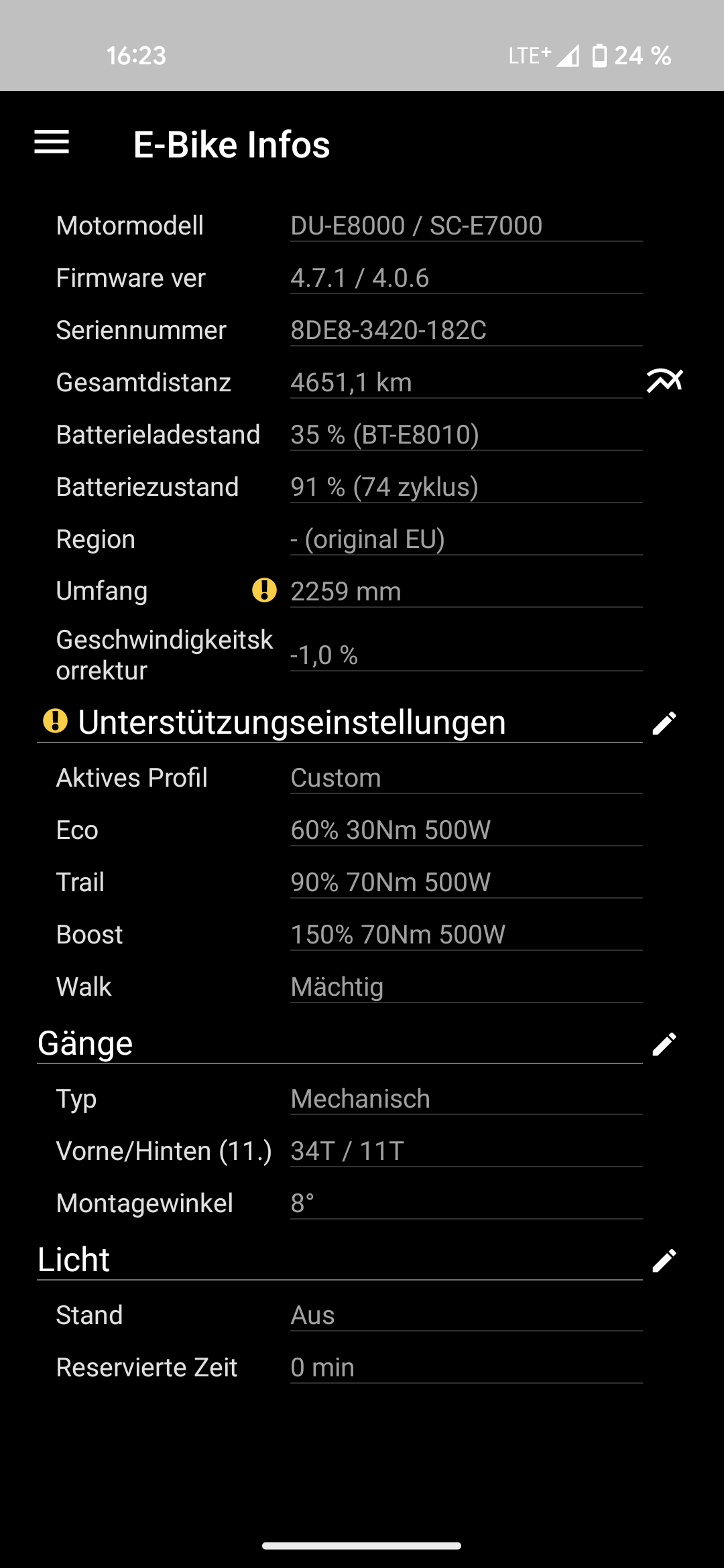
I have an e-bike with an E8000 engine and a BT-E8010 battery. Using the free version of the eTuning Android app, I checked the battery's remaining life and observed that its capacity has been decreasing at an alarming rate. After only 51 cycles, the battery was at 81%. I should mention that most of the time, the battery was only charged to ~80% using a timer. It was also stored at a controlled 18 degrees Celsius with low humidity and was never used below 0 degrees. Although the remaining capacity decreased significantly, I could not feel it during actual usage. This made me wish I could measure the battery's actual capacity, but unfortunately, I don't know how to open its high-voltage output to do so.
I know how to do this with a Bosch Powerpack.
A while ago, I bought a used E8010 battery. The eTuning app reported that it had undergone 120 cycles and had 74% of its capacity remaining. Terrible! Since it was a spare battery, I could afford to experiment with it without risking being left without a battery for my e-bike in case something unexpected happened. I searched the internet for information about how to open the battery. My previous experience with Bosch power packs taught me that they are very difficult to open. This is the best video I found:
You need an T15 security bit to open the case. There are only 4 screws that need to be removed. There are no horrible plastic clips like in Bosch powerpack!
As mentioned in the previous YouTube video, the battery contained Sony VC7 18650 3500mAh cells.
This document contains many interesting facts, starting with the introduction of the cells in 2016, which are still state of the art today. The few 18650 cells with capacities greater than 3500mAh are absurdly priced for only a 10-15% increase in capacity. Furthermore, Sony conducted extreme tests to extract as much energy as possible from the cells.
To achieve 3,500 mAh, the battery must be discharged at 23°C with a constant current of 0.2 x 3.5 A, or 700 mA. The E8010 battery has 40 cells structured 10s4p; that is, ten blocks of four parallel-connected cells are put in series. The average discharging power for the entire battery is 108W, which translates to 0.7A/cell x 40 cells x 3.6V. I think this is ECO mode territory. BOOST uses the maximum power allowed by the MCU, probably 500–600 W.
Also from table 2 we learn that the battery has a
nominal capacity of 40 x 3.5A x 3.6V = 504Wh (this is also written on the E8010 label) and a
rated capacity of 40 x 3.4A x 3.6V = 489.6Wh. You get that capacity only if you discharge to 2V, which I'm sure the Shimano BMS does not do. I do not know where it does stop discharging, but I assume that it is around 3V.
After I opened the battery I used my DTL-150 to measure the energy stored in the battery by connecting it directly to the battery, bypassing the BMS. I measured
440.15Wh from full battery (41.8V) down to 28V. I didn't go lower because I was worried that I will either damage the cells or block the BMS. I used a constant current discharge protocol as stated in row 1 of table 2: 4 cells x 0.7A/cell = 2.8A discharge current.
The eTuning app reports that this battery has only 74% remaining capacity. However, the measured 440.15 Wh is 87.33% of the nominal capacity and 89.90% of the rated capacity. If I had discharged the battery down to 2.0 V, as Sony did, I would have extracted several more Wh from the battery. Therefore, it is safe to assume that
the actual remaining capacity is ~90%. The actual discharge curve can be observed in the following plot.
This result suggests that Shimano's algorithm for measuring remaining capacity is flawed. But what could cause such a poor algorithm? I only have two batteries: One has 120 cycles and 74% life, and the other has 51 cycles and 81% life. These two points map nicely onto the cycle life performance graph in the VC7 PDF (page 6). This makes me suspect that the actual algorithm is a simple look-up table in which you input the number of cycles and get the remaining capacity regardless of how the battery has been used. The graph also shows that the test was performed at 5A per cell and 2.5V cutoff. The cells will never experience such aggressive usage inside the Shimano battery because the BMS stops discharging at around 3V. Furthermore, the highest current for BOOST mode (500–600 W) is ~3.5 A. Moreover, nobody uses BOOST mode at maximum capacity all the time.
In conclusion, if you don't notice a significant reduction in motor assistance length, don't worry too much about reported remaining capacity. For batteries that show a disconcertingly low remaining capacity but feel almost new, it is reasonable to assume that the actual remaining capacity is at least 10-15% higher.
I hope you find this short essay informative.