SRAM Flat Top chains

Mikerb

E*POWAH Elite World Champion
Joined
May 16, 2019
Messages
7,338
Reaction score
5,817
Location
Weymouth
I have SRAM Transmission obviously including a flat top chain. So how are you guys checking chain wear??
I have read conflicting information and some that makes little sense to me!!

SRAM appear to recommend changing chain at 0.8% wear as tested with either a stupidly expensive SRAM chain checker or a Pedro chain checker, yet both appear no different from any other chain checker.
I have also read that mechs at SRAM training workshops have been told to just run both chain and cassette until gear change is no longer working well and then change both together.

The only difference between the flat tops and any other 12 speed chain as far as I can see is that whilst the pitch remains at 1/2 inch/12.5 mm, the rollers have a larger OD. The difference being 7.72mm as opposed to 7.65.........meaning the gap between rollers is 0.14mm smaller.

Currently I am using the same checker I have always used so I am assuming when it gets to 0.5% wear on the flat top chain using it, the wear is actually more than that.......but still well within 0.8%. ?
 
⚡ EMTB Pro Go Pro — exclusive discounts & ad-free Peaty's 25% off & more · Ad-free browsing · Pro badge See the deals →
The Pedro's branded tool is half the price but authorized by SRAM.
 
@Mikerb Remove the chain, stretch out on a flat surface and with a metal tape, measure pin to pin over 100 links. A new chain will measure 50" exactly, one at 0.8% will measure 50.4". Because most metal tapes in the UK have 1/16" increments, the nearest fractional measure will be 13/32" (0.406"). That is easy to estimate. To get that level of accuracy, it will be easier if you have another person at the idiot end to help keep the chain taut and also to get one of the bold inch markers exactly over the centre of one of the pins. The usual reject wear level is at 0.75% which is exactly 50-3/8".

The benefit of measuring this way is that it evens out the unequal wear that seems to happen across the chain's length. I know how to use a vernier calliper gauge and I can measure over 5"-6" with mine. I have learned to measure in various places across the chain because I could not believe how much variation I was getting. I repeated the measurement and I was consistent each time. The chain wear was indeed a variable! (Others have reported this). Why this should be I have no idea, the various components are randomly mixed components each of which has been mass produced in the millions. That should result in zero variation when new. :unsure:

Removing the chain and measuring with a tape is faster and more accurate than repeated measurements with a chain gauge or even a vernier calliper gauge. Especially if the chain is coming off anyway! :)
 
Last edited:
I have SRAM Transmission obviously including a flat top chain. So how are you guys checking chain wear??
I have read conflicting information and some that makes little sense to me!!

I went out and got the Pedro's chain checker when I got my tranny drivetrain. At 1,077 miles, my chain was barely showing 0.5%, but I slapped on a new chain anyway. My thoughts are that when the new chain gets to be around 0.75%, I'll put the first one back on and then just run everything into the ground.
 
I agree measuring the chain is the best guide but it means removing it and using another set of powerlinks to put it back..assuming it is going back on. A checker is so much quicker but I agree it needs to be done in several locations because chain wear is not even.
My issue...even with the Pedros checker is that if flat top chain rollers have a greater diameter, the same checker cannot be a ccurate on all 11/12 speed chains or even just all 12 speed chains. The Pedro claims it can be used for all 12 speed chains.

Seems to me trying to claim any checker is specific to SRAM Flat top chains is just a con to get you to buy another. By my reckoning using any checker for 0.5% wear on a flat top chain means the wear is actually 0.07mm greater........and I doubt most checkers are 100% accurate in the first place.
In conclusion i will continue using my original park tool checker and change chain at 0.5% "indicated" or maybe do a couple more rides once it gets to that point. @RustyIron has it right reckon.........keep the original chain as an emergency trailside spare and put it back on when the replacement is toast...then put it back on and run both chain and cassette into the ground.
 
even with the Pedros checker is that if flat top chain rollers have a greater diameter, the same checker cannot be accurate on all 11/12 speed chains or even just all 12 speed chains. The Pedro claims it can be used for all 12 speed chains.

Therein lies the cleverness of their checker. It might be difficult to explain and will require a little visualization, but I'll try.

Old-school chain checkers measure the distance in between two rollers--the left of one roller to the right side of another. If we were to calculate the numeric value for that distance, it's going to be some multiple of 1/2" (the pitch of the chain), minus the diameter of a roller (2x the radius). If someone can't visualize that, go ahead and stick your checker onto the chain. You'll see what I'm talking about.

The problem arises with the larger diameter of the rollers on a flattop chain. The checker will be thrown off by the different dimensions. The measurement IN BETWEEN two rollers will be less, and the checker will always show less than the actual wear.

Now let's talk about measuring the pitch of a new chain. It doesn't really matter where we measure from, as long as we choose the same spot on the links. We can choose the centerline of the leading pins, the centerline of the trailing pins, the leading edge of the outer plate, the trailing edge of the outer plate, or even the middle of the plate, if we could figure out an easy way to mark the exact center. As long as we choose the same spot on the links, our measurement will always be a multiple of 1/2".

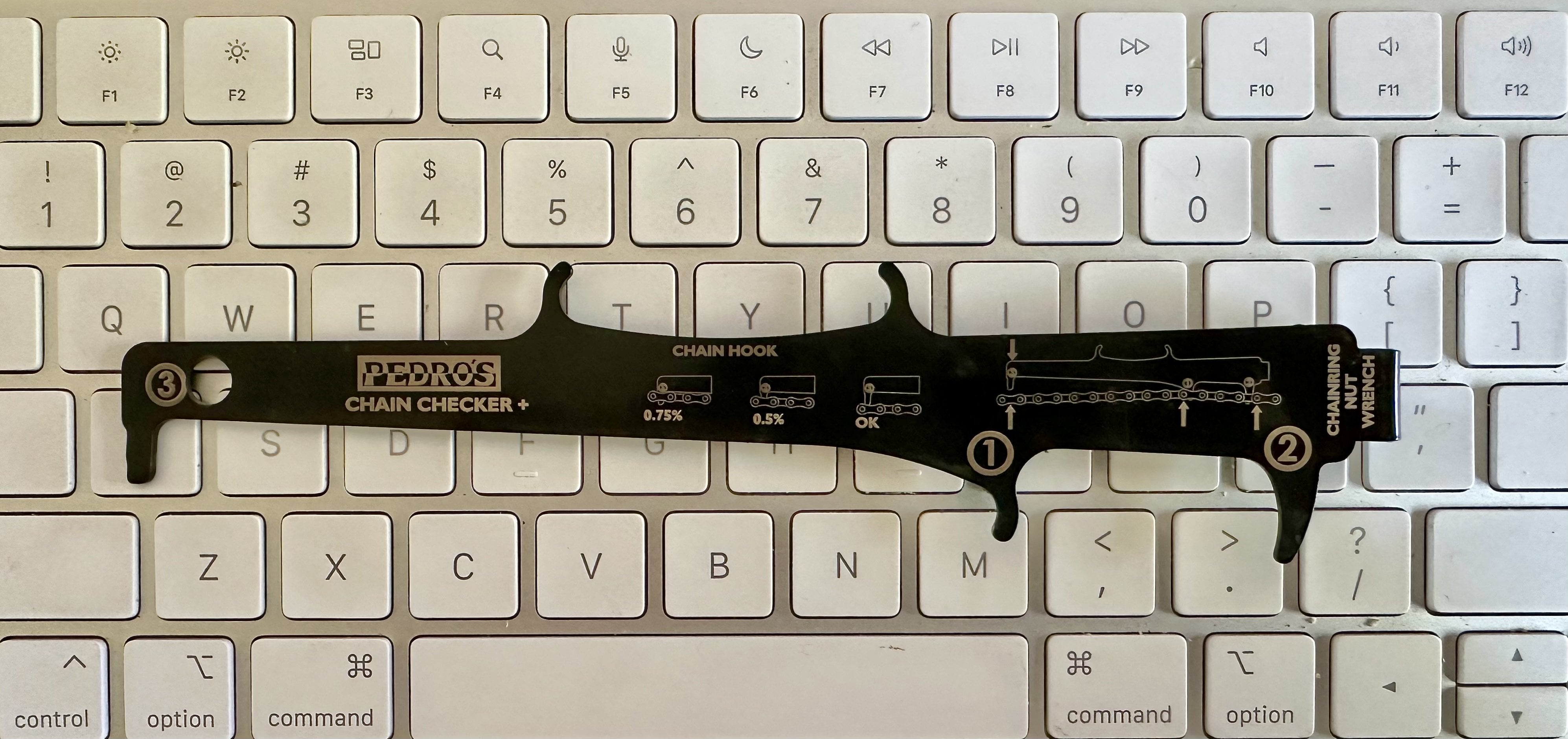
Pedro's came up with a weird little contraption that measures the RIGHT SIDE of pins that are ten links apart. What's important is they're measuring on the SAME SIDE of the pins--not the distance in between the pins. On a new chain, the Pedro's measurement is going to be an exact multiple of 1/2". Compare this with the second paragraph of my post. The diameter of the rollers is not relevant. Because the Pedro's tool is measuring the same spot on the links and the diameter of the rollers is not relevant, it can be used on different style chains.

Check out the attached picture of Pedro's tool. When in use, the hook labeled "1" grabs the RIGHT SIDE of a roller. The hook labeled "3" jams in on the RIGHT SIDE of another roller. The hooks are ten links apart. On a new chain, the distance between ten links is 5". You might not be able to see it in the picture, but Hook 3 is stepped. The distance between Hook 1 and the first step is 0.5% (0.025") greater than 5", and the distance between Hook 1 and the second step is 0.75% (0.0375") greater than 5".

IMG_2265.jpeg
 
just bought a Park tool CC 4...does the same method as the Pedros...Pedros not readilly avaialble in the UK.
 
Abbey Bike Tools recently came out with a (pricey, but very nice) chain checker that works on all chains.

 
I agree measuring the chain is the best guide but it means removing it and using another set of powerlinks to put it back..assuming it is going back on. A checker is so much quicker but I agree it needs to be done in several locations because chain wear is not even.
....................
Two points:
1) I use the same set of powerlinks for the entire life of the chain. Once the chain is done, so are the powerlinks. However, I keep the old powerlinks as free spares to hand out for free to those stranded on the trail for want of a powerlink. Our much-missed member @Gary had a serious go at me for palming off worn out powerlinks, but all were very grateful, as I would have been! :)
2) It's good to see an acknowledgement that it's not just me that sees variation in wear across the length of a chain. Given the randomisation of the production process, I cannot see why a chain should wear randomly during its life.
Edit added on 9th Nov'24: I now can appreciate that this apparent "variation in wear" is probably muck in the chain, in between the rollers and the pins. That makes much more sense than actual variable wear.
 
Last edited:
had a serious go at me for palming off worn out powerlinks, but all were very grateful, as I would have been!

Oh, you awful man! Helping out stranded riders by giving them used parts! I'll bet you also eat the delicious muffin tops and give the icky bottoms to hungry hobos.

But good on ya for helping out the ill-prepared. It's the responsibility of the alpha-dogs to help out the young pups.

2) It's good to see an acknowledgement that it's not just me that sees variation in wear across the length of a chain. Given the randomisation of the production process, I cannot see why a chain should wear randomly during its life.

I suspect that some of the measured variation is the result of scrunge taking up space inside the chain.
 
.......................................


I suspect that some of the measured variation is the result of scrunge taking up space inside the chain.
Now that is an idea that I never thought of.

When using a vernier caliper, I measure nominally 5.700" using the internal measurement arms. That is 11 full half inch links and the wall thickness of two rollers at 0.1" each.

I measure a new chain and record what that measurement is. It is nearly always bang on, but can vary. Whenever I get anything that is not 5.700" exactly, I remeasure just to make sure that I haven't made an error. If I get the same reading, say 5.702", I use that one as the baseline.

With 300 miles on the KMC (silver x12) chain, I measured it at 5.719" average, in a 10-position range from 5.709" to 5.728". These readings were not randomly scattered, but went from low to high and back to low as I moved along the chain.
5.719/5.700 = 0.33% stretch (That seems a lot to me for only 300 miles). Maybe the KMC silver chain is not a good one (it was the only one I could get when I needed a chain).

The biggest place for "scrunge" is between the pins and the rollers, but only the two rollers that the caliper pins are touching. So to give a variation of 0.019", that would take half that under each roller, say 9 or 10 thou each. That seems quite a lot to me.

With 715 miles on the chain, I measured it at 5.740" average with hardly any variation at all (0.001" from low to high). I cannot account for the lack of variation; maybe the chain was cleaner than usual! Maybe the gap was large enough for the usual "scrunge" to fall out? Or maybe it was just well packed in there?
5.740/5.700 = 0.7% This chain is almost knackered on that result. :unsure: After only 715 miles!

Yet when I stretched it out on a flat surface and measured it from pin to pin over 100 links, I got 0.125%. Using that method, any "scrunge" under the rollers is irrelevant. So the chain is good to go, and so it should be at only 715 miles. When I got the contradictory result, I measured it again on a different part of the chain and got someone else to look after the idiot end, for improved accuracy. I didn't believe that it would be too different because I only have 120 links and I'm measuring 100 of them. The result was exactly the same. That chain is still on and I will be checking it again today at 1008 miles. (Later Edit: It was the same at 0.`125%).

Note: As you might deduce from this post, I no longer work for a living and I have the time to do this. :giggle:
 
Last edited:
I think the gunge between pin and roller is probably the cause of the variation but maybe not "resident" gunge. Mud, slurry, grit get thrown at the chain in muddy or even just dusty conditions but probably not. evenly and some of it might be enough to cause wear even during a single ride.
The answer is obviously to replace the chain after every ride........or never change it until no gear change works properly.........then buy a new bike.........with a belt drive. SORTED!
 
Two points:
1) I use the same set of powerlinks for the entire life of the chain.

Me too. The manufacturers claiming you should change them each time you separate them is clearly a moneymaking scheme. My previous XX1 chains were off and on about 10 times each in their lifetime as I used to rotate them and take them into work and clean them in the ultrasonic bath. I never once replaced the powerlinks - and have never had an issue with reusing them,
 
Hi, is this chain out of use?

The tool have to go to the end or only insert the part? Thanks

IMG_4781.jpeg
 
your chain checker is showing 0.8% wear which is the point at which the chain should be changed.............however, as per the post a bove the chances are that the cassette is also pretty worn as chain and cassette both wear together. So changing the chain now, could cause more issues than it solves. Provided everything is working OK with no skipping or slipping, it is probably best not to change the chain. When those issues do start to occur, change the chain and cassette together.
 
your chain checker is showing 0.8% wear which is the point at which the chain should be changed.............however, as per the post a bove the chances are that the cassette is also pretty worn as chain and cassette both wear together. So changing the chain now, could cause more issues than it solves. Provided everything is working OK with no skipping or slipping, it is probably best not to change the chain. When those issues do start to occur, change the chain and cassette together.
Then Is The same that the tool entre 1mm or full???
 
Then Is The same that the tool entre 1mm or full???
I cannot tell on your specific tool. On mine the tip has 2 distinct profiles. The lowest one is 0.5%. If that goes further into the chain it is 0.8%...or more!!
 
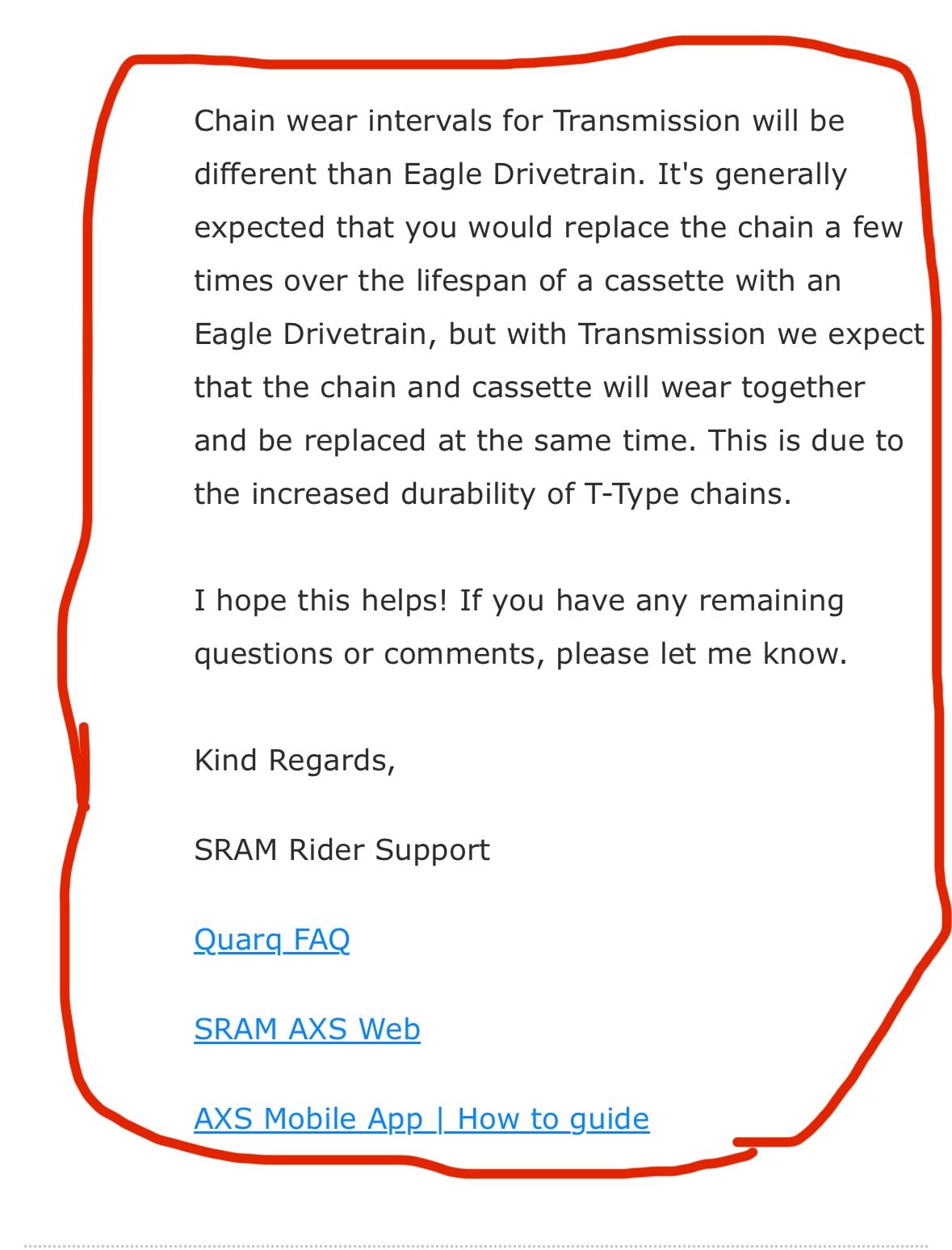
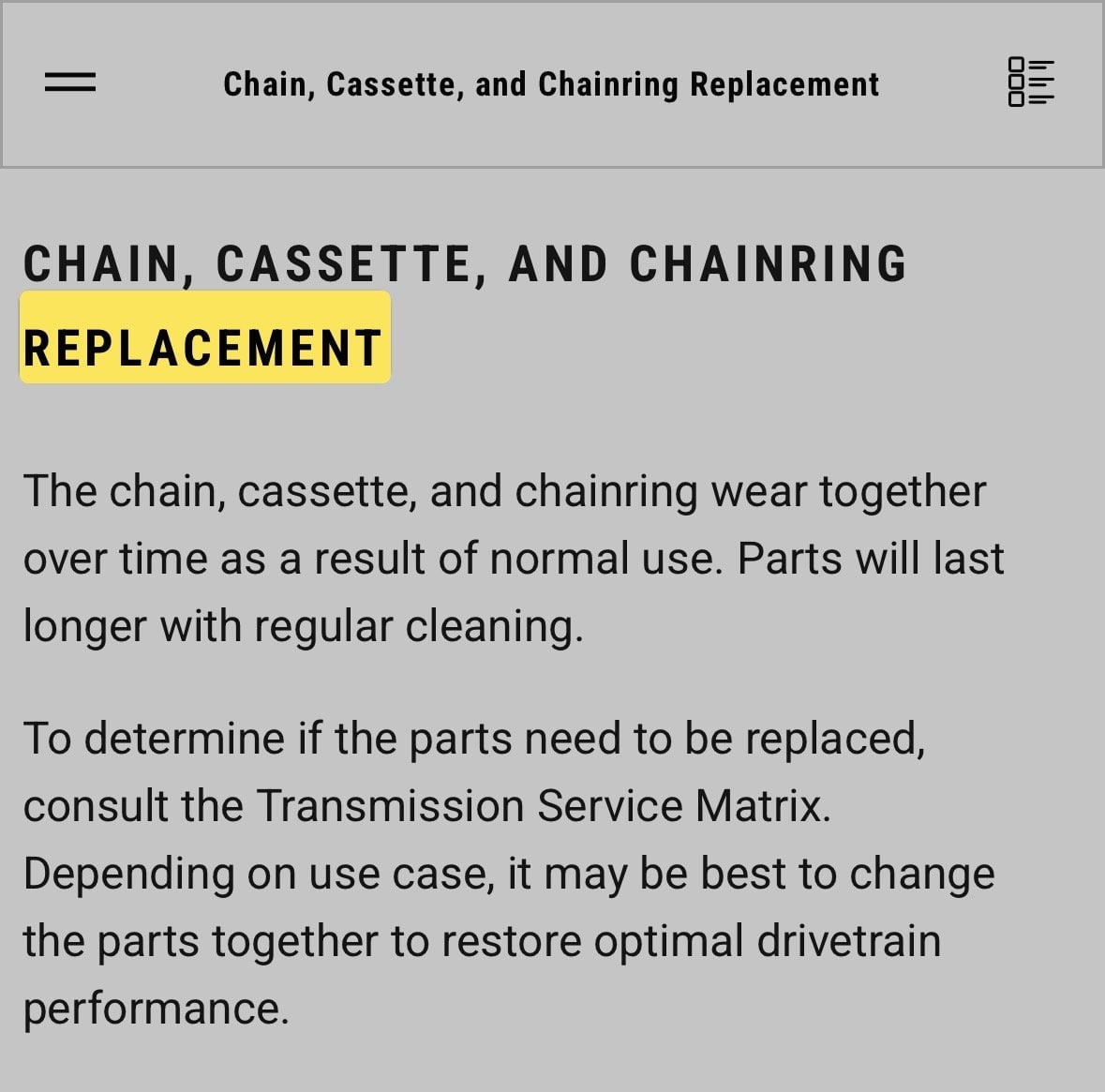
To be fair SRAM are pretty vague on this issue. Whereas replacing chain only at 0.5 wear was pretty standard on Eagle and 9/10/11 speed chains, and Shimano the same, the only reference to maintenance on T Type is the attachment above.
I guess it really comes down to how much longer T Type lasts before wear causes issues, compared to standard Eagle. The T Type chain is supposed to be the strongest chain SRAM have made and the cassette also more robust.
Personally I have both T Type and standard Eagle AXS. I know how long my Eagle chain lasts and I know a cassette will work well with 2 chain changes......a chainwheel, probably 2 cassettes. I intend running T Type until it gives issues so I have a comparison.
 
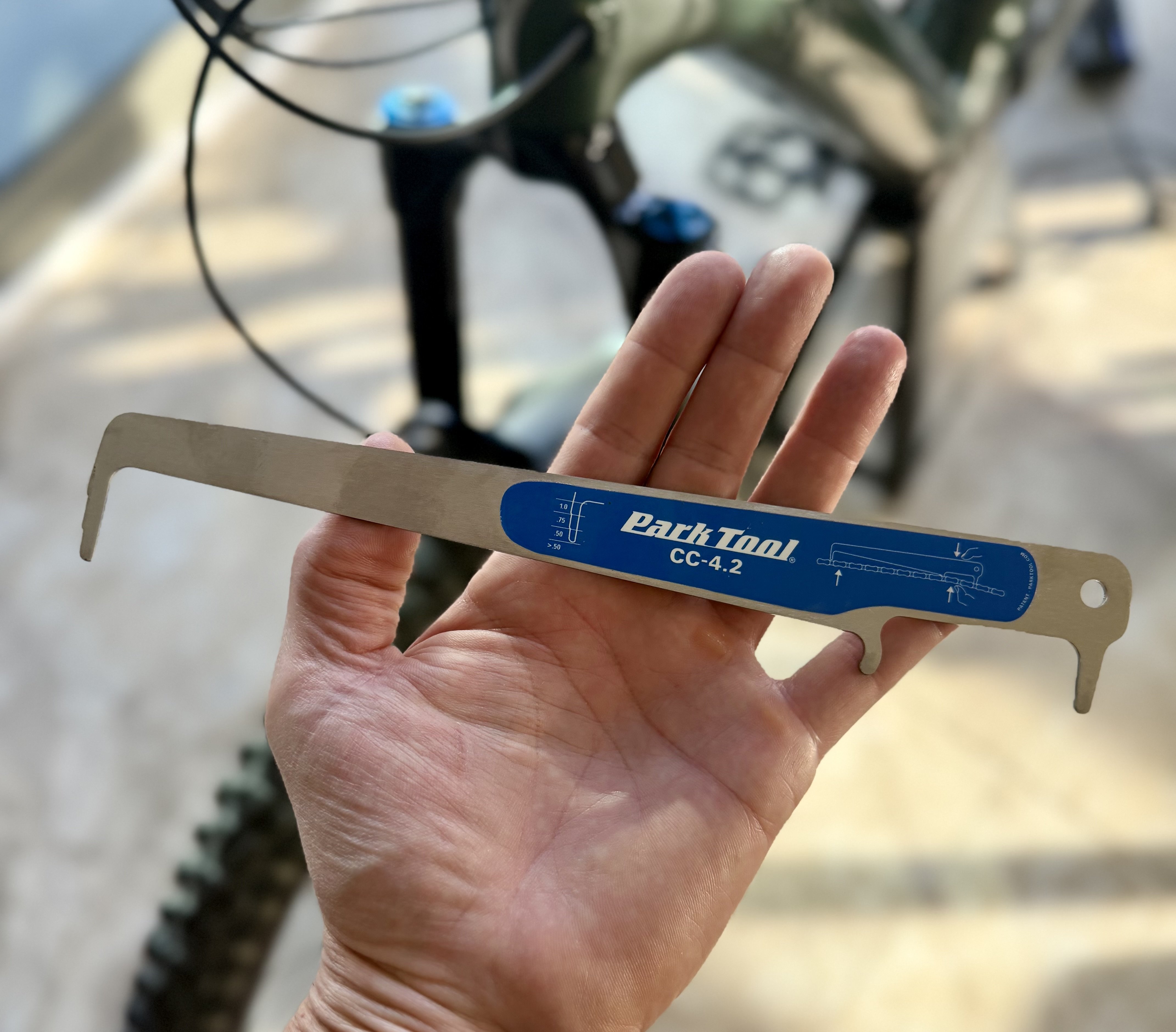
just bought a Park tool CC 4...does the same method as the Pedros...Pedros not readilly avaialble in the UK.
The correct Park Tool chain gauge for T-type is CC-4.2.
I have a little over 900mi on my GX chain and I’m about .55-.60 mark. Never muddy here in the desert but it is dusty as hell.

IMG_1493.jpeg
 
Keep reading
    Browse all

    Community Stats

    Since 2018
    668K
    Messages
    40,802
    Members
    Join 30,000+ Riders, it's free!
    Back
    Top