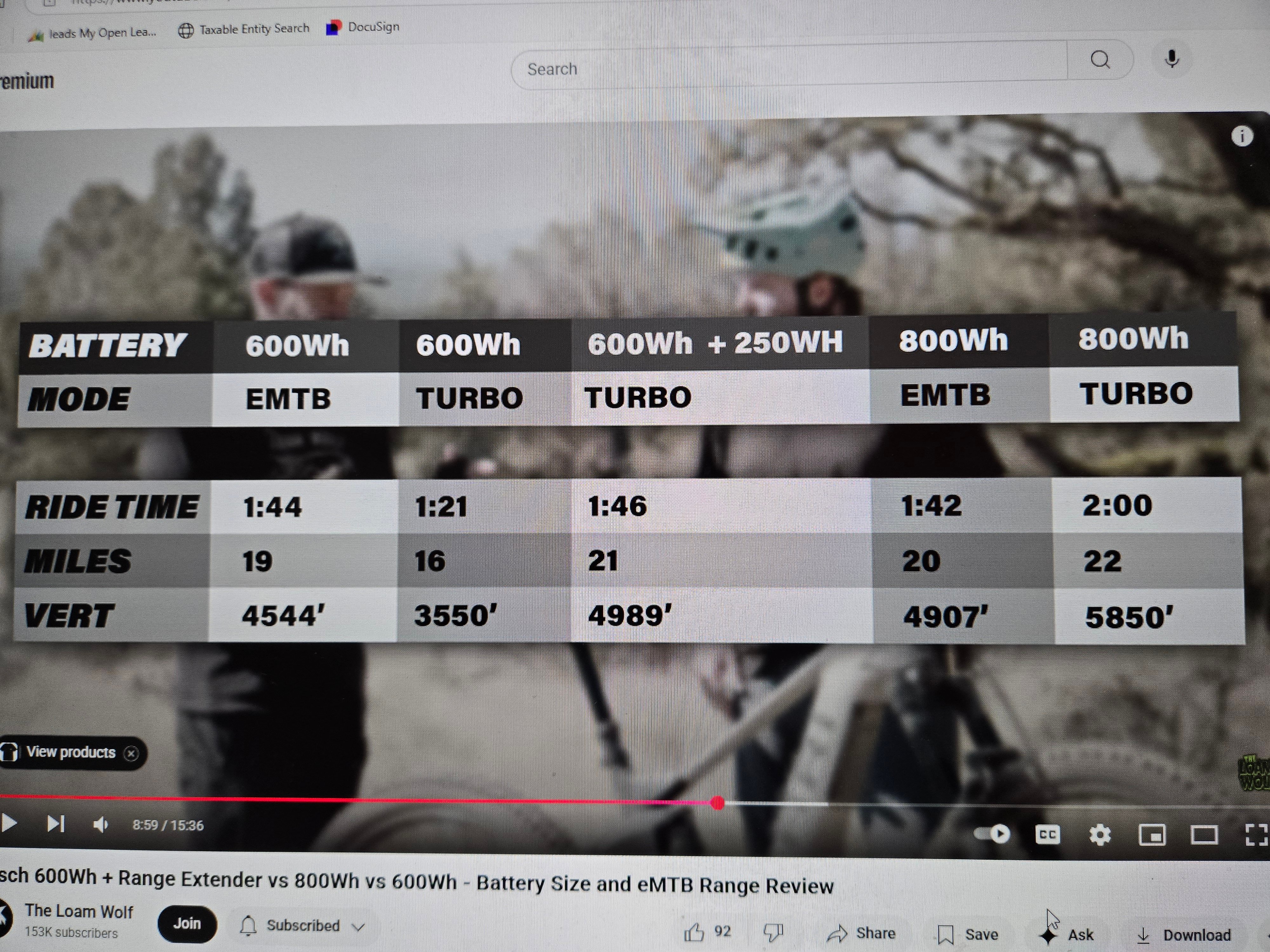
Bosch Range Tests - Comparisons

Suns_PSD

E*POWAH Elite
Joined
Jul 12, 2022
Messages
1,895
Reaction score
1,683
Location
Austin
Thought these were interesting.

195# rider. What I'd call easier terrain.


Interestingly both riders said they would choose the 600w battery if they had their choice for their own bike. That surprised me a bit.

PS. Stats were swapped for the 800W for emtb & turbo. In reality turbo goes less long/ high/ far.


20250808_140259.jpg
 
Last edited:
⚡ EMTB Pro Go Pro — exclusive discounts & ad-free Peaty's 25% off & more · Ad-free browsing · Pro badge See the deals →
If I got your discount on transition, I would have one in my stable today.

(referring to a regulator cx)
 
Not watched the video yet, but that table seems wrong.

800Wh did better on Turbo than EMTB but 600Wh was the other way round?
 
I'm certain that some, particularly in the Avinox motored bike threads, are tired of hearing my ruminations about Bosch motors almost certainly having about 20% better efficiency than the Avinox, so I'm keeping it here. It does matter because it effectively erases the weight advantage and even some of the charging speed advantage of the Avinox, because it takes more (heavy) battery to climb the same distance with an Avinox than it likely does with the Bosch. People have correctly pointed out that there are some variables so it's hard to know for certain.

I've analyzed some anecdotal evidence a few times from riders that have had similar days on both motors, as well as just what people tend to notice.

However this review, is a lot more scientific in it's approach to measuring battery efficiency: 30 eMTBs in Our Huge 2025 E-MOUNTAINBIKE Comparison Test: What’s the Best eMTB of the Year?
They used a 2-3 kg heavier Bosch e-bike vs. 2 cutting edge Avinox bikes (Amflow & Mith) and the Bosch bike used less battery watts to climb further, and very importantly, also while climbing FASTER than both of the Avinox bikes. All while utilizing power input measuring pedals to remove a significant variable, rider input.

But then I came across this older motor review at PB. The DJI is tested as well as the Gen4 Bosch. So it's the older Bosch but I'm going to assume that efficiency has NOT dropped with the Gen5 Bosch.


Here are the relevant parts of the efficiency portion of the review:

#5 DJI - 0.645 Wh/m, (this result was in turbo)
"the Avinox’s “Trail” mode is more comparable to other motor brands’ boost setting. The Trail mode also cuts off the wild Turbo burst, lowering the pace, but more importantly, conserving the battery. For what it's worth, we conducted a bonus lap in the lower Trail mode and result in efficiency score of 0.604 Wh/m." *(this result was in trail mode)

#1 Bosch - 0.490 Wh/m
"Bosch is well known name when it comes to motors. As it turns out, they know a thing or two about efficiency. Although it squeaked into first place, my money was on the Performance CX Line based on total ride times with other eMTBs. It was satisfying to confirm that theory to rest with back-to-back laps on each motor.

The math is pretty simple really, (.604-.490)/ .490 = 23% more battery usage in the Avinox to climb the same feet/ meters. What does that mean practically speaking? Well for example, our resident Weight Weenie Kiwi, would need a 493W battery in an Avinox bike to match his 400W Gen5 Crestie battery. Add a bash guard and poof, there goes your Avinox weight advantage not to mention your piece of mind since the Avinox rattles a fair bit. The high pivot Avinox bikes are going to suffer even poorer efficiency.

I too have been really stoked on the Avinox motor, but I'm putting together all of the evidence before me and I just think the Bosch is a better motor and we've all sort of been wooed by the absolute power and stunning looks of the Avinox. The Bosch is more efficient, much quieter, has better power delivery, is well supported by dealers, has a lower center of gravity for a given number of feet climbed, technically lighter in terms of climbing meters, has better heat management & has a natural bash guard. It now also has an excessive power option for the road climbs as well as an updated display, much like the Avinox. Furthermore, the CX-R version will be lighter still and quite likely have even greater efficiency with the ceramic bearings.

That's my take on it and I think the evidence is pretty conclusive at this point. The Avinox needs a V2 to try and catch up to the Bosch.

My next bike will almost certainly be a Regulator CX-R because I like the geo but I absolutely prefer the Bosch motor. but I'd also be pretty stoked on a lightly used Bosch Crestie (there is one for sale locally but the guy won't sell just the frame at this time).
 
Last edited:
I'm certain that some, particularly in the Avinox motored bike threads, are tired of hearing my ruminations about Bosch motors almost certainly having about 20% better efficiency than the Avinox, so I'm keeping it here. It does matter because it effectively erases the weight advantage and even some of the charging speed advantage of the Avinox, because it takes more (heavy) battery to climb the same distance with an Avinox than it likely does with the Bosch. People have correctly pointed out that there are some variables so it's hard to know for certain.

I've analyzed some anecdotal evidence a few times from riders that have had similar days on both motors, as well as just what people tend to notice.

However this review, is a lot more scientific in it's approach to measuring battery efficiency: 30 eMTBs in Our Huge 2025 E-MOUNTAINBIKE Comparison Test: What’s the Best eMTB of the Year?
They used a 2-3 kg heavier Bosch e-bike vs. 2 cutting edge Avinox bikes (Amflow & Mith) and the Bosch bike used less battery watts to climb further, and very importantly, also while climbing FASTER than both of the Avinox bikes. All while utilizing power input measuring pedals to remove a significant variable, rider input.

But then I came across this older motor review at PB. The DJI is tested as well as the Gen4 Bosch. So it's the older Bosch but I'm going to assume that efficiency has NOT dropped with the Gen5 Bosch.


Here are the relevant parts of the efficiency portion of the review:

#5 DJI - 0.645 Wh/m, (this result was in turbo)
"the Avinox’s “Trail” mode is more comparable to other motor brands’ boost setting. The Trail mode also cuts off the wild Turbo burst, lowering the pace, but more importantly, conserving the battery. For what it's worth, we conducted a bonus lap in the lower Trail mode and result in efficiency score of 0.604 Wh/m." *(this result was in trail mode)

#1 Bosch - 0.490 Wh/m
"Bosch is well known name when it comes to motors. As it turns out, they know a thing or two about efficiency. Although it squeaked into first place, my money was on the Performance CX Line based on total ride times with other eMTBs. It was satisfying to confirm that theory to rest with back-to-back laps on each motor.

The math is pretty simple really, (.604-.490)/ .490 = 23% more battery usage in the Avinox to climb the same feet/ meters. What does that mean practically speaking? Well for example, our resident Weight Weenie Kiwi, would need a 493W battery in an Avinox bike to match his 400W Gen5 Crestie battery. Add a bash guard and poof, there goes your Avinox weight advantage not to mention your piece of mind since the Avinox rattles a fair bit. The high pivot Avinox bikes are going to suffer even poorer efficiency.

I too have been really stoked on the Avinox motor, but I'm putting together all of the evidence before me and I just think the Bosch is a better motor and we've all sort of been wooed by the absolute power and stunning looks of the Avinox. The Bosch is more efficient, much quieter, has better power delivery, is well supported by dealers, has a lower center of gravity for a given number of feet climbed, technically lighter in terms of climbing meters, has better heat management & has a natural bash guard. It now also has an excessive power option for the road climbs as well as an updated display, much like the Avinox. Furthermore, the CX-R version will be lighter still and quite likely have even greater efficiency with the ceramic bearings.

That's my take on it and I think the evidence is pretty conclusive at this point. The Avinox needs a V2 to try and catch up to the Bosch.

My next bike will almost certainly be a Regulator CX-R because I like the geo but I absolutely prefer the Bosch motor. but I'd also be pretty stoked on a lightly used Bosch Crestie (there is one for sale locally but the guy won't sell just the frame at this time).

This is completely and utterly meaningless without control tires. It's certainly possible that the Bosch is more efficient than the others, but by how much? No way too know. Tires make a huge difference, anyone who has ever pedaled a bike knows that.

Any perceived efficiency difference is going to come down to:
1. How honest they are about rated battery capacity
2. Tires
3. Levels of boost on tap

Modern electronic motors and controllers are all going to be within a couple percent of eachother.

So yeah, a well controlled test would be valuable to know the effective turbo range, but needs control tires to have any meaning whatsoever.
 
This is completely and utterly meaningless without control tires. It's certainly possible that the Bosch is more efficient than the others, but by how much? No way too know. Tires make a huge difference, anyone who has ever pedaled a bike knows that.

Any perceived efficiency difference is going to come down to:
1. How honest they are about rated battery capacity
2. Tires
3. Levels of boost on tap

Modern electronic motors and controllers are all going to be within a couple percent of eachother.

So yeah, a well controlled test would be valuable to know the effective turbo range, but needs control tires to have any meaning whatsoever.

They used control tires in both of the efficiency tests linked above.
 
But then I came across this older motor review at PB. The DJI is tested as well as the Gen4 Bosch. So it's the older Bosch but I'm going to assume that efficiency has NOT dropped with the Gen5 Bosch.


Here are the relevant parts of the efficiency portion of the review:

#5 DJI - 0.645 Wh/m, (this result was in turbo)

#1 Bosch - 0.490 Wh/m
I think there's a lot of misleading comments about motor "efficiency" going around.

Motor efficiency is correctly defined as Power-out/Power-in. Sadly the industry hasn't yet got its act together and decided on a standard way to quote power-out, so this adds to the confusion. Is this power delivered at the crankshaft or the rear wheel? (Some may even be quoting electrical power from the battery, but of course this is really power in.)

I doubt whether there's really much difference in the electrical losses in all these motors, but there could be more variation in the mechanical losses across the different gear reduction designs.

What the quoted Pinkbike test did (and also the Loam Wolf) was to compare height gain (and/or distance) in metres for a given usage of battery in Wh. This may well be a more useful statistic for us riders, but it is not power-out/power-in.

You may think I am being pedantic here, but there's another relevant statement in the Pinkbike review which Suns_PSD did not mention. It is ....

"Here’s another plot twist though: the other four bikes took about 45 minutes to complete the test loop. The Avinox knocked ten minutes off that time. That might explain why the Avinox had the lowest efficiency in this test."

You may choose to consider that two motors have the same "efficiency" if they achieve the same height gain for the same Wh consumed. But clearly that cannot still be said if one motor achieves the same height gain at a significantly faster speed. Interestingly the Avinox took 10 minutes less than the 45 minutes of the other bikes, and 10/45 = 22% which (coincidently??) is exactly how much more battery Wh it consumed!

A more genuinely useful test for us riders would be to perform the comparison rides while regulating the bike's speed so as to achieve the same height gain in the same elapsed time and then compare battery consumption in Wh.

I have a Trek Rail with the Bosch gen 4 motor so I don't have any skin in the game and I am not trying to claim the Avinox is a "better" - or even more efficient - motor. But I just think that the media reviewers are unintentionally misleading us with these invalid statements about motor "efficiency" and "performance".
 
I think there's a lot of misleading comments about motor "efficiency" going around.

Motor efficiency is correctly defined as Power-out/Power-in. Sadly the industry hasn't yet got its act together and decided on a standard way to quote power-out, so this adds to the confusion. Is this power delivered at the crankshaft or the rear wheel? (Some may even be quoting electrical power from the battery, but of course this is really power in.)

I doubt whether there's really much difference in the electrical losses in all these motors, but there could be more variation in the mechanical losses across the different gear reduction designs.

What the quoted Pinkbike test did (and also the Loam Wolf) was to compare height gain (and/or distance) in metres for a given usage of battery in Wh. This may well be a more useful statistic for us riders, but it is not power-out/power-in.

You may think I am being pedantic here, but there's another relevant statement in the Pinkbike review which Suns_PSD did not mention. It is ....

"Here’s another plot twist though: the other four bikes took about 45 minutes to complete the test loop. The Avinox knocked ten minutes off that time. That might explain why the Avinox had the lowest efficiency in this test."

You may choose to consider that two motors have the same "efficiency" if they achieve the same height gain for the same Wh consumed. But clearly that cannot still be said if one motor achieves the same height gain at a significantly faster speed. Interestingly the Avinox took 10 minutes less than the 45 minutes of the other bikes, and 10/45 = 22% which (coincidently??) is exactly how much more battery Wh it consumed!

A more genuinely useful test for us riders would be to perform the comparison rides while regulating the bike's speed so as to achieve the same height gain in the same elapsed time and then compare battery consumption in Wh.

I have a Trek Rail with the Bosch gen 4 motor so I don't have any skin in the game and I am not trying to claim the Avinox is a "better" - or even more efficient - motor. But I just think that the media reviewers are unintentionally misleading us with these invalid statements about motor "efficiency" and "performance".

The 10 minute climbing advantage was when they tested the Avinox in turbo mode, and it showed about 32% less efficiency compared to the Bosch in turbo, while traveling 22% faster. Not surprising because it's clearly making a lot more power (600w vs 750w at that time). This was a Gen 4 Bosch and was not eligible for the power upgrade which didn't even come till later anyways for the Gen5. So this sort of time difference over a 45-minute climb isn't surprising. However it does not apply to the efficiency percentage difference that I calculated because...(See below)

The efficiency difference I calculated was between the Avinox in TRAIL mode vs. the Bosch gen4 in TURBO mode. Unfortunately they did not share with us the climbing times of these two options. But I feel comfortable in saying that the DJI was not faster up the hill while in trail mode than the Bosch was in Turbo mode.

It's true that extremely clear-cut scientific evidence on this matter is really impossible to find or even calculate. But at this point I feel like there is some denial.
I've already shown evidence in other posts where other testers have noted very significant efficiency differences between different motors. There is in fact a difference.

Do really appreciate everyone's input, opinions and experiences on this and many more topics.
 
Last edited:
We seem to get the same story everytime there is an efficiency test

A channel makes a video, comes to a conclusion with a methodology that can be picked apart (e.g. pink bike 10mins less, ignoring the fact the rider has put in effort for 10min less and on a motor with a higher assitance ratio)

I agree with @nickf, not much point trying to find efficiency differences until someone comes up with a radically different motor. Velomotion do the most detailed tests with dynos etc and the more recent videos don't bother with efficiency and essentially conclude if you want more range get a bigger battery.
 
  • Like
Reactions: rzr
FWIW I recently tested the Santa Cruz Vala and Bullit with their 600 batteries and I worked out roughly they had about the same range as my Specialized 700 battery on my Kenevo which I was surprised by.
 
Just to reiterate my point not to pick on you but:
Did you put the same amounts of wh through the pedals when you are comparing?
Did the motors put out the same amount of power?
How old is the Kenevo's battery, has it degregraded etc

It's so much effort to do an efficiency test properly and then the slighest change in conditons can throw it off.

I do think bosch's emtb mode is good at encouraging you to keeping you pedaling and putting work in. I'm certainly not doing that on the avinox and subsequently getting worse range.
 
  • Like
Reactions: rzr
Anecdotal, but I raced this weekend gone on an ebike (kill me now). I rode a Bosch Gen5 with an 800 battery. It was approximately 40km & 1400m of climbing. I rode round with a guy on a new Mith.

He rode everything in Auto, apart from the stages, which he did in Turbo, I rode everything in EMTB apart from the stages, which I also did in Turbo.

We were both about 85kg, both running the same tyres, similar pressures, both ended up around 35% left. Chatting to him he seems to get a similar range to my G5 bike, with similar use.
 
Loam Wolf are Okey are reviews but this one was below average to be hones when adding conclusions to the mix. I've ridden over 1000 km now on my Crafty with both the 600wh and the 800 wh and for a regular person reaching anything above 1400 meters or around 4500 feet from the 600wh is hardly achievable. Maybe with alot of Eco and so but who rides a full power bike like that bought the wrong bike. Period. This equals basically to a 1 hour and a half to two hours of bike riding with some decent climbs. Most of my rides fit here.
Now for anything above that the 800wh adds more than enough range for a proper day of ridding.

Getting back to the review, where it lost me is the guy clearly says at the beginning he didn't like the bike balance with the range Extender added on top but it the end it would choose one... Also to be noted even from the graph, the 800wh outlasted the combo of 850wh.

So this being said for most rides the 600wh is ok, but a solution to swap batteries is an amazing thing if you either :

1. Have a longer day on the bike
2. Do loop laps as you can swap batteries quickly
 
Anecdotal, but I raced this weekend gone on an ebike (kill me now). I rode a Bosch Gen5 with an 800 battery. It was approximately 40km & 1400m of climbing. I rode round with a guy on a new Mith.

He rode everything in Auto, apart from the stages, which he did in Turbo, I rode everything in EMTB apart from the stages, which I also did in Turbo.

We were both about 85kg, both running the same tyres, similar pressures, both ended up around 35% left. Chatting to him he seems to get a similar range to my G5 bike, with similar use.

It's a good data point for sure and contrary to other reports.

Was the Mith working well for him?
 
Would love someone to do an actual review back to back (Gen 5 vs Avinox) pick the closest two modes (possibly Auto on Avinox vs EMTB on Bosch) whatever velo say is closest to output. Control tyres and same rider. Settle this once and for all.

Watts used and time taken etc, would be interersting to see.
 
Would take it a step further and customize the stock modes to have the same parameters.
e.g. equalize to the same torque, watts, same battery size etc.
 
To be clear, if the efficiency difference is, ya know, <4% I don't care.

It just seems to be significantly more than that.
 
Would take it a step further and customize the stock modes to have the same parameters.
e.g. equalize to the same torque, watts, same battery size etc.
Agree with this, but actually it's simpler. For two bikes+rider of equal weight that climb the same +ve height gain they have both performed equal work (where work = mgh, mass, gravity, height). If they climb it in the same elapsed time they will have used the same average power. That's power delivered by the motor and the rider. It doesn't really matter how the mode settings are adjusted as long as the weight, height, and time are identical for both bikes. The key factor to provide a fair motor comparison is to ensure that the rider's leg power is equivalent across both bike tests. This can be done with a power meter on the pedals. Then just need to compare battery usage for both bikes.
 
Was the above bosch test 100nm or 85nm?

Seems similar to what im getting.
Last night i did 913mtr 3013ft, 23km 14mi, 1 hour 39
400wh, 4% left. mostlt in 85nm emtb mode. Some tour+, maybe 2% 100nm emtb +, downhill road sections off.
.43wh / mtr. But, I've id gone full fat 100nm mode it would have been a lot worse.
 
It was a Gen4 (in the PB test) and released in April, so 85NM.

Once again (reading is a lost art I swear!) the efficiency test I compared was the Avinox in TRAIL mode vs. the Bosch Gen4 in Race mode. Although PB did not provide the exact times.
 
Last edited:
Agree with this, but actually it's simpler. For two bikes+rider of equal weight that climb the same +ve height gain they have both performed equal work (where work = mgh, mass, gravity, height). If they climb it in the same elapsed time they will have used the same average power. That's power delivered by the motor and the rider. It doesn't really matter how the mode settings are adjusted as long as the weight, height, and time are identical for both bikes. The key factor to provide a fair motor comparison is to ensure that the rider's leg power is equivalent across both bike tests. This can be done with a power meter on the pedals. Then just need to compare battery usage for both bikes.

So, you mean like the e-mtb comparison test I linked above? Where they used power pedals, control tires, control cadence, a stopwatch, the Gen5, all of the way until all of the batteries were depleted, coasting back downhill with the motor off, and a basic climb that requires no skills?

The only thing they didn't control for was different models of bikes and the weight of the bikes, as the Bosch test bike was 2-3 kgs heavier than the 2 Avinox bikes that they tested.

Well in that e-bike review the Avinox was 20% less efficient (+/- 2%), just like the it was in the PB review, just like I've consistently calculated when reading other range comparisons. It turns out that in spite of the wide range in other variables, this efficiency thing nearly always comes out consistent, with a handful of notable outliers.
 
Last edited:
Would love someone to do an actual review back to back (Gen 5 vs Avinox) pick the closest two modes (possibly Auto on Avinox vs EMTB on Bosch) whatever velo say is closest to output. Control tyres and same rider. Settle this once and for all.

Watts used and time taken etc, would be interersting to see.

In the coming weeks I will have an opportunity to borrow a Mith for a reasonable period of time. I intend to ride a place where I can use the same climb multiple times to ride various trails - one day on my G5 bike, one day on the Mith, normalise the settings & see what happens. I’ll use the same wheelset between the bikes.
 
So, you mean like the e-mtb comparison test I linked above? Where they used power pedals, control tires, control cadence, a stopwatch, the Gen5, all of the way until all of the batteries were depleted, coasting back downhill with the motor off, and a basic climb that requires no skills?

The only thing they didn't control for was different models of bikes and the weight of the bikes, as the Bosch test bike was 2-3 kgs heavier than the 2 Avinox bikes that they tested.

Well in that e-bike review the Avinox was 20% less efficient (+/- 2%), just like the it was in the PB review, just like I've consistently calculated when reading other range comparisons. It turns out that in spite of the wide range in other variables, this efficiency thing nearly always comes out consistent, with a handful of notable outliers.
Do any of those factors take into account how conservative the Bosch motor seems to be with its watt output? According to Velomotion at 100W input the Bosch outputs 362 Watt, that is in SL territory. The Avinox produces twice the power at 100W.

 
  • Like
Reactions: ZR1
The cynic in me will say it's to leave a gap for the race motor

Sort of off topic but the flip side of putting power back in is where Bosch is a bit behind this example is a bit of skewed as the last bit of a battery takes way longer to charge

on a vala if you used up all your 600wh and wanted to charge up and get 600wh again its like 5hours?
an empty 800/840wh avinox/spec with fast charge you can put 600wh in barely over an hour.

Hopefully the next gen bosch or if they update can shove a slim 800wh into a vala and give fast charge too, I think that would be a great combo.
 
Last edited:
On another topic: the first Solid State Batteries for public sale in a car has just occurred in China. Specs that we care about, primarily watts/ kg, have yet to be released.


High end e-bikes would be the primary application for this technology as the battery packs are quite small (compared to a car), it's a very weight sensitive application & we'll pay more.

Hopefully these batteries will retrofit in place of existing batteries.

SS batteries will make mid power motors, even maybe the Maxon redundant, because the real weight of the e-bike system is in the battery and the motors don't weigh much different. Better to have a full power motor turned down with a new lightweight battery pack.
 
Keep reading
    Browse all

    Similar Threads

    Community Stats

    Since 2018
    668K
    Messages
    40,773
    Members
    Join 30,000+ Riders, it's free!
    Back
    Top