BIKEDRIVE AIR
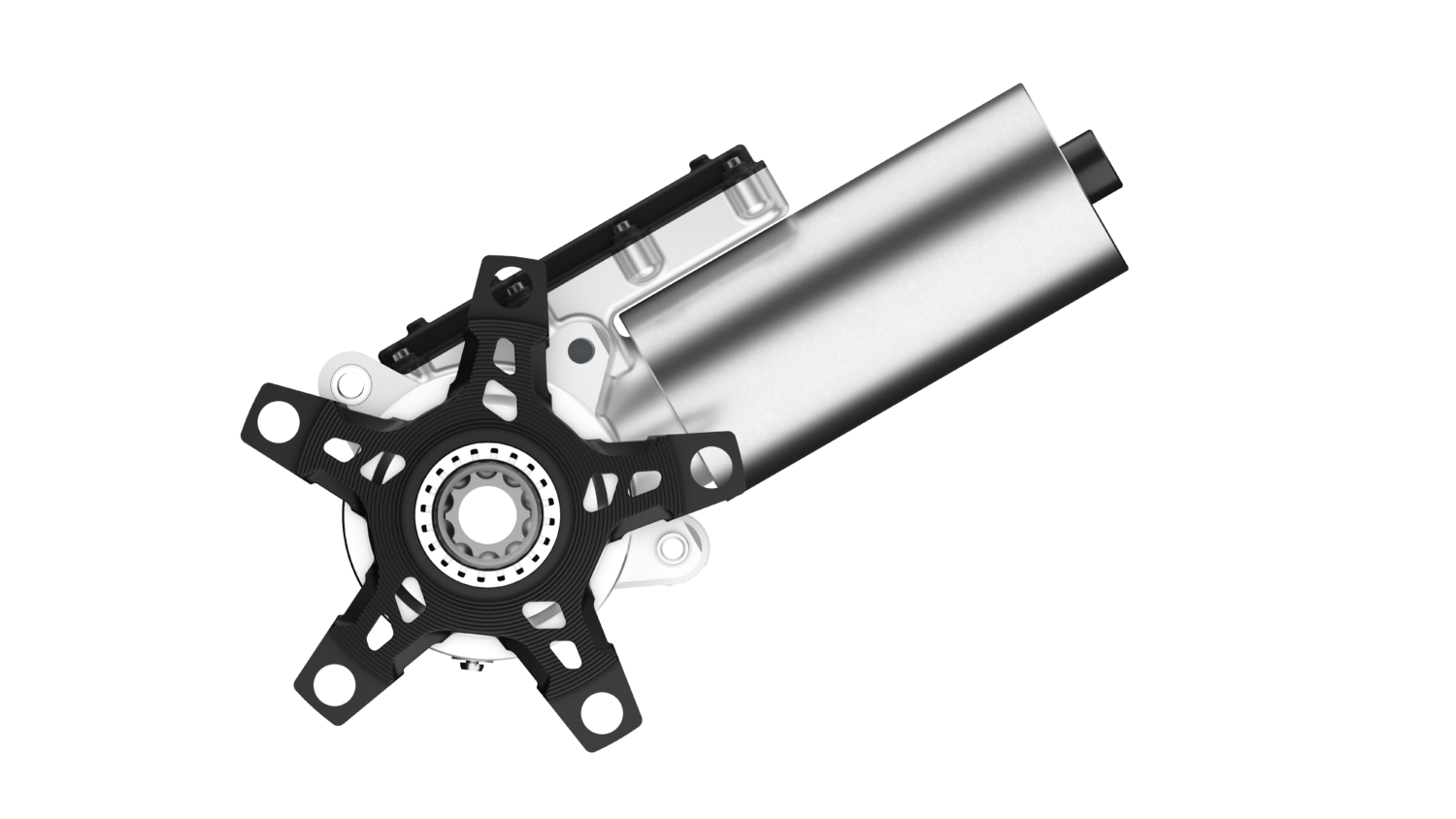
Maxon's first e-bike drive is the featherweight of the SL world: a roughly 1.9 kg Swiss-made motor built for riders who want a whisper of help, not a shove. It chases lightness and a natural pedal feel over outright punch — 30 Nm nominal, peaking to 40 Nm.
Weak off the bottom and rising late, the AIR only reaches its modest peak at high cadence and then holds output rather than tailing off. The plotted shape follows BIKE Magazin's measured PT Labs dyno curve, which peaks at 245 W around 85-95 rpm before easing.
Maxon BIKEDRIVE AIR is the lightest mid-drive Maxon has ever shipped, and the whole system rationale follows from that single number. The drive unit pairs a brushless EC internal-rotor motor with a single-stage planetary gearhead, delivers a nominal 30 Nm that peaks to 40 Nm, and puts roughly 220 W of continuous output through the pedals (around 280 W at peak on Maxon's tuned figures). It carries a 250 W regulatory continuous rating and tips the scales at roughly 1.9 kg. With a 250 Wh battery the complete system lands around 3.5 kg, undercutting almost everything in the light-assist class when it launched.
It rides like its spec sheet reads. BIKE Magazin's bench and trail test — over 14,000 data points on a PT Labs roller dynamometer — measured a peak of 245 W and 32 Nm at the crank, and described a motor that "dislikes lazy pedalling and low cadences" but turns "harmonious, very natural and zippy" once you spin it up. Power arrives at high rpm and holds to the top, so it rewards a fast, fit cadence rather than grinding torque. The frictionless freewheel means no drag when you outrun the assist, which is exactly the SL brief, but the same mechanism produces a distinct rattle on rough descents that testers flagged.
The trade-off is honesty about what it is. In a back-to-back climb test a Bosch Performance CX banked 1,950 vertical metres to the Maxon's 924 on the same battery energy budget. That is not a failure; it is the cost of choosing ~1.9 kg and a tiny battery. Maxon sells assistance through three named modes — Cruise, Push and Blast — rather than a published support percentage. If your goal is the lightest possible e-MTB and a ride that feels like a slightly stronger you, the AIR delivers. If you want to flatten 1,500 m days, this was never the tool.
Note that this is the original BIKEDRIVE AIR (2021). It was joined in 2025 by the far stronger BIKEDRIVE AIR S (90 Nm / 620 W peak), a full-power motor that shares the lightweight philosophy but is a different unit entirely — don't conflate the two.
Character
The case for and against
Strengths
- Exceptionally light at ~1.9 kg, system ~3.5 kg
- Natural, drag-free pedal feel via frictionless freewheel
- Quiet under power — quieter than Fazua/SL 1.1 under load
- Compact: 155 mm Q-factor, fits 60 mm down tubes
- Efficient — stretches small batteries
Compromises
- Modest power: 30 Nm nominal / 40 Nm peak, 245 W measured peak
- Weak low-cadence delivery — demands a fast, fit pedal
- Freewheel rattles on rough descents
- Tiny 250/360 Wh batteries limit range
- Superseded in 2025 by the stronger AIR S