Descending
56
A solid all-round descender (66.5° head angle, 140mm) — capable in the rough and steep without being an all-out bruiser.
Ultra-lightweight carbon eMTB with maxon BIKEDRIVE AIR motor (40Nm)
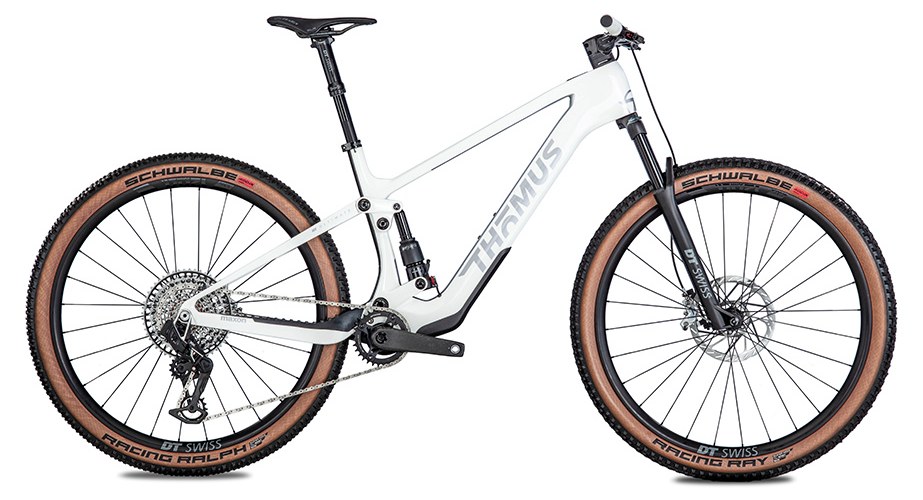
The Thömus Lightrider E Ultimate 2026 is the Swiss boutique brand's flagship ultra-lightweight eMTB: 140 mm of travel front and rear, the Maxon BIKEDRIVE AIR motor at 40 Nm of torque, an integrated 250 Wh battery, and a remarkable 16.1 kg claimed weight on a single-piece bearingless carbon flex-stay frame. At £12,999 base price, this is firmly halo territory and one of the most aggressive answers in the market to the question "how low can total weight go?" The Lightrider competes more with high-end analogue trail bikes (around 14 kg) than with mainstream eMTBs.
Drive system and range. The Maxon BIKEDRIVE AIR is the engineering centrepiece. 40 Nm of torque, 280 W peak and a 1.85 kg unit weight place this firmly in the lightest lightweight class — even lighter than the Specialized SL 1.2 (50 Nm, 1.95 kg) or Fazua Ride 60 (60 Nm, 1.96 kg). 250 Wh of integrated battery capacity is small but consistent with the philosophy: this is a bike designed to feel like an analogue trail bike with a small electric assist, not a full-power assistance platform. Real-world range with 250 Wh on this kind of system typically delivers 500–800 m of climbing per charge depending on assistance mode and rider weight. The Maxon ecosystem includes app integration and OTA-capable firmware.
Geometry and handling. A 66.5–66.6 degree head angle is trail-leaning rather than aggressive enduro — appropriate for a 140 mm travel platform with this lightweight focus. Reach progresses sensibly: 431 mm (S), 466 mm (M), 500 mm (L). The 444–445 mm chainstay is held essentially constant across sizes. The single-piece bearingless carbon flex-stay rear is the bike's signature design feature: zero pivots, zero bearings, lower maintenance overhead and a distinctive ride character. Three sizes is the main fit caveat — riders below roughly 5'4" or above 6'2" should check geometry tables carefully.
Build and value. Only the £12,999 base trim is gold-listed. Thömus is a Swiss handcrafted brand and pricing reflects that: full carbon construction, hand-finished detail, low production volumes and bespoke components throughout. At this price tag the Lightrider competes with Pivot Shuttle SL S-Works trims and Specialized Levo SL Gen 2 halo builds. The technical sell is the combination of weight, motor exclusivity and the bearingless rear-end design.
Caveats and known gripes. Forum data is essentially absent — one stray rider quote covers the broader Lightrider lineup. The 250 Wh battery is the most significant practical limitation; this is firmly not a bike for big-day Lake District or Alpine epics without a range extender. The 40 Nm Maxon BIKEDRIVE AIR is the entry-level Maxon motor (the AIR S sibling has 90 Nm) — buyers expecting trail-class punch will find this distinctly less powerful than even Bosch SX (55–60 Nm). Maxon's service network for the BIKEDRIVE family is essentially limited to specialist Swiss/European dealers; UK warranty pathways need confirmation. The 66.5 degree head angle is conservative for a 140 mm trail bike in 2026 where 64.5–65.5 degrees has become the new norm. The bearingless flex-stay rear is innovative but a less proven long-term design than conventional pivot-based four-bar layouts. At £12,999 you are paying boutique premiums for technical novelty and weight savings rather than mainstream value.
Verdict. The Thömus Lightrider E Ultimate is one of the most distinctive ultra-lightweight eMTBs of 2026: 16.1 kg, a bearingless single-piece carbon flex-stay frame, Maxon BIKEDRIVE AIR power and Swiss handcrafted boutique provenance. It will suit affluent riders who prioritise weight and ride character above all else, value Swiss engineering exclusivity and want a bike that feels closer to a pure analogue trail bike than a traditional eMTB. Buyers wanting full-power assistance, larger removable batteries, established UK dealer support or first-hand community ownership data should look at the Specialized Levo SL Gen 2, Pivot Shuttle SL/AM or Instinctiv Ocelot 145 alternatives. Production status: current.
Computed from this bike's geometry, spec and build kit — reach, wheelbase, chainstay, head and seat angles, travel, motor, weight and the fork/tyre/brake spec — and worked out per size, because a fixed chainstay can make an S and an XL feel very different.
A solid all-round descender (66.5° head angle, 140mm) — capable in the rough and steep without being an all-out bruiser.
Short 445mm rear and a lighter build — easy to pop, manual and throw around.
Not enough geometry on record to judge size balance.
A workmanlike climber — expect to put in more rider effort on the steep stuff. 280W of peak power and 40Nm of torque.
Easy to throw around; happiest when you're active on the bike.
Lower torque or a slacker seat angle — fine, just don't expect a winch.

| S | M | L | |
|---|---|---|---|
| Reach | 431 mm | 466 mm | 500 mm |
| Stack | 601 mm | 615 mm | 628 mm |
| Chainstay | 445 mm | 444 mm | 445 mm |
| Headtube Angle | 66.6° | 66.5° | 66.5° |
| Seattube Angle (eff) | 73.1° | 73° | 72° |
Base £5,500 | |
|---|---|
| Motor | Maxon BIKEDRIVE AIR · 40 Nm |
| Battery | Maxon BIKEDRIVE AIR 250Wh · 250 Wh |
| Travel F/R | 140/140 mm |
| Frame | Carbon |
| Weight | 14.8 kg |
| Price | £5,500 |
Other eMTBs with the closest geometry to this one.
Suggest a correction. We review every submission before publishing.
