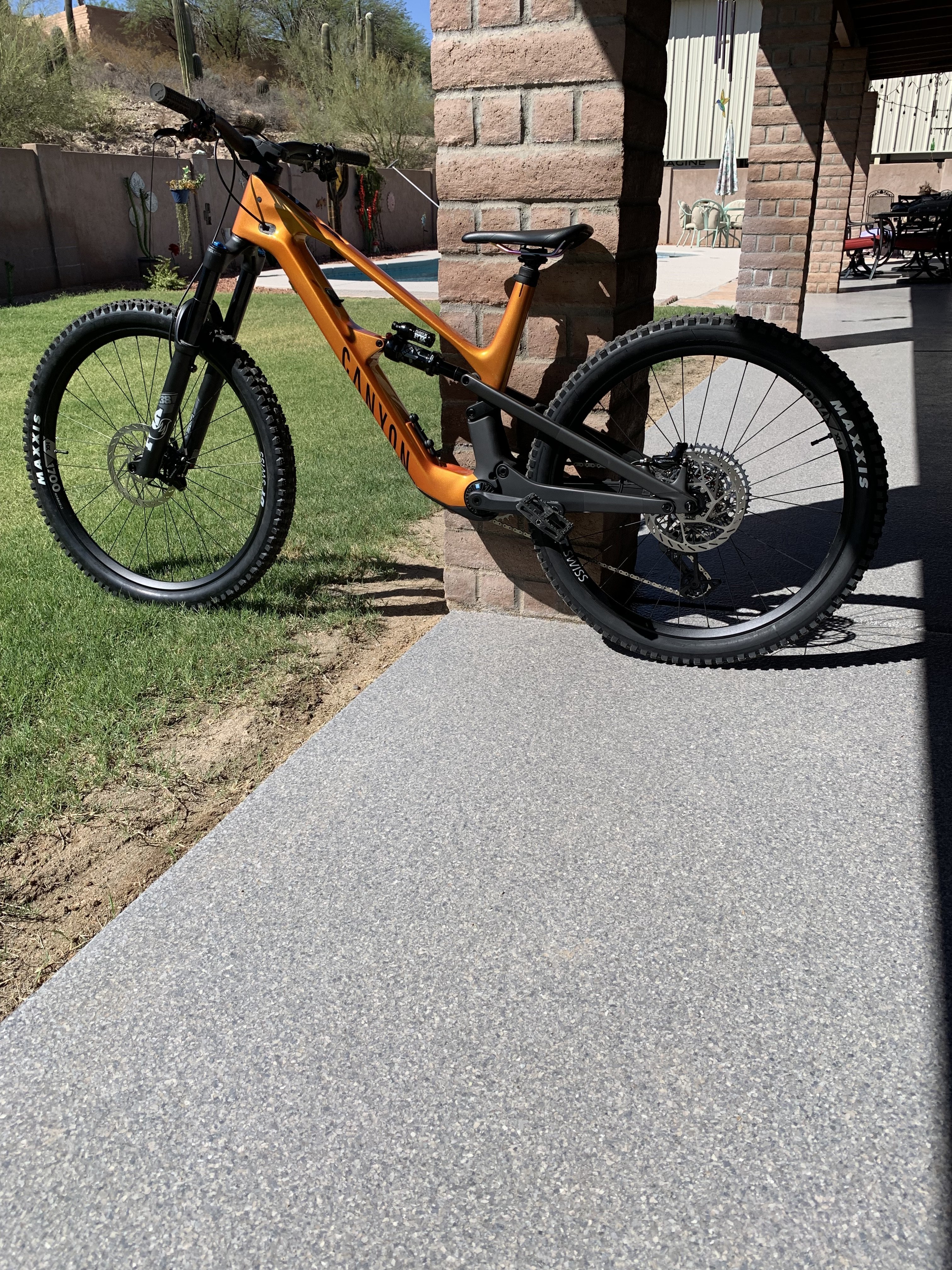
The SL bike is dead. Long live the SL bike!

This is exactly the point though. Motors optimized for higher torque & output require larger batteries to get equivalent range. The larger battery increases the system weight. Then every other part of the bike gets heavier to deal with the power, torque, weight.

I would really like to see some bike reviews compare range and ride feel with these higher power motors used exclusively at low assist. I searched and couldn't find any Vala/Regulator reviews that talked about maximum vert without a range extender.

Accept that some people just don't want boost mode power/torque/speed. If SL bikes disappeared, these people will probably just go back to meat bikes.


I agree with this about the TQ. The bike reviews focus on motor power, we need to be talking about the long-term ownership experience- not just the motor but the entire bike.
1,500 miles so far on my TQ 50 and it is solid as a rock 👍
 
⚡ EMTB Pro Go Pro — exclusive discounts & ad-free Peaty's 25% off & more · Ad-free browsing · Pro badge See the deals →
“Many” of the Amflow bikes are cracking? Maybe do some research because it is 0.3% which is in line with most carbon bikes. Additionally; some owners contributed to the cracks by changing components where the quality of instillation was suspect.

I’d be very surprised if the exact percentage of carbon framed bikes cracking from any manufacturer would be public knowledge.

Anyway, of no concern on a thread about SL e-bikes.

Am I wrong to believe that the SX demands a lot more high cadence, even in the 100, to deliver power,

The 60Nm update has changed the torque curve in my opinion, and whilst the SX does reward cadence if you want maximum support, that’s kind of inline with how I’d ride a non e-bike so to me it feels natural.

Noise wise, mine is quiet, but I don’t use it on ‘chunky’ rides (I have other bikes for that) but more XC/trail riding so probably why. I’ve never been sensitive to motor rattle to be fair, there’s usually much more noise coming from the rest of the bike if it’s that rough.
 
I can tell you. My wife has the Bosch SX in her Canyon Neuron. I have the TQ50 in my Canyon Spectral. Her Bosch absolutely trounces the TQ50 even before the Bosch 60 Nm update. The only downside of the Bosch SX is its motor rattle when going over chunk. My wife plays music so she never hears it, but me being a retired mechanic hears it all the time. It is simply the gears engaging each other during bumps while coasting and has no impact on reliability.
Thanks a ton Scott, I understand the SX has more power than the HPR50, and even the 60. What about the pedaling? But I am looking at an HPR 60 bike, which I understand will be less NM/watts than then SX, but seems quite better than the 50. Most importantly I am very interest in pedaling experience, is the SX a high cadence bike, does she really need to be cranking 95-100 rpm to get the SX to moving? would love to hear from peeps who try the HPR 60 vs the SX.
 
Most importantly I am very interest in pedaling experience, is the SX a high cadence bike, does she really need to be cranking 95-100 rpm to get the SX to moving? would love to hear from peeps who try the HPR 60 vs the SX.
SImilar here- my partner has a Devinci E-try lite (Bosch SX / 400wh) while I have the HPR50 Slash+ with both 360 & 580wh batteries. Agree that the Bosch is way more powerful. The main thing I noticed is that with the Bosch, if you want more assist you just pedal faster, whereas on the TQ I would shift from trail into boost to get a similar effect. It doesn't require the high cadence but it definitely helps.

Range wise, the Bosch 400 is pretty close to the TQ 360, but you're working harder on the TQ.
For us, 3500' is a typical max ride with those batteries. With the 580wh, I do a 4700' ride and end with 15-20% left. I'm sure the HPR60 is more efficient.

The SX does have a rattle, it doesn't bother her, but it does bother me as her mechanic. Bike didn't have it when new, it developed after 6 weeks. We have not updated her motor because she doesn't want to give up range.

I understand it's not critical for many people, but the removable battery is a huge advantage to me, with the TQ. We do camping/riding trips, I can ride one battery while the other charges, and I don't have to deal with that until day 3 of riding. I can sneak a charge in breweries, cafe's, restaurants, bathrooms, etc. Using the lighter 360 for bike parks and quick weeknight rides is great.
 
Thanks a ton Scott, I understand the SX has more power than the HPR50, and even the 60. What about the pedaling? But I am looking at an HPR 60 bike, which I understand will be less NM/watts than then SX, but seems quite better than the 50. Most importantly I am very interest in pedaling experience, is the SX a high cadence bike, does she really need to be cranking 95-100 rpm to get the SX to moving? would love to hear from peeps who try the HPR 60 vs the SX.
I have ridden her bike quite a few times as I’m the main bike mechanic 😉. In my opinion with all the miles I’ve done through Utah, Colorado and Arizona the TQ motor never disappoints. Very quiet, but the best feature is how natural it feels. It basically feels like your riding with a wind on your back. The Bosch SX is a great motor and is well proven but it has a different feel and form factor which makes it less stealthy if you know what I mean. Here is a picture…where is the motor?

IMG_1443.jpeg
 
Last edited:
Thanks a ton Scott, I understand the SX has more power than the HPR50, and even the 60. What about the pedaling? But I am looking at an HPR 60 bike, which I understand will be less NM/watts than then SX, but seems quite better than the 50. Most importantly I am very interest in pedaling experience, is the SX a high cadence bike, does she really need to be cranking 95-100 rpm to get the SX to moving? would love to hear from peeps who try the HPR 60 vs the SX.
I own a HPR50 bike and have ridden the SX on a demo day. It’s way way more powerful, no you don’t need to hit a cadence of 90+ to get power.

Using watts as a guide, the 600w max of the SX does indeed feel almost twice as powerful as the 300w max of the HPR50. Also makes sense considering the SX has up to 400% support vs the max 200% on the HPR50.
 
“Many” of the Amflow bikes are cracking? Maybe do some research because it is 0.3% which is in line with most carbon bikes. Additionally; some owners contributed to the cracks by changing components where the quality of instillation was suspect.
he‘s always exaggerating…
 
Had a few SLs probs tried most of them and i always end up selling them as theyre to slow for my FF ebike mates rides, and such a similar workout to my normal bike which is lighter id end up taking the normal bike.

I think if i was purely riding solo it would be the one bike id only need...but so would my trail bike.
 
Is the Rocky Mountain Instinct SL the most overlooked bike in this conversation that kinda bridges the gap between SL and FF?

They released a motor software update that gets 75nm and 700w. It's a 480wh battery and weight of around 20kg depending on parts spec.
 
Is the Rocky Mountain Instinct SL the most overlooked bike in this conversation that kinda bridges the gap between SL and FF?

They released a motor software update that gets 75nm and 700w. It's a 480wh battery and weight of around 20kg depending on parts spec.
Maybe overlooked because excuse the pun but RM has had such a Rocky outlook lately. Most of the dealer network in NZ collpased when the brand filed for bankruptcy protection.
 
Is the Rocky Mountain Instinct SL the most overlooked bike in this conversation that kinda bridges the gap between SL and FF?
You could be right! The Loam Wolf included it in their recent 2025 SL shootout Loam Wolf Rocky Mountain SL

Sadly at 5mins in they discuss the fact that the motor has its own uniquely irritating noise to it. Nothing's perfect!
 
I really like the RM, but the noise, no mullet frame only option, and BK thing gives me pause. Yet the bike is a really cool unit imo.
 
This is exactly the point though. Motors optimized for higher torque & output require larger batteries to get equivalent range. The larger battery increases the system weight. Then every other part of the bike gets heavier to deal with the power, torque, weight.

I would really like to see some bike reviews compare range and ride feel with these higher power motors used exclusively at low assist. I searched and couldn't find any Vala/Regulator reviews that talked about maximum vert without a range extender.

Accept that some people just don't want boost mode power/torque/speed. If SL bikes disappeared, these people will probably just go back to meat bikes.


I agree with this about the TQ. The bike reviews focus on motor power, we need to be talking about the long-term ownership experience- not just the motor but the entire bike.
I really don't believe the full power motors are less efficient at low outputs.
I can milk my 400wh to on bosch gen 5 cs 3 hours run time in 60 and 70nm modes. Probably longer in eco only.

So the big question is. Are there times when you want full power? if yes, that rules out sl's and mid powers.
If not, is there times when you want more range than sl or mid power batteries can offer? if yes then that also rules out sl's and mid powers.
 
what are the real difference between the TQ HPR60 and the Bosch SX, apart from, probably, better reliability for thee Bosch.
Am I wrong to believe that the SX demands a lot more high cadence, even in the 100, to deliver power, while the TQ delivers earlier, in a more natural pedaling way, as if one was riding a normal MTB? Also, from all reviews, the SX is noisy and rattling?
SO, more power/watts but more natural high cadence spinning on the SX? am I wrong?

Pretty much, although reliability on the HPR60 is unknown yet, but rumoured to be improved.

The SX rattles like the Gen4 CX, which you get used to, but when you ride a Gen5 bike, or the TQ, it’s really loud & noticeable. It’s a step change in power, no where near an 85nm Bosch, but noticeably more ‘ebike’ than the TQ, which just feels really natural (so natural in fact it’s really quite pleasant when you are mid trail & over the top of the motor). The range of the TQ is also vast compared to the SX, it is considerably more efficient. In fact I think I could possibly “out elevation” an 800w Bosch With it.

I am really enjoying the 2 full power bikes I have at the moment for blasting laps, but I still think if I had to be in the one ebike club, I’d keep the TQ bike over everything, it’s really that good. That might be because the Yeti is actually annoyingly good.
 
Last edited:
So the big question is. Are there times when you want full power? if yes, that rules out sl's and mid powers.
If not, is there times when you want more range than sl or mid power batteries can offer? if yes then that also rules out sl's and mid powers.

Perhaps another ‘big question’ to ask is does it really matter if you want ‘full power’, but don’t have it? What critical applications outside of racing is it a requirement?

Or, you want more range than your SL battery can offer, does it matter if you can’t have it?

If the answer to those questions for you is that it does matter, then the full power and big battery options are for you, with the accompanying downsides.

Doesn’t mean that SL/Mid-Power EMTBs don’t have a place, just that they’re not for you.

We’re basically back to saying buy the best bike for you, and accept that others may want something different. 🤷‍♂️
 
Perhaps another ‘big question’ to ask is does it really matter if you want ‘full power’, but don’t have it? What critical applications outside of racing is it a requirement?

Or, you want more range than your SL battery can offer, does it matter if you can’t have it?

If the answer to those questions for you is that it does matter, then the full power and big battery options are for you, with the accompanying downsides.

Doesn’t mean that SL/Mid-Power EMTBs don’t have a place, just that they’re not for you.

We’re basically back to saying buy the best bike for you, and accept that others may want something different. 🤷‍♂️
For sure match the bike to your requirements.

For me, do I have full power requirements. Yes, I ride with full power mates and having a mid power does not cut it on those rides with full power mates.

Do i want to ride longer than what a small battery profides? yes i do. Therefore i run a bike that can take different batteries sizes.

Do I want to run a range extender? no. I want a water bottle there and not a range extender. So i prefer a battery swap than addition a ranger extender.

Do i want a lighter mid power experience? Yes. Therefore I spec a full power bike with light gear and one that can option a small battery. Thus i have a 400wh battery for my full power bike.

I get all of that in one eyewateringly expensive bike!.... hehehehe.
 
I get all of that in one eyewateringly expensive bike!.... hehehehe.
😂

For sure match the bike to your requirements.
Which is what I’d expect anybody to do, as indeed the comments are showing.

None of that means that SLs or ‘mid-powers’ don’t have a place for lots of people, and they wouldn’t exist in the first place if that wasn’t the case.

Choosing a bike/solution that isn’t an SL doesn’t mean anything more than somebody buying an SL and declaring ‘full power/big battery’ e-bikes dead/obsolete?

I know it’s nature for old guys to argue/debate stuff like this like it really matters, but the reality is it doesn’t and there’s room for all sorts of bikes and riders in the hobby. 😃

As a point of interest, I saw an e-cargo bike being ridden in the Lake District recently, not in town but off-road.

They didn’t stop and I didn’t get a picture, but had to laugh, the same way I do when I see an old hearse being leaned on its door handles around the Nurburgring! 😂
 
None of that means that SLs or ‘mid-powers’ don’t have a place for lots of people, and they wouldn’t exist in the first place if that wasn’t the case.

Choosing a bike/solution that isn’t an SL doesn’t mean anything more than somebody buying an SL and declaring ‘full power/big battery’ e-bikes dead/obsolete?
They definitely have their place, IMO two types of people ride/prefer SL's. Those that don't ride massive amounts of elevation each ride and those that are very fit.

I ride a 22.8kg FF, but I would sell it and keep my EX-e if the TQ could output 450w+ something like the SX/Fazua. Even the HPR60 at 350w is less than I'd like, but still keen to try one sometime soon.

Then again, if I started riding endless hills close to home, my fitness would get up and I'd probably fall in love with the TQ again :ROFLMAO:
 
I really don't believe the full power motors are less efficient at low outputs.
I can milk my 400wh to on bosch gen 5 cs 3 hours run time in 60 and 70nm modes. Probably longer in eco only.

So the big question is. Are there times when you want full power? if yes, that rules out sl's and mid powers.
If not, is there times when you want more range than sl or mid power batteries can offer? if yes then that also rules out sl's and mid powers.
For me, the big question is: "How will the bike feel on the descents and in the air, how will it corner and brake, how well can I shift my weight about to influence it, to bunnyhop and to get over obstacles?" And this is mostly proportional to weight and weight distribution.
There is no point keeping up with FF bikes on the uphills to be stuck behind them on the downs. And there is no point fitting in 5 descents instead of 3 if those descents are all compromised by a super heavy bike.
There is also a grain of truth in the suggestion that as the ebike gets heavier, more powerful and less agile the rider gets heavier, less powerful and less agile....
 
For me, the big question is: "How will the bike feel on the descents and in the air, how will it corner and brake, how well can I shift my weight about to influence it, to bunnyhop and to get over obstacles?" And this is mostly proportional to weight and weight distribution.
There is no point keeping up with FF bikes on the uphills to be stuck behind them on the downs. And there is no point fitting in 5 descents instead of 3 if those descents are all compromised by a super heavy bike.
There is also a grain of truth in the suggestion that as the ebike gets heavier, more powerful and less agile the rider gets heavier, less powerful and less agile....

Can't speak for all big bikes, but I don't feel held back by my mondraker '25 crafty (49.5 pounds).
My descent times are actually equivalent to, or faster, than my acoustic enduro bike.
 
For me, the big question is: "How will the bike feel on the descents and in the air, how will it corner and brake, how well can I shift my weight about to influence it, to bunnyhop and to get over obstacles?" And this is mostly proportional to weight and weight distribution.
There is no point keeping up with FF bikes on the uphills to be stuck behind them on the downs. And there is no point fitting in 5 descents instead of 3 if those descents are all compromised by a super heavy bike.
There is also a grain of truth in the suggestion that as the ebike gets heavier, more powerful and less agile the rider gets heavier, less powerful and less agile....
I totally agree with the tradeoff between weight and performance. Where does that sit?
I think it will be different for different locations and riders.

For me i think optimal weight will sit around 20kg for ultimate descending speed for an e bike. I'm currently sitting betwwen 21.5 and 22.5kg depending on battery size selected.

At 21.5 I am not slower than my 16kg enduro bike me on the down. Infact there are many places where i am faster on the E, excluding motor usage. The places I am faster and can hold a line better on the E is big fast chunk. The bike is more stable and doesn't bounce around as much and you can just let it run.

The places where my enduro bike is better is real tight stuff with nose wheelie turns and times when you need to bunny hop big features. Basically anything trailsy. Also slow wet steeps, the extra weight is more difficult to control.

On jumps the enduro is more playful, but there' s nothing i cant achieve on the E.

Also, its common for dh and enduro racers to add weights to there bikes to make them more stable and faster dh. That is born out of a lot of them cross training on E's and finding out that the e bike is faster in spots due to its stability.

On riders getting fatter with more power bikes. I see that as a valid argument for for someone with a lack of will power. To appose that argument the most mentally and physically gassed i have been on a bike is during full power full speed technical single track session. Find a location with good rooty/rocky tech climbs and descends and just go full gas until your brain melts and your heart burst out ya throat.
 
On riders getting fatter with more power bikes. I see that as a valid argument for for someone with a lack of will power. To appose that argument the most mentally and physically gassed i have been on a bike is during full power full speed technical single track session. Find a location with good rooty/rocky tech climbs and descends and just go full gas until your brain melts and your heart burst out ya throat.

Exactly, more of an intensive power workout compared to an aerobic grind. An hour or more of that and you're cooked.
I suspect that perception may also be associated with terrain available as well. As in, yourself and myself have legitimate enduro/dh terrain available, I can see people getting pretty lazy in rolling terrain on an e-bike.
 
Purpose of the thread was to talk about the future of SL bikes. Is there a place for them etc. My position is that there is. Not for everyone, but it should be a big enough market to warrant the bikes' existence, in exactly the same way that DH bikes, XC bikes, Trail bikes and Enduro Bikes all fit different niches.
And despite the last 5 pages of discussion, I don't think many would argue with this...
The problem at the moment is that most bikes are Medium or FF, and where SL parts do exist they are suffering from serious mission creep. They are getting updates for more torque and power and bigger batteries, leaving them in danger of becoming too heavy to be noticeably lighter. Instead manufacturers should be looking at weight and efficiency advances instead.
Many would argue that a 40Nm 300W motor would be an abject failure, but if it was in the 1-1.5kg range then that would put a whole different light on it.
 
For me the biggest draw of an SL is the transition when you hit the assistance speed limit. On my full fat Vala it's like pedalling in treacle.
 
For me the biggest draw of an SL is the transition when you hit the assistance speed limit. On my full fat Vala it's like pedalling in treacle.
I have to say that I've never felt the motor drag with my Bosch Gen 4 was too bad when over the speed limiter. But then I rode the TQ60 on my new Fuel+ and it's night and day better!
 
I have to say that I've never felt the motor drag with my Bosch Gen 4 was too bad when over the speed limiter. But then I rode the TQ60 on my new Fuel+ and it's night and day better!
You sure it's not just due to the difference in power overall ?
I've observed that running in a detuned eco mode that the pedalling felt exactly the same as an acoustic bike at cutoff.
Running in turbo mode it feels like you're in sand after cutoff.
Riding an mte (tq60) and a bosch gen 5 with the system shut off, they felt identical to me, other than the extra weight of the bike itself.
 
You sure it's not just due to the difference in power overall ?

Riding an mte (tq60) and a bosch gen 5 with the system shut off, they felt identical to me, other than the extra weight of the bike itself.
I've ridden my Bosch Gen 4 Rail alternating between Off and Eco modes on tarmac at the end of the ride in order to eek out the last few Wh of battery to get home. The difference to me is very noticeable when switching between them.

Conversely, I often start my ride on the TQ60 Fuel+ in Off mode (cos I forget you need to switch it into Eco mode) but don't notice until I get to a hill. Of course, my legs are tired at the end of a ride compared to fresh legs when starting out. And the Rail weighs almost 5kg more (but same tyres).

I think comparing rides on flat(ish) tarmac is the most reliable indicator. I typically ride the Rail in Trail mode on tarmac and I do need to put noticeably more muscular effort into the pedals when transitioning beyond 25kph, whereas I just don't notice the transition at all on the Fuel+. YMMV.
 
You sure it's not just due to the difference in power overall ?
I've observed that running in a detuned eco mode that the pedalling felt exactly the same as an acoustic bike at cutoff.
Running in turbo mode it feels like you're in sand after cutoff.
Riding an mte (tq60) and a bosch gen 5 with the system shut off, they felt identical to me, other than the extra weight of the bike itself.

Comparing the TQ & G5 Bosch, there is a noticeable difference IMO. Some it is power, some if it is gearing (you are much more likely to be pedalling at a cadence akin to a naturally aspirated bike on the TQ, whereas unless if specifically focussing on it, my cadence is a good 10/15RPM lower on a full power bike), the weight, probably the tyres & there is a bit more system drag overall.

The Avinox motor is worse over the top, probably the worst I have ridden of all the current motors. I can see why people VPN hack them.
 
J'avais un Trek Fuel EX E et un SANTA Heckler SL, et je viens de commander le nouveau Trek Fuel+ pour retrouver le moteur TQ et un débattement arrière un peu plus important (MX avec 65 mm de débattement). J'y installerai une batterie de 360 W pour avoir un modèle plus léger, même s'il sera entièrement équipé d'un ressort pour la gravité.
 
Keep reading
    Browse all

    Similar Threads

    Community Stats

    Since 2018
    668K
    Messages
    40,720
    Members
    Join 30,000+ Riders, it's free!
    Back
    Top