I have a 2018 Levo and recently got a new battery on warranty and at the same time got V2 of Mission Control app. My problem is trying to change settings for the three modes. Any changes I make don't stay, and yes I'm using the "make change" (or whatever it says) button. Confused as it seems some of you have been able to make changes to your settings.....
Navigation
Install the app
How to install the app on iOS
Follow along with the video below to see how to install our site as a web app on your home screen.
Note: This feature may not be available in some browsers.
More options
Style variation
You are using an out of date browser. It may not display this or other websites correctly.
You should upgrade or use an alternative browser.
You should upgrade or use an alternative browser.
Sweet spot on assistance levels
- Thread starter george
- Start date

brizi2003
Active member
That doesn't sound right - go the dealerI have a 2018 Levo and recently got a new battery on warranty and at the same time got V2 of Mission Control app. My problem is trying to change settings for the three modes. Any changes I make don't stay, and yes I'm using the "make change" (or whatever it says) button. Confused as it seems some of you have been able to make changes to your settings.....

- Thread starter
- #33
Hey George that's really interesting what you've discovered. And using a 'test' route is a good idea. I too have a Kenevo Comp and I'm enjoying mine too for all the same reasons you said! The furthest I've managed so far was 38.2miles, with 3167ft climbing and my battery ran flat about 1 mile from home, but unfortunately I can't remember what settings I was using, but remember mainly using ECO mode (not that enjoyable!). Today I was running 15/30, 20/100, 100/100 - flat/down in ECO, medium climbs in TRAIL and steep climbs in TURBO and I did 21.8 miles, 2350ft climbing, Avg Speed 9.2mi/h and used 341Wh (about 75% on the 460Wh battery capacity). Using 15 & 20 for ECO & TRAIL means the jump between the modes is not so large then the jump to TURBO is massive! I never considered using a lower setting for motor power than assistance level as you did on Day 3 - but perhaps that's the key to preserving battery. I think I will try something closer to your settings but I will need to keep TURBO at 100/100 since my son also has an eBike and we go for shorter but more fun rides TURBO up, TRAIL everything else!. I've tried the automatic distance/time function but haven't found it that good - so I think manual tuning specific to the type of ride your going to do is the way to go. Happy riding/tuning! Brian
You are right, I prefer the manual tunning too. (I'm guessing since the automatic tune based on time will not know your rute profile so if you start with a climb, the automatic tune will be cutting the power in case your ride is pure climbing)
You can set turbo to 100/80 (changing your peak power from 100 to 80) and you will notice some extended battery life, and in my case is not that bad.
Here is the trick
If I'm going with analog bikes non-competitive group just to enjoy the ride I use ECO or off mode.
Going with a hard core competitive group with analog bikes I use TRAIL MODE most of the time
But riding alone I always tempted to going in TURBO (even 100/100) feels not fast enough. (And here is when I try to remember my self this is a bicycle not a motorcycle)
I just can't stop riding this bike! and have the ability to choose is a great feature!
Happy raiding my friend!
- Thread starter
- #34
Thanks for sharing this very usefulThe first number is related to the assistance level, that increases the power delivered by the rider by a factor of 3.2x at 100%
So, if you deliver 100 watts with your legs, at 100% assistance the motor will deliver 320 additional watts, 420 watts in total.
if you deliver 100 watts with your legs, at 50% assistance the motor will deliver 160 additional watts, 260 watts in total.
And so on.
The second number is related to the maximum power that the motor can deliver.
At 100% PP, the motor could deliver (just for a short time) 700 watts of maximum power.
If you limit this peak by 50%, the motor will deliver 350 watts of maximum power.
Just another example to clarify:
If you deliver with your legs 200 watts at 100% assistance, the motor will deliver 640 watts. This happens if you don’t limit the peak power, leaving it at 100%.
If you limit the peak power by 50%, you are asking the motor to deliver no more than 350 watts.
In this case, in the example above, if you deliver 200w with you legs, you will get only 350 watts from the motor.
This means that, with low assistance levels, the Peak Power setting has no influence on the motor behaviour unless you are delivering very high levels of power with your legs.
Hope that the attached excel file could be more clear than my words:
EDIT: better excel file
Download and play with the excel file: you can change the Peak Power setting to your desired level, and see the changes in the table below.
- Thread starter
- #35
WeirdI have a 2018 Levo and recently got a new battery on warranty and at the same time got V2 of Mission Control app. My problem is trying to change settings for the three modes. Any changes I make don't stay, and yes I'm using the "make change" (or whatever it says) button. Confused as it seems some of you have been able to make changes to your settings.....
Did you try different phone? It could be some phone Bluetooth issue too.

Frenchy_Eric
Member
I don’t know if there is a more recent post concerning assistance levels sharing. But I found this one very instructive for my I own personal tries. I would like now share my own settings if it could help some people.
Here attached are my settings for a 2019 Turbo Levo.
Depending the type of ride I want to perform, or if I ride with an analog rider, I choose one of the 3 settings.
- LOW is quite similar to Levo SL settings (with more peak power). Perfect for sportive rides.
- MEDIUM is the one I prefer for around 50-60km / 700-1000m trails 18km/h average speed. I think it is quite similar to Bosch performance CX assistance levels, but with all the natural feeling of Brose motor !
- HIGH is initial default setting with ECO tuned. Perfect for fast and fun rides !
Hope this could help ?
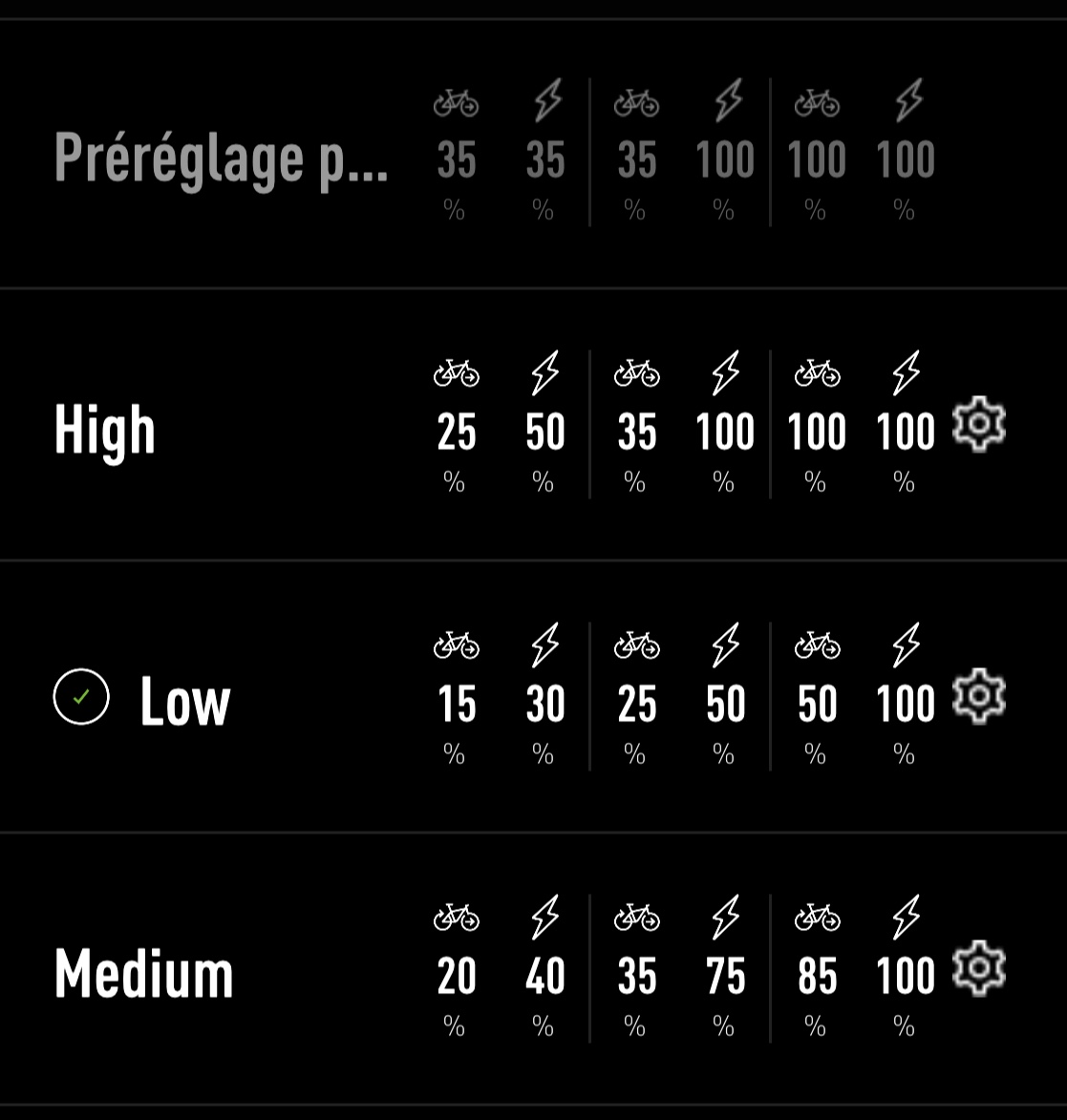
Here attached are my settings for a 2019 Turbo Levo.
Depending the type of ride I want to perform, or if I ride with an analog rider, I choose one of the 3 settings.
- LOW is quite similar to Levo SL settings (with more peak power). Perfect for sportive rides.
- MEDIUM is the one I prefer for around 50-60km / 700-1000m trails 18km/h average speed. I think it is quite similar to Bosch performance CX assistance levels, but with all the natural feeling of Brose motor !
- HIGH is initial default setting with ECO tuned. Perfect for fast and fun rides !
Hope this could help ?
Last edited:
brizi2003
Active member
Similar to mine... (Kenevo 2019)
SuperEco - long rides max range
The Lads - riding with Analogue bikes and fit riders (mainly used at ECO level)
Dan - Setup to match my son's Trek Powerfly. (ECO/EMTB/TURBO)
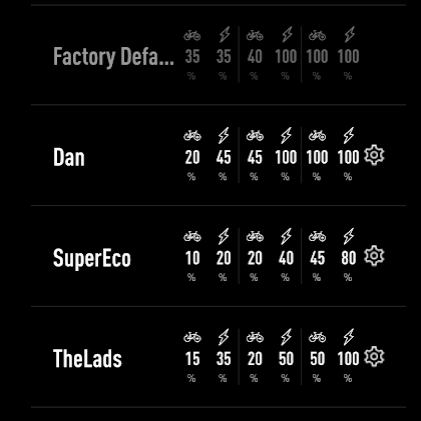
SuperEco - long rides max range
The Lads - riding with Analogue bikes and fit riders (mainly used at ECO level)
Dan - Setup to match my son's Trek Powerfly. (ECO/EMTB/TURBO)
Frenchy_Eric
Member
Update of my settings for a 2019 Levo (up to x4.1 assist / 90Nm torque)I don’t know if there is a more recent post concerning assistance levels sharing. But I found this one very instructive for my I own personal tries. I would like now share my own settings if it could help some people.
Here attached are my settings for a 2019 Turbo Levo.
Depending the type of ride I want to perform, or if I ride with an analog rider, I choose one of the 3 settings.
- LOW is quite similar to Levo SL settings (with more peak power). Perfect for sportive rides.
- MEDIUM is the one I prefer for around 50-60km / 700-1000m trails 18km/h average speed. I think it is quite similar to Bosch performance CX assistance levels, but with all the natural feeling of Brose motor !
- HIGH is initial default setting with ECO tuned. Perfect for fast and fun rides !
Hope this could help ?
View attachment 28306
- changed the names (more explicit in term of practice)
- added a Touring/Commuting setting
- decreased the Turbo assist level (too violent before)
Acceleration is set 60% for Touring, 20% for Sport and 0% for others.
Enjoy ?
Last edited:

maynard
E*POWAH Elite World Champion
Acc 80 eco 30 / 35 Trail 36/65 Turbo 51 / 100


