Real assist limit

Bufort

New Member
Joined
Mar 26, 2026
Messages
31
Reaction score
33
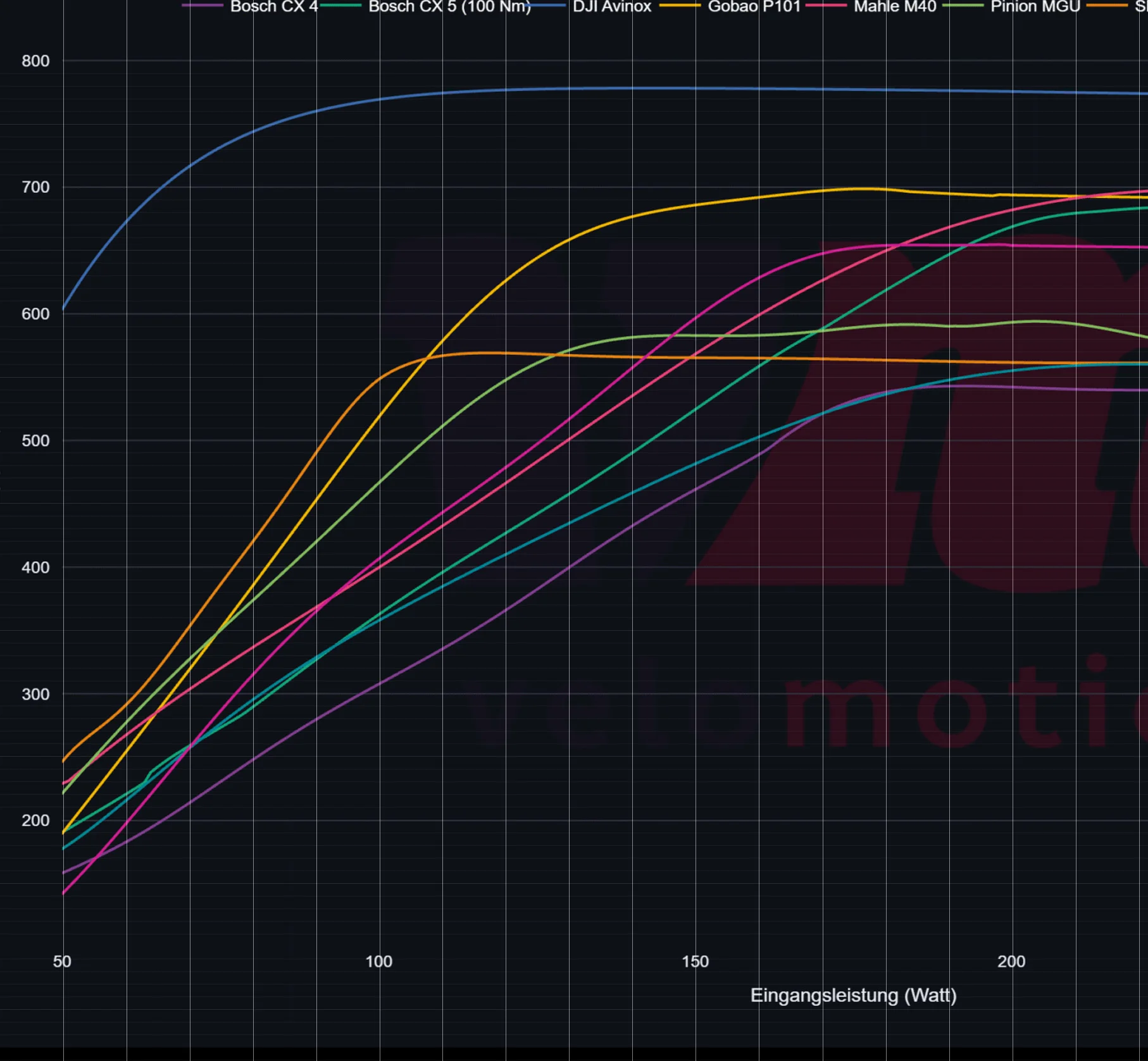
I've been looking at a lot of graphs about assist levels for various motors, and this one I just realised (which I've seen from more than one site) shows that you can get 600w assist from just 50w input, but that would make it 1200% assist.Avinox is supposedly 800% max assist. Which of these numbers are wrong?

This would be perfect for me as I calculated I need 600w to get back up the hill at a bike park, and I want to put in as little effort as possible. I don't need 1000w of motor power, I just need 600, but available instantly.
graph.webp
 
⚡ EMTB Pro Go Pro — exclusive discounts & ad-free Peaty's 25% off & more · Ad-free browsing · Pro badge See the deals →
Curious how you calculated you "need" 600w? An Avinox motor certainly will allow you to put in very little effort. Maybe only surpassed by those CYC or an emoto...
 
Curious how you calculated you "need" 600w? An Avinox motor certainly will allow you to put in very little effort. Maybe only surpassed by those CYC or an emoto...
Calculation based on total weight (me & bike), hill gradient and speed. You can then also add in length of climb to calculate the Wh used per climb, and then the total climb you could do with a specific battery size.
 
Last edited:
Calculation based on total weight (me & bike), hill gradient and length. You can then also calculate the Wh used per climb, and then the total climb you could do with a specific battery size.
If you have done the calculation. I'd be interested to see the actual maths including the equations used.
 
If you have done the calculation. I'd be interested to see the actual maths including the equations used.
Power = mass * gravity * speed * gradient
Power = (kg) * 9.81 * (m/s) * (0.2)
eg. 100kg bike & rider * 9.81 * 2.68m/s * 0.2 (20% gradient) = 525w

6mph is a speed I calculated based on my own test of a comfortable easy cycle in a gear/cadence that I would be able to do all day back to the top. Also need to factor in inefficiencies & inaccuracies of the climb, so I came to 600w.
 
Power = mass * gravity * speed * gradient
Power = (kg) * 9.81 * (m/s) * (0.2)
eg. 100kg bike & rider * 9.81 * 2.68m/s * 0.2 (20% gradient) = 525w

6mph is a speed I calculated based on my own test of a comfortable easy cycle in a gear/cadence that I would be able to do all day back to the top. Also need to factor in inefficiencies & inaccuracies of the climb, so I came to 600w.
Nice. Calculation checks out. 6mph is very slow on a 20% gradient though. So I understand why you don't want more power.
 
Nice. Calculation checks out. 6mph is very slow on a 20% gradient though. So I understand why you don't want more power.
Yep, but with the max assist ratios to go faster I would need to pedal more, and if I do that I won't be able to do as many runs. I'm after a free shuttle back to the top, the cycle uphill isn't part of the experience I enjoy.

If I were to use it to cycle all day for 20 miles then I'm sure it would be a different story, but this is basically just to replace my 10 minute pushup and 10 minute rest between runs.
 
Keep reading
    Browse all

    Similar Threads

    Community Stats

    Since 2018
    668K
    Messages
    40,770
    Members
    Join 30,000+ Riders, it's free!
    Back
    Top