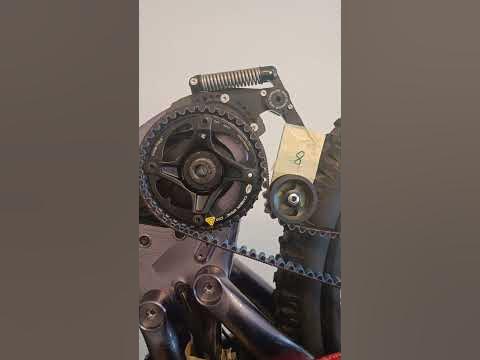
Ok, so it’s been awhile since I last contributed to this thread. The intervening time has been spent getting one of the very few Sonni’s up an running at the very moment Pole closed it’s doors (now, for good, at least as far as that business entity is concerned). Now that I’m comfortable with riding characteristics of the bike (and there’s a lot to share I’m sure when I write an eventual review of the bike) I’m returning the steps to get my bike into a belt-driven internally geared transmission. I hope this should prove interesting or useful despite that I’m working on a bike that nearly nobody else has. My sense is that a lot of this will transfer to other bikes and might be especially relevant to bikes with Bosch Gen 4 (perhaps Gen 5 as well) motor.
ASAIC, and I’ve mentioned this before, while belt-drive is not required to moving to a geared transmission, it is inextricably essential to having a geared transmission in the first place and there are too many benefits to belt transmission, not to mention a capability that is simply denied with derailleurs. So anything that gets in the way of incorporating a belt drive is simply a nonstarter.
Which gets me to the biggest obstacle of a belt drive solution for MTBs/EMTBs: the need for a spring tensioner, which does 2 important things that standard chains and derailleurs have done all along:
- Since belts sizes can’t be adjusted like chains can, there has to be a mechanism to take up slack and maintain tension on the belt. This can be statically provided by a fixed tensioner or also the design of the bike itself. Take your typical single speed bike - it may have a horizontal dropout or a sliding vertical drop out that allows you to move the back the rear axle to take up belt slack to obviate the need of tensioner at all.
- But unfortunately we have the problem introduced by dual suspension designs on MTBs/EMTBs: almost always the rear axle path of the rear suspension causes the chain length to grow as it progresses through the travel. It’s a dynamic problem that requires continuously varying spring tension on the belt. It’s interesting that suspension chain growth has never been an issue for suspension designers because the derailleur IS a spring tensioner - this critical gear shifting component is already there to take up the duty of taking up slack. But same cannot be said of IGH hubs, and so a spring tensioner is essential.
The other problem with spring tensioners (especially belt tensioners) is there is no standard by which they are designed, located, and implemented. Some of this has to do with the fact that internal geared transmissions are fairly rare to begin with mountain bikes and only a small batch of bike companies have MTB/EMTB dual suspension bikes expressly designed for geared transmissions. Those that do each have their own spring tensioner solutions, and admittedly some can be rather ungainly, intrusive, and heavy (when it comes to belts) or look too much like freaking derailleurs (when it comes to chains) - a clear aesthetic I want to be rid of in the first place.
But what of MTBs/EMTBs that were not designed for geared transmissions? Well there’s no choice but to either adapt an existing spring tensioner or craft your own. I’m in the former camp (I’m a software guy). But to adapt a spring tensioner requires that everything has to work: a firm mounting placement, the attachment, the space required, tension arm angle, etc. The best approach is to prototype solutions and choose the best one.
For the tensioner itself I chose the one made by Universal Transmissions, which is the tensioner used by Nicolai for the EBOXX and Saturn IHG/MGU bikes, and chose it for the following reasons:
- This tensioner has a transverse mount design so it can be tucked behind the motor so as to not protrude under the bike where it would otherwise be prone to damage from undercarriage bashing and rock strikes. A counter example here is the Pinion tensioner, which is exposed and rides along the bottom of the motor where a bash guard would normally go.
- The tensioner is not hard-designed for a particular frame, but rather is designed to swap out its mounting flanges. This design basically allows you to craft your own flanges to adapt the tensioner to your own bike.
- The current flanges that come with tensioner are designed (or at least I thought so) to mount to Bosch Performance CX Gen 4 motors , which the Sonni, as well as many other esteemed bikes have.
That said there are two downsides to this tensioner:
One is that’s it's heavy. I’m not sure why, but the tension arm appears to be some kind of
cast ferrous metal rather than CNC or forged alloy. A prior version had a
tension arm made of CNC alloy but the flanges were an intrinsic part of the tensioner casing, reducing its adaptability. Still I feel this is the best tensioner out there for the job. Hopefully future versions will bring about a lighter design.
And the other problem was the time and effort just trying to get one. Universal Transmissions does not directly market this tensioner (at least a few months ago this was the case). Rather, they rely on B2B relationships with bike manufacturers to spec the tensioner for their bikes, unless of course you were willing to buy, say a hundred of them. That said, I did find an indirect way to get the tensioner and if you are interested you can PM me and I can describe what I did.
Regarding the installation, I had hopes to just bolt the thing onto the Bosch motor, since the flanges were designed for this motor and because the Sonni has basically a naked motor bolted to the bottom of the bike frame as it’s signature (notorious?) design aesthetic, seemingly offering easy open access to mount the tensioner. Unfortunately this was not case, as the rear mounting point surfaces of the frame bulge out (for added strength I suppose) and threw off what could have been clean and simple mounting point opportunities. As such I had to design my own flanges.
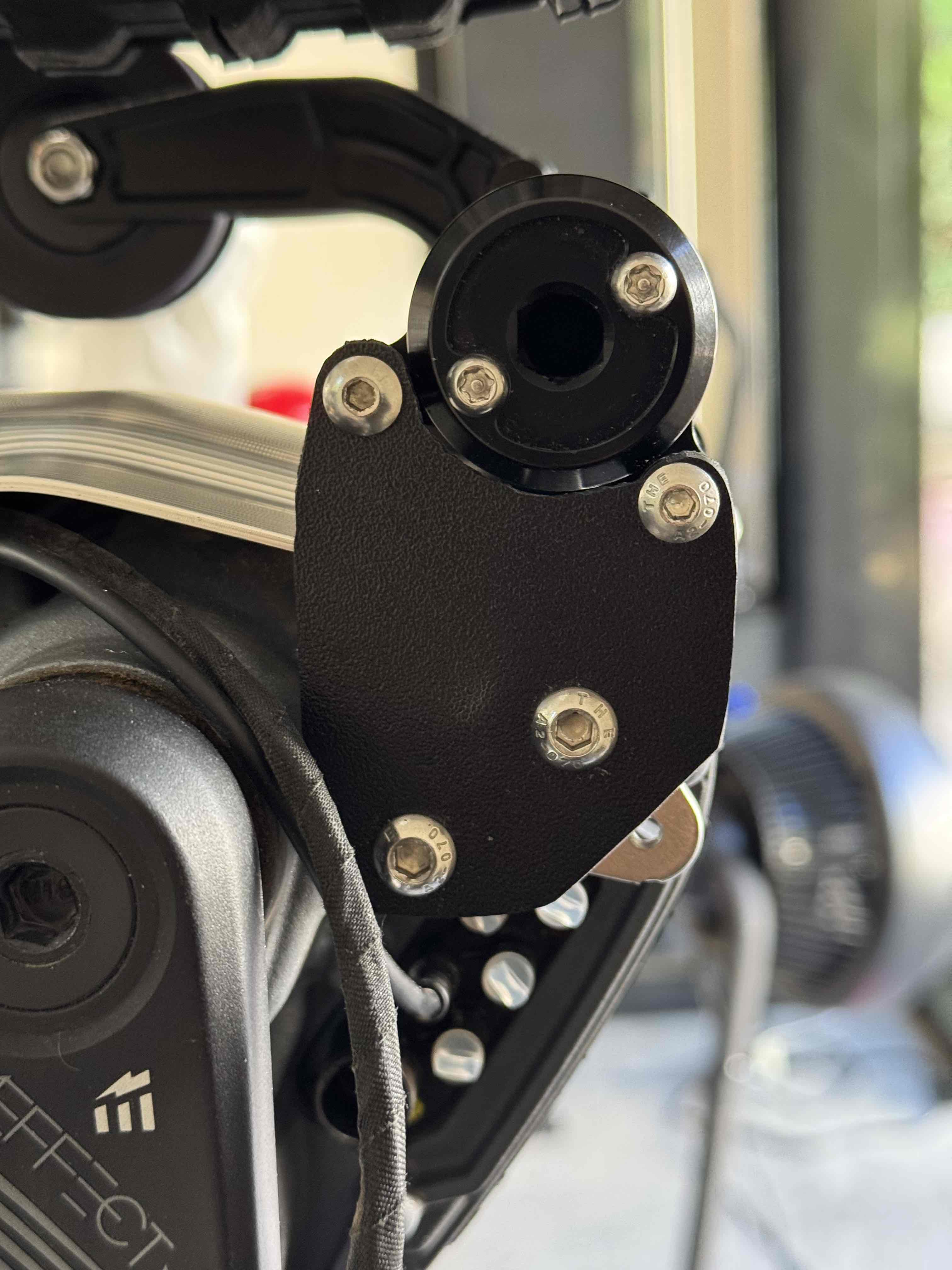
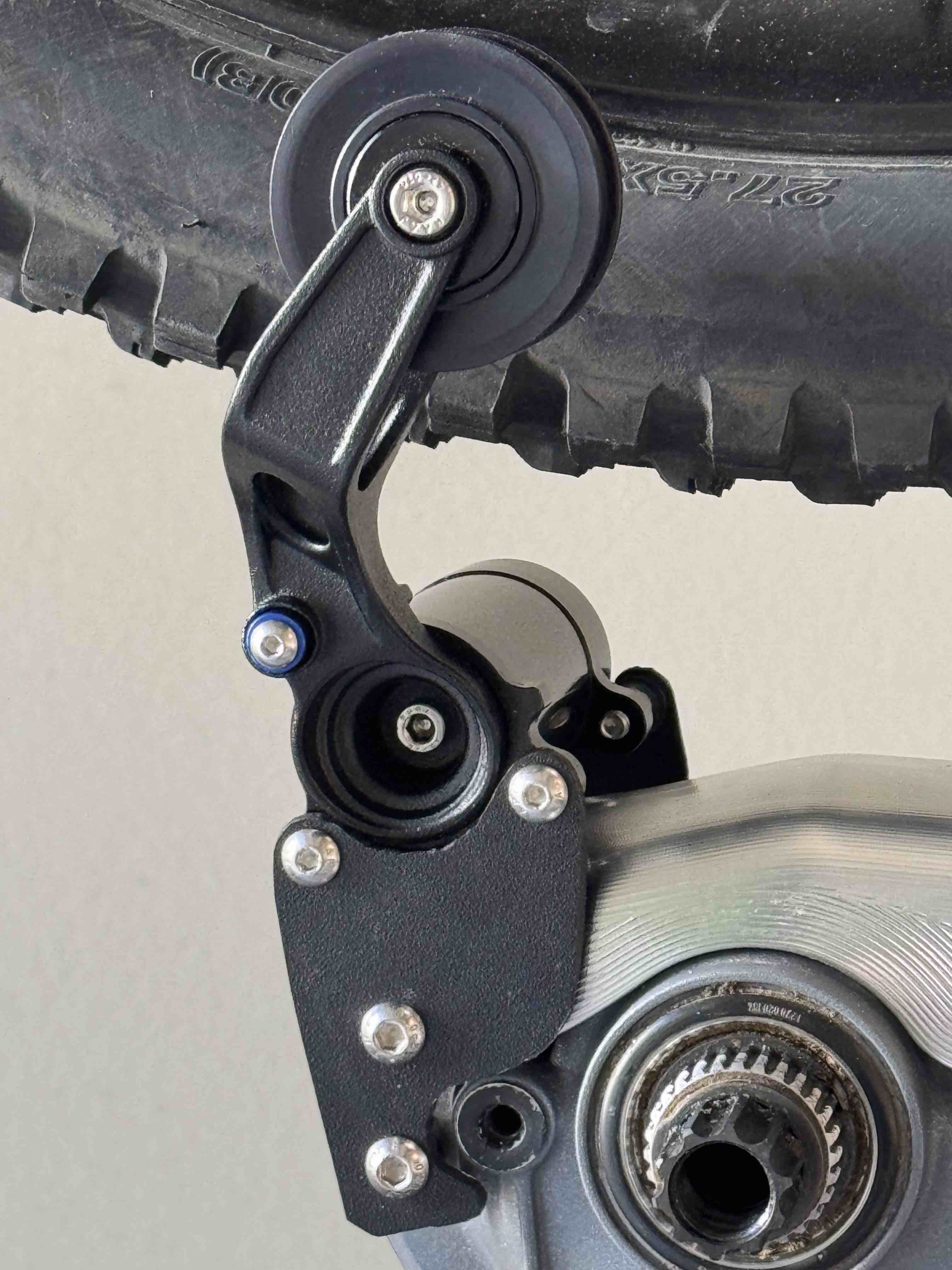
So for the adaptation design, I decided to go with a 1/8” 7075 alloy sheet, cutting it out (by hand or perhaps by laser) as a flange to be mounted to each side of the tensioner. For prototype purposes I used 1/8” ABS plastic sheet in place of the alloy sheet to try out and test various designs. Once I settle on a functional design, I’ll carve out the alloy versions, matching the shape of the plastic ones, which can be seen below.
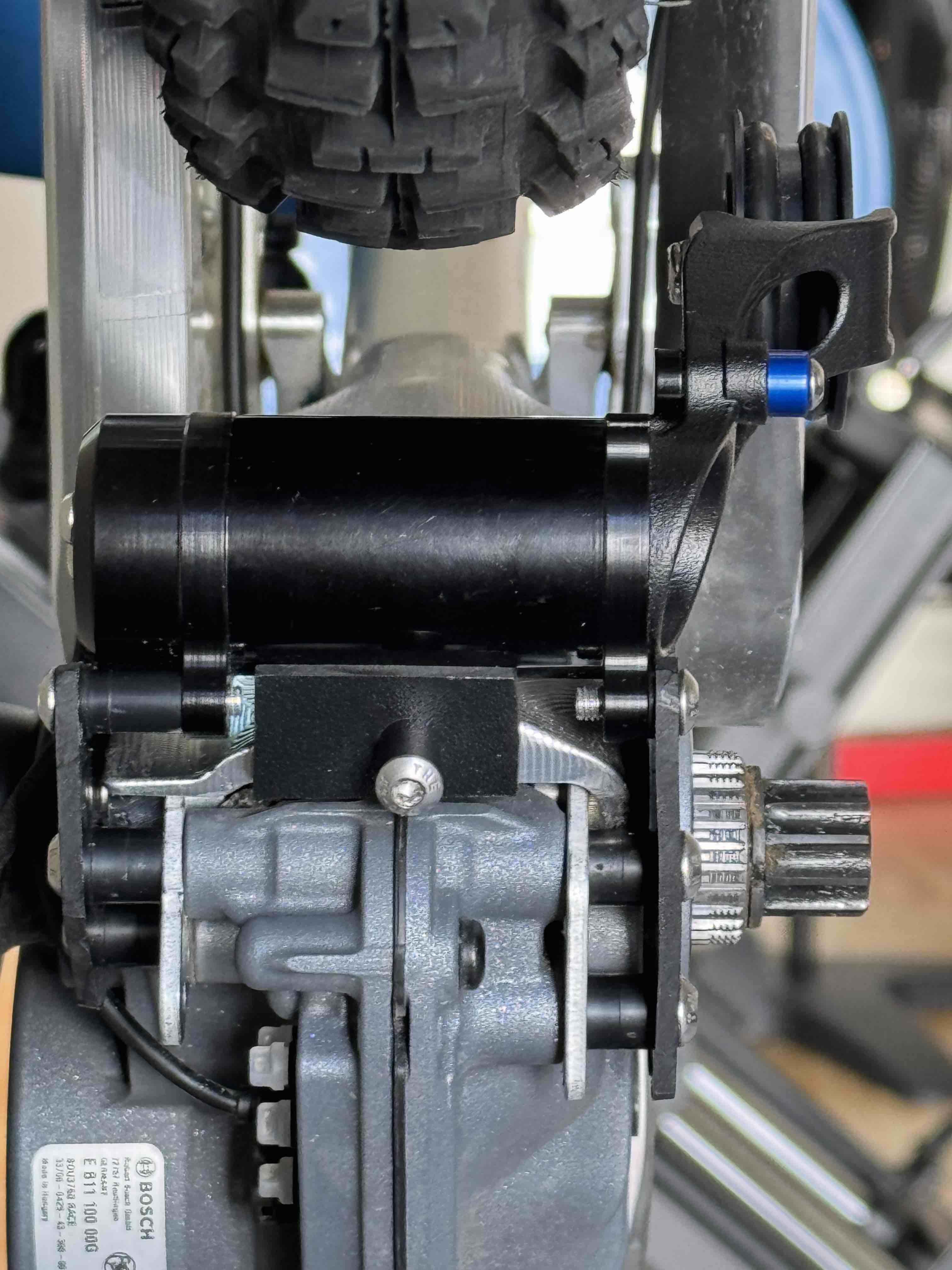
I used various-sized ABS plastic spacers and longer stainless bolts to stand off the flanges from the inner mounting plates of the motor. This was tedious process of trial and error to the get the offsets right to get the tensioner aligned with the Gates front sprocket with a 52mm chainline. Note that I avoided using the bolt motor mounts that attached the frame to the motor. Instead, the longer bolts replaced the ones used to attach the smaller stock alloy plate mounts to the motor. I also temporarily installed a back plate that was used as a small jig to keep the tensioner alignment true when I drilled holes into the plastic flanges. This plate will be removed in the final product.
Overall I think it looks pretty clean and looks like it will work. Which is important because the next steps involve purchasing the the internal gear hub, shifter, and associated components, which is a financial commitment I didn’t want to make unless this critical spring tensioner solution was in place.