KELLYS 2026: LIGHTEST FULL-POWER E-BIKE SYSTEM IN THE WORLD?

⚡ EMTB Pro Go Pro — Living Intelligence Reports, exclusive discounts & ad-free Up to 25% off Peaty's, PEMBREE, Magicshine & more · Ad-free browsing · Pro badge See the deals →
Impressive weight numbers however the controller/display offerings seem a little behind the curve. Cool that they are offering EU fabricated frames though (if I heard correctly).
 
The big motor players (i.e. Avinox, Bosch & Brose) all can easily blow past the 750w Class 1 limit.

The future is lighter smaller very efficient motors (i.e. Maxon) in combo with Solid State batteries that are designed to perform as Class 1 e-bikes only. We'll have proper Enduro spec e-bikes weighing 46-47#s in 2-4 years.
 
This is crazy if true
1758035943330.png
:eek:
 
By comparison, my Shimano EP8 weighs 3.51 kg and has 625 kw-hrs.

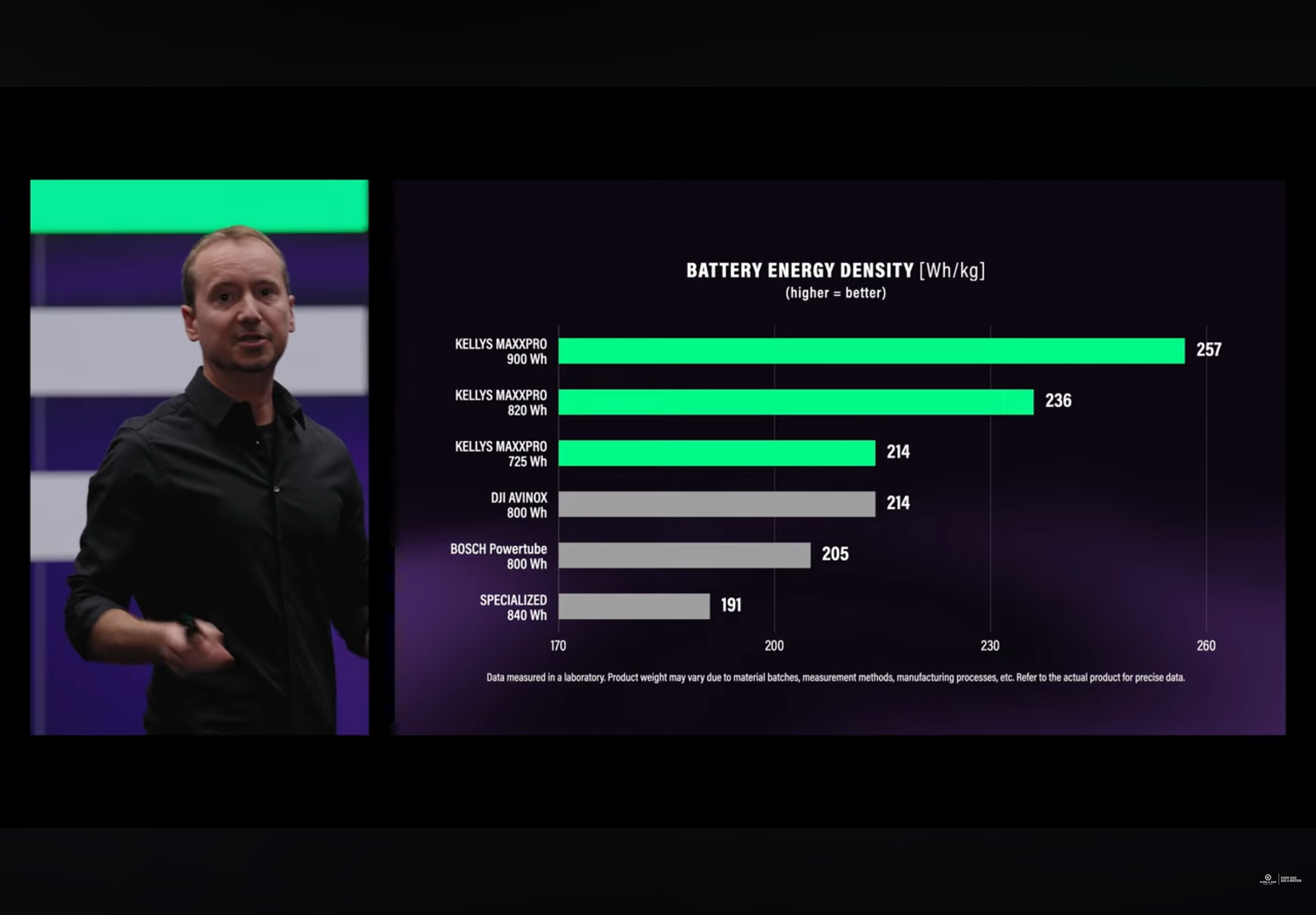
But note: The battery container is carbon fibre. Unless Kelly's have come up with a revolutionary new battery compound, then it is highly likely that all their weight gains (and hence their energy density claims) are delivered by having a lighter box to hold the battery cels. But still, they are the first to do so.
 
Last edited:
By the way whatever happened to their revolutionary frame material? Not aluminium, not steel, not carbon fibre, but steel fibre impregnated thermo-plastic (I might have got that wrong!) It was supposed to be as light as CF, and more resilient to knocks than even aluminium. Anyone know? It wasn't mentioned. It was supposed to be the big reason to buy a Kellys Theos.
 
Frame material... I find all of that weird!! Steel fibre.........nah, you can reduce steel to a wire but not a fibre. Carbon fibre is light...depending on the type of carbon fibre, that is correct but a frame or indeed any composite strcuture does not purely consist of a single carbon fibre mat. A high modulus uni directional ( UD) mat is probably the lightest option but then of course it needs to consist a number of layers and epoxy ...just how much of the epoxy is removed either by vacuum bagging or heat, determines how light the composite ends up. Even so UD only composite is strong only against compression along the fibres, not any sideway forces or indeed stretch and certainly not any impact. Then of course in order to make something like a bike frame, the entire frame needs to be either laid up in a mould or sections made and "glued" together. A fully hand made carbon composite frame is very expensive. The frame also has to accept steel or ally inserts with the very focused 360% forces they are likely to impose. That is why a well made bike frame is only marginally lighter than a modern ally frame where the thickness and shape of the tubes can be managed throughout the length of each tube. In other industries carbon composite is being constructed with other materials such as bamboo or where strength and impact resistance is a prime requirement, Kevlar. I dont see any information about what exactly bike brands composite frames consist of...or indeed any news of composite developments to help recycling of the frame etc. What i see on "naked" carbon frames is a plethora of patches and often the need to use filler at junctions.
So I stick to ally!!
 
I think we need to understand the weight difference due to the different materials used in the battery housing structure. It may be more down to the use of carbon fiber vs any major breakthroughs in energy density.
They say their batteries are at least 20% lighter than the nearest competitor. I wouldn’t have thought a carbon shell would count for such a big difference when you take into account the weight of the cells.
All interesting stuff though👍
 
They're claiming the new F100 (which is think is a 140mm rear/150mm fork bike) with a 900 wh battery will weigh under 46LBS!!! And the F90 170mm bike will be under 51LBS. That is a pretty stellar improvement both in weights and battery capacity compared to the status quo.
 
I talked about battery density here already where I said it's the battery housing material where the most weight saving is possible(unless a solid state battery is used), so the weights of these Kellys packs is no surprise at least for me, its just good👌engineering and probably a lot of testing for durability and safety.
Most battery packs are in a metal housing because of safety regulations and standards.

Thread 'Ebike Battery Pack Energy Density Talk' Ebike Battery Pack Energy Density Talk
 
140mm travel is pretty useless. We need more long travel beasts and the lighter weight is a bonus. I’d still prefer an MGU with a belt drive and long travel made as light as possible while still being durable.
 
I talked about battery density here already where I said it's the battery housing material where the most weight saving is possible(unless a solid state battery is used), so the weights of these Kellys packs is no surprise at least for me, its just good👌engineering and probably a lot of testing for durability and safety.
Most battery packs are in a metal housing because of safety regulations and standards.

Thread 'Ebike Battery Pack Energy Density Talk' Ebike Battery Pack Energy Density Ta
Yeah, your points make perfect sense to me. The puzzling thing I guess is why even on, for example, Bosch's 5th generation of motors, they'd still be using a battery with such an excessively heavy housing, but maybe this Kellys one is actually underbuilt, and wouldn't pass whatever durability and safety standards Bosch is targeting.

I do recall seeing someone doing a super light, weight weenie, e-bike build (maybe Dangerholm, but I might be wrong on that). They had "tuned" their stock battery pack, amongst other things, and showed how it had a multi-layer casing, with an outer aluminum layer that seemed to be at least somewhat redundant relative to the fiber reinforced plastic inner layer, so it was removed in pursuit of the lowest possible weight. I could imagine the outer aluminum layer being valuable to prevent punctures of the cells if they were struck by something sharp, but since the whole pack is housed in the downtube, it seems like the bike frame is already adding a very substantial level of protection/shielding. If Bosch is building to a standard for exposed battery packs, but then bike companies are using them for internal applications, that does seem like it leaves some room for optimization.
 
Their weight savings seem to grow with battery size, which doesn't make sense if the housing is the main savings. The larger the battery the less impact the housing should have, right?
 
Even if all the weight savings are from the casing, it's not some huge "gotcha" moment for me. I want a lighter battery, period. If a company can make such huge weight optimizations and produce a durable battery pack with proper warranty I'm questioning wtf are all the other supposedly highly advanced manufacturers doing that are selling their ebikes for 20k...
 
Their weight savings seem to grow with battery size, which doesn't make sense if the housing is the main savings. The larger the battery the less impact the housing should have, right?
I guess it depends, but I agree that their figures merit some closer scrutiny, and further distinction between the "housing" components.

Their connection hardware and end cap should be a flat, "off the top", savings, that should transfer between their three battery sizes, and as you seem to suggest, should not grow with battery size. I agree that this connection and end cap figure would have less impact as the battery grows (i.e. 100g of hardware off a 500wh battery vs. 100g of hardware off a 1000wh battery suggests that the savings would be 20% on the small battery but only 10% on the big battery).

Regarding the "sides" of the housing, I would expect that weight saving to grow proportionally with increasing battery size, once one has taken into account the connection hardware and end cap weight. If the majority of the savings are from the housing on the sides of the pack, not the connection hardware and end cap on either end, then the savings would actually grow with the battery, so as the battery got larger the "fixed costs" (sides and end cap) would have progressively less impact.

Does that make sense, or did I miss your point? If I missed your point, perhaps getting more specific about what you're seeing in their numbers vs. the competition would be helpful.
 
My DIY 882WH battery weighs 3.529 kg with a carbon wrap around the cells, wiring, BMS and mounting so this is not that amazing
Maybe this wasn't a concern for you, but I am curious if, when going the DIY route, you looked into the relevant regulations. If so, was there anything obvious that draws a distinction between Bosch (for example) and Kellys? I find myself pondering if Bosch is building their packs to meet a standard intended for external applications, despite modern e-bikes housing them internally.
 
Even if all the weight savings are from the casing, it's not some huge "gotcha" moment for me. I want a lighter battery, period. If a company can make such huge weight optimizations and produce a durable battery pack with proper warranty I'm questioning wtf are all the other supposedly highly advanced manufacturers doing that are selling their ebikes for 20k...
Exactly! That's what I am saying! WTF is up with Bosch, Specialized, Shimano, etc...who are on their 4th or 5th generation of batteries/motors, but seemingly can't keep up with an obscure company from Slovakia who is doing their own (liscensed) motor for the 1st time? I would love it if Kellys would do a follow-up putting a little more meat on the skeleton they laid out, or, alternatively, I'd like it if one of the big boys did a "debunking" type post regarding the Kellys system, if it's truly not as claimed.
 
1. Kelly's is a small bike brand. Don't have their number's but for sure it's small.
2. They tried in the past to bring "the next big thing" with the printed alloys / steel etc. It didn't pick up . Like at all...
3. The Panasonic motor is not their own, the only thing that appears to be their "own" is a designing a lighter casing battery made and sold by a chinese wholesale. Nothing ground breaking to this to be honest. Canyon tried it . Look where it got them.
4. Besides that, not sure what motor manufacturers can take from this, as it's not the lightest, not the most powerfull out there .
 
1. Kelly's is a small bike brand. Don't have their number's but for sure it's small.
2. They tried in the past to bring "the next big thing" with the printed alloys / steel etc. It didn't pick up . Like at all...
3. The Panasonic motor is not their own, the only thing that appears to be their "own" is a designing a lighter casing battery made and sold by a chinese wholesale. Nothing ground breaking to this to be honest. Canyon tried it . Look where it got them.
4. Besides that, not sure what motor manufacturers can take from this, as it's not the lightest, not the most powerfull out there .
When you say "Besides that, not sure what motor manufacturers can take from this, as it's not the lightest, not the most powerfull out there" I am assuming you are talking about the motor on it's own, as the motor and battery combo are claimed to be the lightest. I only saw total battery/motor system weights, so maybe I missed it in the vid, but where did you see just the motor weight on it's own? Also, does anyone know of any other brands using the Panasonic motor or this battery?
 
They're claiming the new F100 (which is think is a 140mm rear/150mm fork bike) with a 900 wh battery will weigh under 46LBS!!! And the F90 170mm bike will be under 51LBS. That is a pretty stellar improvement both in weights and battery capacity compared to the status quo.
I'm actually not sure it does improve things that much. I was expecting a lot better.

My teewing force with the 800Wh downstroked to 140/140 with alloy wheels, EDC tool, a jones bar, and XT DI2 (a quite heavy drivetrain) is 45lbs w/pedals. The teewing frame is about .5lb heavier than the amflow one, a carbon bar and wheels would shave another 1.5lb (I shit you not, this bar weighs 525g alone). The new fox 36 weighs only 180g more than the outgoing Fox 34 I'm using.

You could easily get down to a 42lb/19kg spec from the Teewing or Avinox frame using the 800Wh, and assuming you took the same scaling penalty for the 600 to 800 wh battery and scaled up to 900Wh, you are talking about adding ~0.5 kg, so still much under 46lbs/21kg.

Indeed, we've seen quite a few frame builds already hit the <21kg threshold with full sized motors and big batteries. The current Orbea Rise hits <44 lbs at 150/160mm travel with not class leading ep801 system and a 630wh battery even. The 210 dedicated extender weighs 2.2lb so it would be dead nuts 46lb for 840Wh.
 
I'm actually not sure it does improve things that much. I was expecting a lot better.

My teewing force with the 800Wh downstroked to 140/140 with alloy wheels, EDC tool, a jones bar, and XT DI2 (a quite heavy drivetrain) is 45lbs w/pedals. The teewing frame is about .5lb heavier than the amflow one, a carbon bar and wheels would shave another 1.5lb (I shit you not, this bar weighs 525g alone). The new fox 36 weighs only 180g more than the outgoing Fox 34 I'm using.

You could easily get down to a 42lb/19kg spec from the Teewing or Avinox frame using the 800Wh, and assuming you took the same scaling penalty for the 600 to 800 wh battery and scaled up to 900Wh, you are talking about adding ~0.5 kg, so still much under 46lbs/21kg.

Indeed, we've seen quite a few frame builds already hit the <21kg threshold with full sized motors and big batteries. The current Orbea Rise hits <44 lbs at 150/160mm travel with not class leading ep801 system and a 630wh battery even. The 210 dedicated extender weighs 2.2lb so it would be dead nuts 46lb for 840Wh.
Wow, that is cool to hear from an actual Teewing owner! I have seen the pics of the bikes at various bike shows, and I liked that they seemed to be similarly light to Avinox, but without the yoke mounted shock, however I was unsure if they really existed (and how they were holding up) in the wild. They seem like they could be a great option for people who want an Avinox motor, but think the Amflow frame might be a little too light-duty for them, and who don't want to step up to a Forbidden or Crestline due to either cost or weight (or excess travel) concerns.

Do you have a dedicated thread on your build? It sounds like you have put a lot of careful thought into your setup, and I'd love to hear more about it Also, I see you're in the USA like me, but I have never seen any sort of official USA based distribution or sales network for Teewing. Where did you get yours, and how was the buying process?
 
Keep reading
    Browse all

    Similar Threads

    Community Stats

    Since 2018
    675K
    Messages
    41,895
    Members
    Join 30,000+ Riders, it's free!
    Back
    Top