Understood. I am pretty sure that I am riding a lot harder and faster than you. I get KOMs and trophies on strava often and ever area/trail I ride. In the endurance capitol of the world. And i am not one of the fastest guys out there. Lots of guys faster. But on a 20 mile rough course i am hard to beat. MY POINT, I spend a lot of time between 15-20 mph as my bike is not derestricted. I climb hard. My average ride is 27 miles and 4000' of climbing, I dont use 12th gear as i hate the motor cutting in and out, so i keep a high cadence and use 10th and 11th a lot. I doubt the bike has ever been ridden in 1rst 2nd or 3rd even in the roughest terrain.
I have zero doubt that you ride harder and faster than me. I never claimed otherwise. If you cannot fit a larger chainring because it fouls the frame, then you are pretty much stuck. All you can do is to ensure that your chain is clean and properly lubed before every ride. Actually, there is one more thing that you can do: measure the chain length more frequently and replace at an earlier stage. you will use more chains, but may save money overall. And have better shifting as a side benefit.
Once chains start to extend in length they are showing signs of wear. The ideal is with unworn chain and gears. The rollers just sit in the teeth of the gears and are carried around without relative movement between roller and teeth. All the wear taking place at this time is between the pins and the inside of the rollers and between the pins and the side plates of the inner links.
But as the chain wears the pitch is no longer half an inch, but gets longer. As this happens, the chain tries to settle into place, but can't, so it slides up and down the face of the tooth. As wear progresses, this gets worse and the tooth can develop a hooked appearance, often called "shark finning". Also, the number of rollers in solid contact with the teeth on the gears goes down. The pressure on each tooth in solid contact goes up and the tooth material can get pushed to the side, causing burrs that can snag on the chain.
So, to minimise tooth wear and to minimise shifting problems, replace your chain earlier. This will require you to measure the chain more frequently. A gap gauge is no use for that as it is too coarse. The best thing is to remove the chain and lay it flat (I use my kitchen worktop on top of a layer of newspaper). Then pull the chain taut and measure pin to pin over 100 links with a metal tape measure. A new chain will measure 50". A worn chain at 0.75% will measure 50-3/8". With a tiny bit of care, you can easily measure to 1/32", so you can be accurate to 0.06%. It does not take long. At what point you choose to replace the chain will be a best guess on your part, at least to start with. But to save replacing the cassette and chain every 3-4 months, it could be worth it in time as well as money.

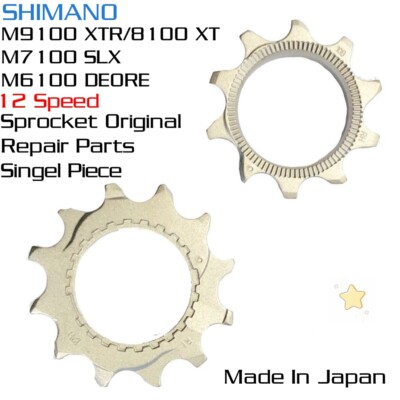
I just had another thought. If it is the smallest two gears that you are wearing out, just replace them. Shimano sell them, I think I have a link here: Yep!
The Model M7100 ,M6100 Can Also Be Matched. -Shimano Cog Sprocket Wheel 10T+12T Or 14T Or 16T. Now The 10 + 12t Are Xtr New Style Y1X498030. It Is Convenient And Cost-effective To Replace A Single Part.
www.ebay.co.uk