I followed the Maven since it came out about 2 years ago, and did some reverse engineering on it after initial impressions that they were awfully unbalanced. I want to lend some clarity to some of the confusion in this thread. All of this revolves around SRAMs idea of using a handle linkage cam called swinglink that takes linearity out of the lever stroke, altering the leverage curve from beginning to end stroke. Without swinglink (gray line in the graph), the leverage is close to the same throughout the stroke. WITH the original a1 swinglink cam in the handle, the first part of the stroke (see red line in the graph) moves lots of fluid, has a comparatively heavy breakaway force and very low hydraulic power. As the lever stroke progresses, past the pad contact point, clamping power is magnified (too much for many riders, especially on the rear) and there is a steep sudden rise in that red curve. This is what "impresses" a lot of people, the shear power increase appeals to the notion of more is better. Fair. The controversy spills out around whether this power is useful in that configuration, referring back to old wisdom, surplus power without control is not useful. I agree.
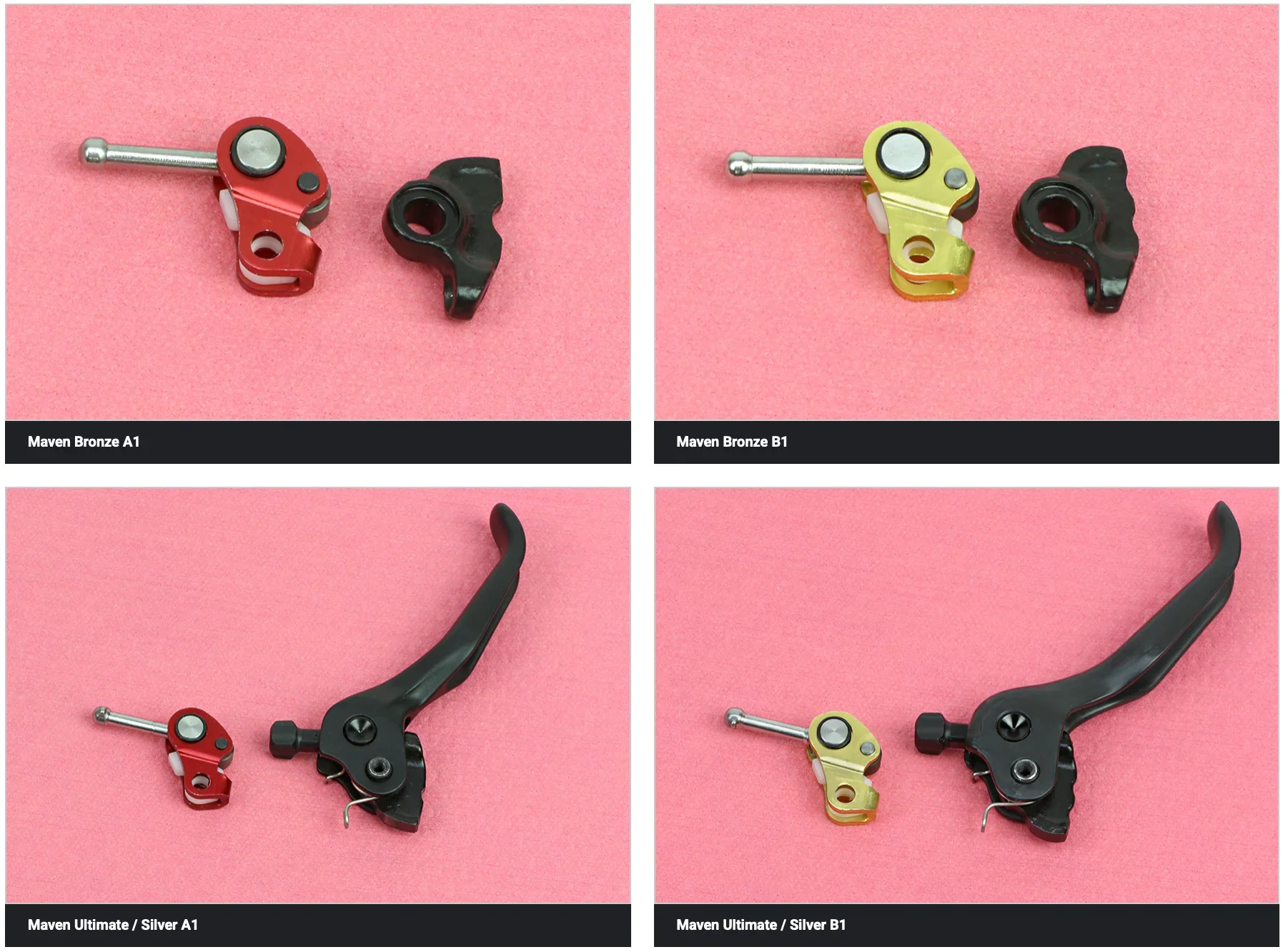
1. First point out of the way, Greg is a compelling idiot. He has lots of information, but also has dementia and is easily confused. The stuff he is quoted on earlier in this thread is AI gibberish. The a1 is the original "on-off" brake that has led to lots of conversation. The b1 is the new, refined, more modulating design recently released to the public.
2. There has been a lot of thread confusion when discussing lever breakaway force and modulation. The "Base" version Maven has NO SWINGLINK (SL) LINKAGE, so the controversy does not apply the the Base brakes. In fact the Base version is widely considered an improvement. The Bronze, Silver and Ultimate are impacted by the SL controversy.
3. ALL a1 linkage equipped (original) brakes have a 2lb (8 newton) breakaway force from the time they were released. THIS is the biggest element of controversy, ahead of Mavens moving bite point and "piston massage" requirement. That 2lb pull is the largest in the industry. The controversy is whether that impacts braking effectiveness from rider to rider. I personally assert that this is a design impediment to effective, intuitive single finger braking.
4. The swinglink (gold, red or whatever) linkage is the same approx design as the Code (black) swinglink, just more magnified in function.
5. IMPORTANT IN THE WHOLE lever feel debate. If you purchased new Mavens, or a bike with mavens, in the last few months, you may ALREADY HAVE the "improved" B1 linkage. This could be why you are on the side of this argument that just leaves you shrugging your shoulders. They simply feel and work in a way that feels familiar and may leave you puzzled about what everyone is talking about.
6. An a1 brake with the b1 upgrade kit does not have the same power as the new brake release, as claimed, however it is close enough for most people to not matter. It matters more if you are a BIG dude on a 60lb ebike. Mathematically the power increase of the original A1 equipped brake vs the latest b1 brake release (bronze, silver, ultimate) is about 8.5% due to different calipers pistons. The original larger 19.5mm caliper piston couple coupled with an 18mm in the original brakes makes the original A1 brake more powerful overall than the recently released dual 18mm caliper in the b1 brake. The new linkage kit does not change this.
7. The free stroke increase (undesired) of the upgrade kit is a result of the new linkage being less effective at moving fluid from the handle to the caliper. The same 8.5% hydraulic power disparity, yields commensurately more free stroke. More lever movement required to pad contact point. This can be compensated for in most cases by overfilling the caliper, I wont get into that here.
8. No, you cant swap only swinglinks around. The lever and SL design work together and go together.
Some thoughts. Going back to number 6, there is a case for using the newer (dual 18mm) caliper on the back, and older, stronger caliper on the front. The 9% less braking on the back will offer improved control in addition to using the kit to lessen the binary feel. Also food for thought, if you are going to find the strongest case for the upgrade kit, it is on the rear, for this and another reason explained here.
Several people like myself were loud about this brake when they first came out. One highly controversial video review was especially attention getting for Sram. My takeaway from the new kit is that Sram has acknowledged design mistakes and is trying to fix them here. They cut the breakaway force in half which is a big deal on 2 planes. If you ever spent 20 minutes on a long, moderately steep descent, say Porcupine Rim, it is self evident at the end of the run with reduced fatigue. More important to me, the traction control or "traction fidelity", particularly as felt on rear, is a clear improvement, and should leave anyone feeling safer on steeps. The higher lever breakaway force of the original brake (less finger fidelity if you will) makes it more difficult to not run into that brick wall of clamping power, IOW the original brake is easier to overshoot right into a rear tire lockup, noted by many many users
Master piston spring. The breakaway force with the B1 upgrade kit goes from 2 lbs to 1 lb. Considering that one of the next most powerful brakes (Dominion T4) dwarf even that number by 80% (3 oz breakaway), I still think there is improvement potential in using a lighter master piston spring, though that may require more trouble than sram was comfortable with. I also suspect that the spring was partly responsible for the bite point troubles many people were having. When combined with the aggressive swinglink, piston return was perhaps just too fast, possibly cavitating the piston area (bubbles coming out of solution), a hydraulic concept that I am going to avoid further describing. Sram seems to think that the new swinglink curve may address it just fine since it does slow down the rate of return of the caliper pistons. Somebody may dive into this theory with a spring company, probably not me.
Please feel free to sticky this.