STEPS E6100
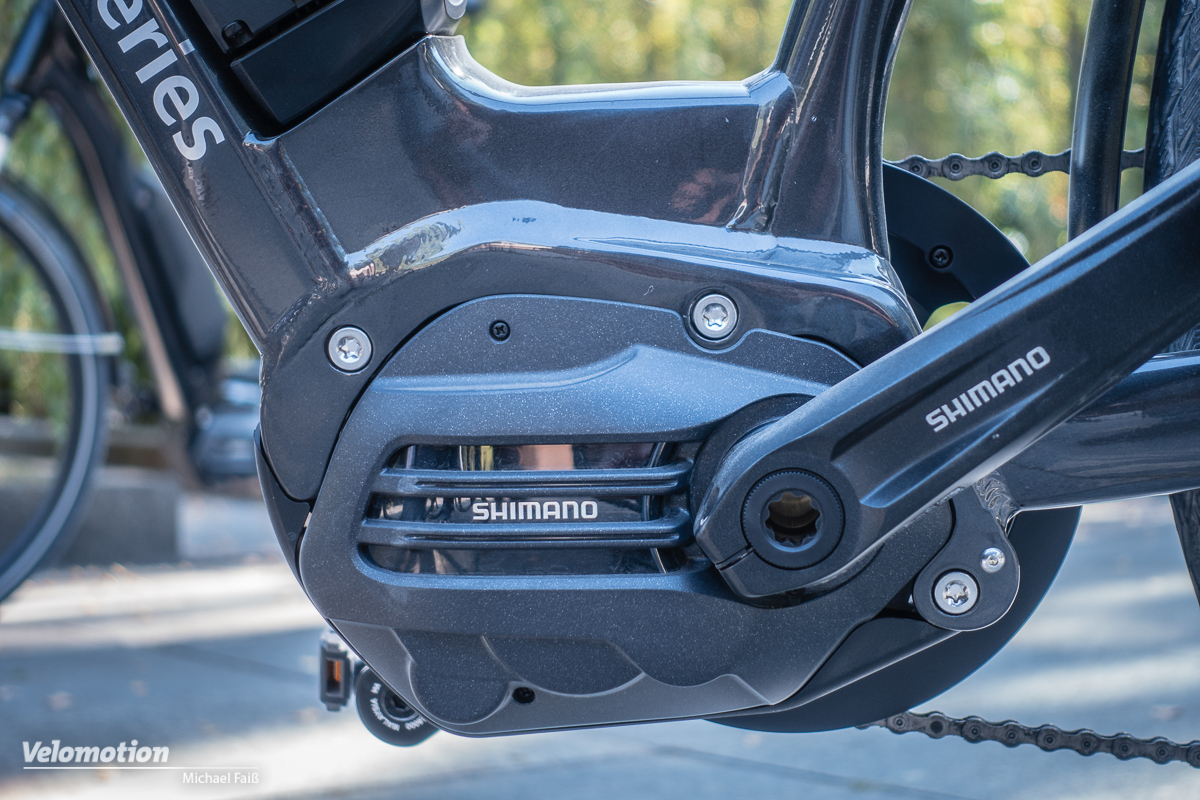
Shimano's 2018 city-and-trekking STEPS unit: 60Nm, 250W rated and a claimed ~500W peak in a 2.8kg casing, with up to 300% assist. Capable, quiet and frugal for commuting and light trails, but never intended as an eMTB motor.
Claim-based representative shape, NOT a measured dyno trace: a firm pull from low cadence up to the claimed ~500W peak, then a steady taper as rpm climbs. No independent dyno exists for this motor and Shimano publishes no power-cadence plot, so the exact cadence at which power peaks is not known — read the shape, not a specific rpm.
Shimano STEPS E6100 was Shimano's volume mid-drive for the masses: the trekking and city motor that sat below the sporty E8000 in the 2018 line-up. The numbers are modest by today's standards — 60Nm of torque, 250W rated and a claimed peak of around 500W, with a maximum support ratio of 300% in Boost (High) mode — but they were tuned for hauling a 22-24kg utility bike up everyday gradients rather than launching out of switchbacks. On that brief it delivers: testers found double-figure climbs trivial on a standard city build, with assist that arrives smoothly and matches rider input naturally rather than shoving.
The headline of the E6100 over the old E6000 it replaced was efficiency. Shimano claimed a 20% efficiency gain for the new casing, which the company says translates into roughly 20% more range from the same battery — its own example being a 50km bike becoming a 60km bike. That figure is a manufacturer claim rather than an independently measured result, so treat it as a direction of travel rather than a guaranteed number; on Shimano's own STEPS packs it means a 418Wh battery doing nearer the work of the old 504Wh, give or take, in matched conditions. It is also notably quieter than its predecessor, dropping to a near-silent whir in Eco and only developing a mild whine in Boost. At 2.8kg it shed 210g over the E6000 and tucked into the same mount as the E8000, so frame designers got a lighter, more efficient unit for free.
The compromises are exactly what you would expect from a city motor pressed into light off-road duty. Power tapers as cadence climbs and the assist cut at 25km/h is a touch abrupt despite STEPS' graduated drop-off. There is no independent dyno trace for the E6100 — it predates the bench-test era and was never a performance unit — so the power-cadence curve here is a representative shape built from Shimano's claimed figures, not a measured plot, and no specific cadence-of-peak should be read into it. Anyone wanting Shimano eMTB drive should look to the EP8/EP801 or the EP6 that superseded this; the E6100 is a commuter's motor that happens to handle a gravel path with composure.
Character
The case for and against
Strengths
- Light at 2.8kg (210g lighter than the E6000)
- Notably quieter than its predecessor
- Up to 300% assist in Boost — strong enough for everyday city/trekking gradients
- Claimed ~20% efficiency / range gain (manufacturer figure)
- Natural, well-matched torque-sensing assist
- No drag with the motor off
Compromises
- Only 60Nm / ~500W claimed peak — a tier below eMTB-grade drives
- Slightly abrupt assist cut at 25km/h
- Power tapers as cadence rises
- Non-serviceable; warranty-replace at this tier
- No independent dyno or noise measurement exists — specs are manufacturer-claimed