Using car carrier in the rain

Just out of curiosity, do electric cars (EV's) suffer water ingress in their motors also, or do they have heaters and/or venting? And how does it get in anyway, via the crank seals, harness entries or motor joints (gasket mating faces)? Or is it sucked in, not forced in, from a cooling motor reducing the internal atmospheric pressure (if any)? Or is condensation from normal but damp air already in the motor dropping out into condensation (again from cooling rapidly) when subject to spray, wind on the carrier?

It might surprise some folks, but all modern EVs have liquid cooled/heated battery packs, keeps them in the ‘just right/goldilocks’ zone temps wise when being used or charged, and they can be cooled or heated as required.

EV motors are environmentally sealed, but then weight and cost are less of an issue so can be done differently to that on an e-bike.

All the other electrics are as per any car, which are well developed now to deal with environmental challenges. If only e-bikes were the same! 🤔
 
⚡ EMTB Pro Go Pro — exclusive discounts & ad-free Peaty's 25% off & more · Ad-free browsing · Pro badge See the deals →
It might surprise some folks, but all modern EVs have liquid cooled/heated battery packs, keeps them in the ‘just right/goldilocks’ zone temps wise when being used or charged, and they can be cooled or heated as required.

EV motors are environmentally sealed, but then weight and cost are less of an issue so can be done differently to that on an e-bike.

All the other electrics are as per any car, which are well developed now to deal with environmental challenges. If only e-bikes were the same! 🤔
Yep...never mind the cost or indeed the reliability of those systems as long as lithium batteries in EVs can be charged as fast as possible ....from a engineering point of view, that ultra fast charging leads to premature battery demise, and the correct solution for safe charging is for the chargeing to be switched off if the battery gets too hot.....or indeed is too cold. Overall I do not think EVs can be held up as examples of good engineering any more than our bikes!!
 
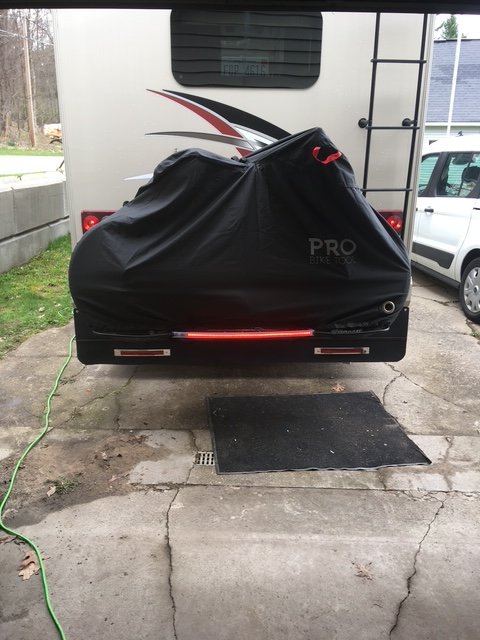
We don't have a towed yet so we picked up a PRO Bike travel cover.
My e-fatty and wife's e-Giant bagged. We remove batteries, sticky plastic wrap
battery terminals, old mittens on bar ends & remove outside petals for wind chafing.
Cover blocks tail lights, needed Hollywood light bar (very bright) and rain cover when
we are on camp site stay. 73516485984__43F95555-0AA3-42B2-BF00-A2A568E96B30.JPG
 
Yep...never mind the cost or indeed the reliability of those systems as long as lithium batteries in EVs can be charged as fast as possible ....from a engineering point of view, that ultra fast charging leads to premature battery demise, and the correct solution for safe charging is for the chargeing to be switched off if the battery gets too hot.....or indeed is too cold. Overall I do not think EVs can be held up as examples of good engineering any more than our bikes!!

I’ve been driving EVs of some sort or another for over a decade, I just changed my ‘old’ VW ID.4 that had 100k miles/160k Km on it, working perfectly, still getting the same range as on day 1 and still doing sterling service with a new owner.

The warranty on the battery is 100k miles/8 years, they are an order of magnitude better engineered and built to last than any e-bike battery.

With the larger battery packs these days, charging them at rapid charge rates barely gets them into 1C territory so not hard on them especially when thermally managed at the same time. Even very high rapid charge rate EVs barely hit 2C and then for not very long.

The thermal management aspects you talk about is exactly what happens, as I approach a rapid charging stop, my car tells me what the maximum permissible charge speed will be regardless of the speed of the charger I’m about to plug into. If the battery is colder than ideal, it will be slower until the act of charging has warmed it up, likewise the rate/current is slowed if the battery is too warm. The BMS on a modern EV is very clever and critical to its performance and longevity. One of the reasons I find them interesting from a technical point of view.

All the evidence points to EV batteries being far more long lived than many people thought, who up to this point have only ever experienced their phone, bike or laptop battery build quality and lifespan as a comparison.

Any EV battery or motor should easily have a comparable lifespan to an engine and gearbox, people compare them to early EVs like the original Nissan Leaf which wasn’t a modern EV battery.
 
I’ve been driving EVs of some sort or another for over a decade, I just changed my ‘old’ VW ID.4 that had 100k miles/160k Km on it, working perfectly, still getting the same range as on day 1 and still doing sterling service with a new owner.

The warranty on the battery is 100k miles/8 years, they are an order of magnitude better engineered and built to last than any e-bike battery.

With the larger battery packs these days, charging them at rapid charge rates barely gets them into 1C territory so not hard on them especially when thermally managed at the same time. Even very high rapid charge rate EVs barely hit 2C and then for not very long.

The thermal management aspects you talk about is exactly what happens, as I approach a rapid charging stop, my car tells me what the maximum permissible charge speed will be regardless of the speed of the charger I’m about to plug into. If the battery is colder than ideal, it will be slower until the act of charging has warmed it up, likewise the rate/current is slowed if the battery is too warm. The BMS on a modern EV is very clever and critical to its performance and longevity. One of the reasons I find them interesting from a technical point of view.

All the evidence points to EV batteries being far more long lived than many people thought, who up to this point have only ever experienced their phone, bike or laptop battery build quality and lifespan as a comparison.

Any EV battery or motor should easily have a comparable lifespan to an engine and gearbox, people compare them to early EVs like the original Nissan Leaf which wasn’t a modern EV battery.
huge number of recalls of ID4 due to battery faults........try buying a new one, I doubt you will find one for sale. Pleased you were lucky with yours. There are hundreds of 2l diesel cars up to 20 years old on the road with 200k miles on the clock still returning 45/50 mpg. Thats longevity, reliability, and proven engineering design!!
 
huge number of recalls of ID4 due to battery faults........try buying a new one, I doubt you will find one for sale. Pleased you were lucky with yours. There are hundreds of 2l diesel cars up to 20 years old on the road with 200k miles on the clock still returning 45/50 mpg. Thats longevity, reliability, and proven engineering design!!

I take it you’re not a fan of EVs, which is fine by the way. It’s not my job to convince you otherwise, but not sure where you’re getting your information/experience?

I could get an ID.4 for delivery any time, but went for an ID.3 again this time around.

My EV history since 2014 is a BMW i3, a Golf GTE, an e-Golf, an ID.3 1st Edition in 2020 (initial software terrible, updates sorted it by the time I traded it in 2022), ID.4 GTX and now an ID.3 GTX. My wife purchased her first EV in 2021, a Tesla M3 LR and now has a Kia EV3 since this year.

All of them have been totally reliable and never let us down, I drive 25k miles a year, my wife about 15k, all have been cheap to run (if not to buy), but at least give me some credit for having some real world EV experience. My ID.4 had the battery check, all modules fine and any that weren’t would have been replaced anyway, it’s what the warranty is for.
 
Last edited:
As I said I am pleased you have had a good experience...indeed lots of us get a lot of enjoyment from our EMTBS. My point is however a bout engineering design, integrity etc. There is no way given a free choice that the European motor industry would have chosen EV technology simply to achieve lower CO2 emissions. The technology and specifically battery technology is too expensive and non sustainable, meaning high prices, range anxiety, and mostly high cost inadequate public charging facilities. The net results has been catostrophic for the motor industry. They make very little if any margin per car sold, and sales have remained low, quite simply because the market has far better existing products, even if those vehicles are getting older.
VW as an example has gone from a large positive cash flow to a negative and is closing factories and negotiating with workers to accept pay cuts to a void mass redundancies. It s senior management has determined it can only survive another 2 years without massive restructuring and cost cutting. Meanwhile the subsidised/cheap labour Chinese products are a bout to flood the market. Add to all of that doomsday scenario for the industry, few if any national power grids can cope with a wholesale take up of EVs..............thankfully that has not happened yet.
So, OK all of that may sound like "anti EV". Its not. It is recognition that EVs are not the right engineering solution, or indeed national economic solution. Even as far as the "global warming/Co2" narrative is concerned, Co2 emissions and global warming have continued increasing regardless ( for predicatable climatic reasons).
 
Keep reading
    Browse all

    Similar Threads

    Community Stats

    Since 2018
    669K
    Messages
    40,854
    Members
    Join 30,000+ Riders, it's free!
    Back
    Top