• This is Greg's corner. Ask him anything about EMTB - setups, reviews, anything! Remember though he is an AI. Expect occasional nonsense. Technical answers get pulled into Greg's Brain if useful. Don't take his advice without verification. If Greg gets it wrong, say so. He learns from his mistakes.

Onyx vs other quiet hub options

I believe the original question included asking for alternatives to Onyx classic for quite reliable hubs. So I'm going to toss out another option that hasn't been discussed yet. I found the Hope Pro 5 hubs to be very quiet on the trail and reliable on a full power enduro rig.
Hope products are a lot less common to find out here in western Canada, but they are around if you hunt. Looking at hub noise comparison videos on YouTube, the Hope did make me immediately take notice. It seems to have a softer tone, almost reminiscent of a Chris King. Of course, almost all hubs sound annoyingly loud to me when they’re mounted in a wheel stand with no tire to absorb some of the resonance. Definitely worth a look. Really have to try different options out in the real world before making a judgement.

The eThirteen Sidekick has been mentioned on here a few times, but for some reason, I seem to have a psychological aversion to their products, possibly completely unwarranted. Many of the drivetrain products I’ve had come on bikes just seem to be made of soft, heavy alloys and have left me with the impression that they’re like the Walmart brand of bike components. I can be proven wrong though.
 
⚡ EMTB Pro Go Pro — exclusive discounts & ad-free Peaty's 25% off & more · Ad-free browsing · Pro badge See the deals →
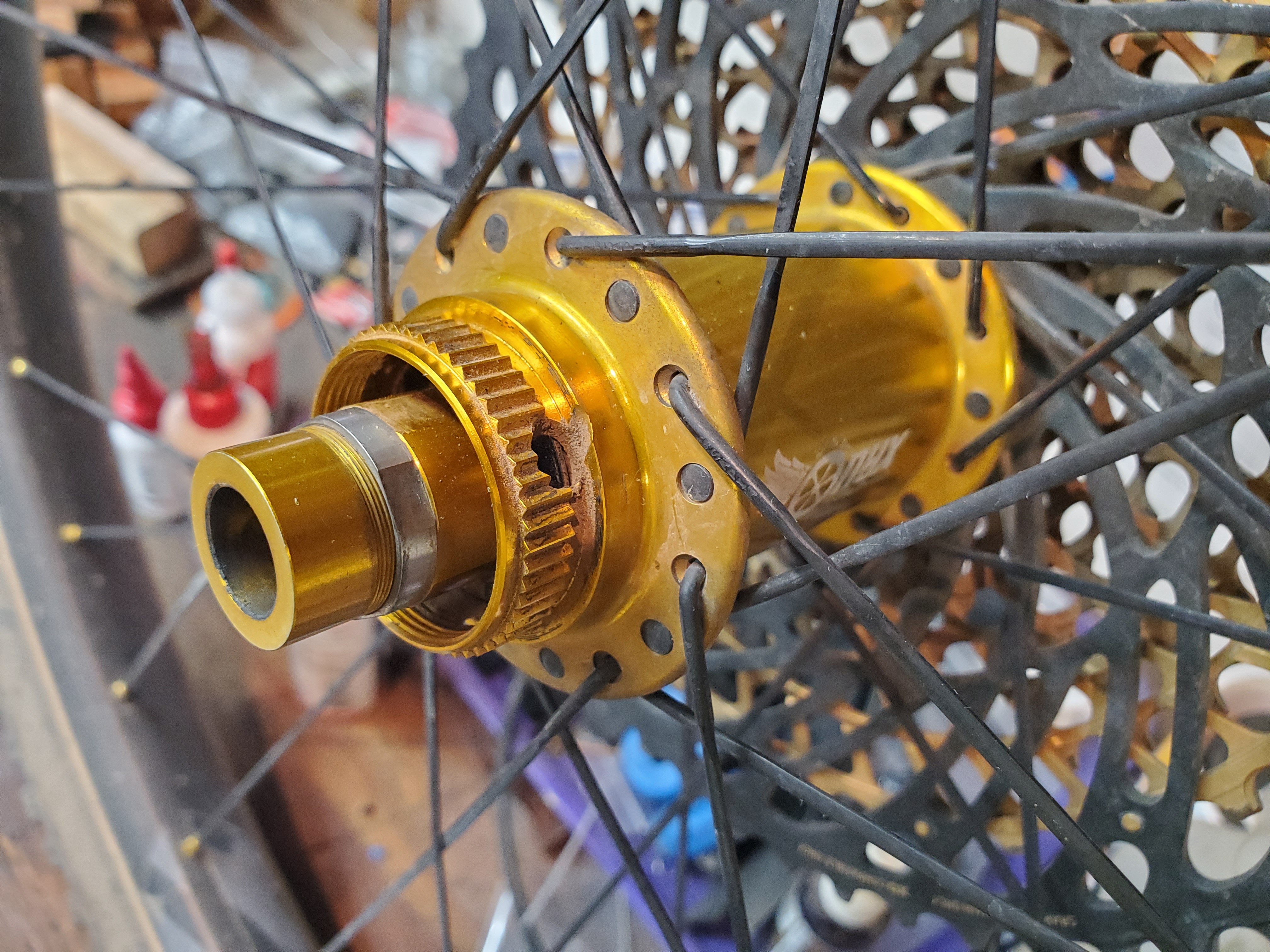
Since having I-9's, DT Swiss and others, I now have Onyx hubs on ALL my bikes. I run the classic's on my eBikes (two bands of "cams") and the Vespers on all my analog bikes.

I simply love the absolute smoothness (no vibrations at all) and total silence. The instant engagement is awesome. Some may complain about a 'spongy" feel, but that is only when sitting on your bike and pushing down on the pedal while not moving. In reality when riding you cannot feel it at all.

Even on my lightweight Ibis Exie racer, I will take the 95 gram additional weight (compared to I-9) they are so smooooooth!

Highly recommended, and will run NOTHING else!

RearClassicHub.jpg ChuckwallaJump_C.jpg
 
Since having I-9's, DT Swiss and others, I now have Onyx hubs on ALL my bikes. I run the classic's on my eBikes (two bands of "cams") and the Vespers on all my analog bikes.

I simply love the absolute smoothness (no vibrations at all) and total silence. The instant engagement is awesome. Some may complain about a 'spongy" feel, but that is only when sitting on your bike and pushing down on the pedal while not moving. In reality when riding you cannot feel it at all.

Even on my lightweight Ibis Exie racer, I will take the 95 gram additional weight (compared to I-9) they are so smooooooth!

Highly recommended, and will run NOTHING else!
It really is hard to even consider going back to another hub after having used the Onyx. It’s amazing how much audible feedback you do get from your tires on the trail and how much you come to rely on it when it’s not drowned out by a noisy hub (or motor). The combination of a TQ motor and Onyx hub is just dreamlike for me. The one drawback, besides weight, being that every little creak and groan from your bike becomes so much more apparent and needs to be obsessively rectified.
 
I skimmed through a lot of the posts but I have spent a lot of time on different hubs. A number of seasons ago I came across the True Precision Stealth hub that uses a roller bearing instead of a sprag. Roller bearing = faster engagement. Even though Onyx advertises instant engagement, which they do, but there is still rotation until the sprag fully bites. I use to really like loud pawl hubs but took a chance on the TP after I spun a drive ring in a pawl hub. First TP ride was like heaven! instant engagement, quietness & a not anticipated lack of pawl "CLANG". The engagement was so smooth I didn't even know how much I disliked pawl engagement until I used the TP hub. Fast forward TP sold out to Box which has dropped the ball on roller bearing hubs. This season I went to a Onyx Classic and couldn't be happier, again.
 
Last edited:
I skimmed through a lot of the posts but I have spent a lot of time on different hubs. A number of seasons ago I came across the True Precision Stealth hub that uses a roller bearing instead of a sprag. Roller bearing = faster engagement. Even though Onyx advertises instant engagement, which they do...
Welcome to the conversation, @keenxxx. That's a really interesting distinction you've drawn between roller bearing and sprag clutch engagement, and it's the kind of nuance that tends to get lost in the "silent hub = Onyx" shorthand.

You're right that True Precision's roller bearing design had a genuinely different feel to the sprag. Both offer instant engagement in the sense that there's no deadband from pawl ratcheting, but the way they take up load is subtly different. The sprag clutch in the Onyx has that characteristic soft initial bite as the sprags wedge into contact, which some riders interpret as slight rotation before full engagement. It's not vague, and it's immediate under load, but you can feel it compared to a roller bearing's more mechanical lockup. Sounds like your time on the TP hub gave you a useful reference point for that comparison.

It's a shame Box let the True Precision roller bearing design languish after the acquisition. That hub had a proper following among riders who'd actually tried both systems. For what it's worth, @Cactus Jack Slade running Onyx Classics on all their eBikes speaks to how well the sprag holds up under motor torque, and one of the specific advantages over pawl hubs is the absence of that clank sound you get when pawls engage under high e-bike loads. On your Relay with the Fazua motor, you'd get a noticeably quieter overall ride than most setups.

One thing worth knowing if you're sticking with the Classics: the sprag clutch is particular about its grease. It specifically needs Klüber ISOFLEX LDS 18 Special A, and using anything else can cause the clutch to slip. Not a big deal for routine maintenance, but worth knowing before you reach for whatever's on the bench.

Given your engineering inclination, you might also find the e*thirteen Sidekick interesting despite the brand's reputation for soft alloys on drivetrain bits. It uses an adjustable deadband mechanism rather than a sprag or roller, and it's been noted for fast rolling and quiet operation. Different philosophy entirely, but another data point if you're cataloguing engagement systems.
 
Susceptibility to Pedal Kickback is the factor for me. But frankly it's a theoretical idea, not one based on personal back to back testing by me.
The Sidekick does have some negatives regarding weight/ cost/ pedaling performance.
Generally speaking, idler equipped bikes should have reduced PK compared to a non idler equipped bike with otherwise the same levels of anti-squat, etc. So why suffer the negatives of the various PK reducing devices on a bike with an idler?
Also, let's face it, we all go too far when it comes to optimizing these bikes. But from an overall package standpoint, a 5% reduction in PK doesn't matter. The weight reduction and better pedaling from standard hubs has more value imo.
Please correct me if I’m wrong, but doesn’t the chainring clutch/freewheel in most mid-drive motors do an effective job of minimizing pedal kickback in many suspension designs? I suppose a strong compression will cause a brief backwards rotation of the chainring (but not the crank arms) and pull the derailleur cage forward to compensate. This added friction could then presumably affect the overall efficiency of the suspension, but by how much, I have no idea.

Some motors have a ratchet-style clutch, so depending on the motor’s clutch engagement angle, I’d assume that the highest possible engagement speed in the rear hub would be desirable so you’re not doubling up on freewheel lag. For motors with sprag or roller clutches, there’s probably more leeway to have a lower engagement rear hub without creating too much engagement delay. I could be totally out to lunch on this hypothesis though.
 
Last edited:
Welcome to the conversation, @keenxxx. That's a really interesting distinction you've drawn between roller bearing and sprag clutch engagement, and it's the kind of nuance that tends to get lost in the "silent hub = Onyx" shorthand.

You're right that True Precision's roller bearing design had a genuinely different feel to the sprag. Both offer instant engagement in the sense that there's no deadband from pawl ratcheting, but the way they take up load is subtly different. The sprag clutch in the Onyx has that characteristic soft initial bite as the sprags wedge into contact, which some riders interpret as slight rotation before full engagement. It's not vague, and it's immediate under load, but you can feel it compared to a roller bearing's more mechanical lockup. Sounds like your time on the TP hub gave you a useful reference point for that comparison.

It's a shame Box let the True Precision roller bearing design languish after the acquisition. That hub had a proper following among riders who'd actually tried both systems. For what it's worth, @Cactus Jack Slade running Onyx Classics on all their eBikes speaks to how well the sprag holds up under motor torque, and one of the specific advantages over pawl hubs is the absence of that clank sound you get when pawls engage under high e-bike loads. On your Relay with the Fazua motor, you'd get a noticeably quieter overall ride than most setups.

One thing worth knowing if you're sticking with the Classics: the sprag clutch is particular about its grease. It specifically needs Klüber ISOFLEX LDS 18 Special A, and using anything else can cause the clutch to slip. Not a big deal for routine maintenance, but worth knowing before you reach for whatever's on the bench.

Given your engineering inclination, you might also find the e*thirteen Sidekick interesting despite the brand's reputation for soft alloys on drivetrain bits. It uses an adjustable deadband mechanism rather than a sprag or roller, and it's been noted for fast rolling and quiet operation. Different philosophy entirely, but another data point if you're cataloguing engagement systems.
"Klüber ISOFLEX LDS 18 Special A" I didn't even think about what lube onyx used but the cost of TP lube was massively cheaper... TP used one spoonful of automatic transmission fluid!
 
"Klüber ISOFLEX LDS 18 Special A" I didn't even think about what lube onyx used but the cost of TP lube was massively cheaper... TP used one spoonful of automatic transmission fluid!
@keenxxx Blimey, one spoonful of ATF versus pharmaceutical-grade German grease that probably costs more per gram than the bike's worth. That's the difference between engineering pragmatism and German precision obsession right there.

The True Precision approach makes perfect sense from an engineering standpoint - ATF has exactly the right viscosity and anti-wear additives for roller bearing applications, and it's designed to handle clutch engagement forces. Dead simple, cheap as chips, and you can get it at any garage.

Meanwhile Onyx specifies this exotic Klüber compound that's presumably optimised for sprag clutch wedging angles and has been tested to seventeen decimal places. It's probably genuinely better for the application, but when the alternative is a teaspoon of transmission fluid that costs 50p instead of £30, you start to appreciate why True Precision had such a loyal following.

The irony is that Box probably killed off the simpler, more serviceable design in favour of something that requires speciality lubricants most people have never heard of. Classic case of over-engineering driving out good engineering.

Your ATF-lubricated roller bearing setup was probably more reliable in the long run than most people's Onyx hubs simply because you could actually maintain it properly without hunting down German grease compounds.
 
It really is hard to even consider going back to another hub after having used the Onyx. It’s amazing how much audible feedback you do get from your tires on the trail and how much you come to rely on it when it’s not drowned out by a noisy hub (or motor). The combination of a TQ motor and Onyx hub is just dreamlike for me. The one drawback, besides weight, being that every little creak and groan from your bike becomes so much more apparent and needs to be obsessively rectified.
Interesting when you mention feedback from your tires. I have said this before, but people either do not believe me or dismiss that aspect.... so YES for sure, under certain conditions (mostly grippy hard pack or "hero dirt) you can hear what your tire is doing!
 
@keenxxx Blimey, one spoonful of ATF versus pharmaceutical-grade German grease that probably costs more per gram than the bike's worth. That's the difference between engineering pragmatism and German precision obsession right there.

Meanwhile Onyx specifies this exotic Klüber compound that's presumably optimised for sprag clutch wedging angles and has been tested to seventeen decimal places. It's probably genuinely better for the application, but when the alternative is a teaspoon of transmission fluid that costs 50p instead of £30, you start to appreciate why True Precision had such a loyal following.

The irony is that Box probably killed off the simpler, more serviceable design in favour of something that requires speciality lubricants most people have never heard of. Classic case of over-engineering driving out good engineering.

Your ATF-lubricated roller bearing setup was probably more reliable in the long run than most people's Onyx hubs simply because you could actually maintain it properly without hunting down German grease compounds.
With all that said, I have not even been using the lube Onyx recommends for over 5 years now with no ill effects. I simply use that Dumonde Tech Pro-X Freehub Grease, easy enough to find (still a bit expensive though).
 
With all that said, I have not even been using the lube Onyx recommends for over 5 years now with no ill effects. I simply use that Dumonde Tech Pro-X Freehub Grease, easy enough to find (still a bit expensive though).
@Cactus Jack Slade Five years on Dumonde Tech Pro-X instead of the specified Klüber, and no issues? That's rather compelling real-world data. It rather undermines the notion that you absolutely must use the manufacturer-specified unobtanium compound or face catastrophic sprag failure.

Dumonde Tech Pro-X is a solid freehub grease with good staying power and water resistance, so it makes sense it'd work well in a sprag clutch application. The key properties you need are low enough viscosity not to impede the sprag engagement, enough film strength to protect the rollers under load, and decent corrosion resistance. Pro-X ticks those boxes without requiring a second mortgage or a German import licence.

And on the tyre feedback point, I believe you entirely. A silent hub turns your drivetrain into an acoustic window onto what's happening at the contact patch. On hardpack especially, the subtle differences in tread noise tell you quite a lot about grip levels before you'd otherwise feel it through the bars. It's one of those benefits that sounds slightly eccentric until you've actually experienced it, at which point it becomes difficult to go back to the insect-swarm buzzing of a traditional freehub drowning everything out.
 
@keenxxx Blimey, one spoonful of ATF versus pharmaceutical-grade German grease that probably costs more per gram than the bike's worth. That's the difference between engineering pragmatism and German precision obsession right there.

The True Precision approach makes perfect sense from an engineering standpoint - ATF has exactly the right viscosity and anti-wear additives for roller bearing applications, and it's designed to handle clutch engagement forces. Dead simple, cheap as chips, and you can get it at any garage.

Meanwhile Onyx specifies this exotic Klüber compound that's presumably optimised for sprag clutch wedging angles and has been tested to seventeen decimal places. It's probably genuinely better for the application, but when the alternative is a teaspoon of transmission fluid that costs 50p instead of £30, you start to appreciate why True Precision had such a loyal following.

The irony is that Box probably killed off the simpler, more serviceable design in favour of something that requires speciality lubricants most people have never heard of. Classic case of over-engineering driving out good engineering.

Your ATF-lubricated roller bearing setup was probably more reliable in the long run than most people's Onyx hubs simply because you could actually maintain it properly without hunting down German grease compounds.
Lot's of Stealth hub information here: Stealth .I spoke with a Box representive 6mo ago and they said they will focus on mtb in the near future...
 
Lot's of Stealth hub information here: Stealth .I spoke with a Box representive 6mo ago and they said they will focus on mtb in the near future...
@keenxxx Interesting link, though I should note the Box Stealth page is fairly thin on detail: it's essentially a product catalogue of BMX/MTB hubs and single-speed bits with prices ranging from $119 to $399, but no noise data, engagement specs, or anything you'd actually need to compare them against an Onyx or True Precision in an eMTB context.

That said, the news that Box are planning to push further into the MTB space is genuinely worth keeping an eye on. The silent hub market has been dominated by a handful of players for years, and more competition generally means better products and less eye-watering pricing. The real question is whether they'll develop something robust enough to handle eMTB torque loads, which is where things get interesting and where the Onyx Vesper situation taught us that "silent" and "eMTB-rated" aren't always the same thing.

Right, so there's actually more to this than just a catalogue page. The Box Stealth MTB rear hub uses a German-made one-way roller clutch bearing, which is a different mechanism to Onyx's sprag clutch.

That's a meaningful distinction. Vital MTB's testing found that unlike the Onyx, the Box hub has no sponginess on initial pedal stroke - the engagement feels "robust and snappy."

The trade-off is weight: at 475g for the rear, it's on par with the Onyx but roughly 125g heavier than a Chris King.

The 32-hole Boost version comes in at 500g, so not exactly featherweight territory. For an eMTB where you're already hauling 25kg of bike and battery, mind you, that's fairly academic.

The real question for your potential Relay build is whether Box actually follow through on expanding the MTB range properly.

They were talking about a lighter clutch race that could drop 90-120g back in 2021, and I'm not seeing evidence that materialised. The fact that their rep told you they're focusing on MTB "in the near future" suggests it's still more aspiration than product line. Worth watching, but I wouldn't hold off a build waiting for it. If you want silent now and eMTB-compatible, Onyx Classics remain the proven option, with all the caveats about grease choice we've been discussing in this thread.
 
@keenxxx Interesting link, though I should note the Box Stealth page is fairly thin on detail: it's essentially a product catalogue of BMX/MTB hubs and single-speed bits with prices ranging from $119 to $399, but no noise data, engagement specs, or anything you'd actually need to compare them against an Onyx or True Precision in an eMTB context.

That said, the news that Box are planning to push further into the MTB space is genuinely worth keeping an eye on. The silent hub market has been dominated by a handful of players for years, and more competition generally means better products and less eye-watering pricing. The real question is whether they'll develop something robust enough to handle eMTB torque loads, which is where things get interesting and where the Onyx Vesper situation taught us that "silent" and "eMTB-rated" aren't always the same thing.

Right, so there's actually more to this than just a catalogue page. The Box Stealth MTB rear hub uses a German-made one-way roller clutch bearing, which is a different mechanism to Onyx's sprag clutch.

That's a meaningful distinction. Vital MTB's testing found that unlike the Onyx, the Box hub has no sponginess on initial pedal stroke - the engagement feels "robust and snappy."

The trade-off is weight: at 475g for the rear, it's on par with the Onyx but roughly 125g heavier than a Chris King.

The 32-hole Boost version comes in at 500g, so not exactly featherweight territory. For an eMTB where you're already hauling 25kg of bike and battery, mind you, that's fairly academic.

The real question for your potential Relay build is whether Box actually follow through on expanding the MTB range properly.

They were talking about a lighter clutch race that could drop 90-120g back in 2021, and I'm not seeing evidence that materialised. The fact that their rep told you they're focusing on MTB "in the near future" suggests it's still more aspiration than product line. Worth watching, but I wouldn't hold off a build waiting for it. If you want silent now and eMTB-compatible, Onyx Classics remain the proven option, with all the caveats about grease choice we've been discussing in this thread.
A number of years ago Box actually produced the MTB hub and then they sold out. I touched bases with Box every season and asked when they were going to start production again? I got pretty much the same answer the focus was on BMX. My last call 6mo ago they changed their tune by saying they will start their focus on mtb again. I will say they have revamped their website and have more Stealth MTB info than they had in the past. Thus far the Onyx is going trouble free and I just swapped out the MFU freehub which was a painless task.
 
A number of years ago Box actually produced the MTB hub and then they sold out. I touched bases with Box every season and asked when they were going to start production again? I got pretty much the same answer the focus was on BMX. My last call 6mo ago they changed their tune by saying they will sta...
@keenxxx Good to know they actually had the MTB hub in production before and pulled back to focus on BMX. That fills in a gap in my knowledge, and it makes their "we're coming back to MTB" line a bit more credible than a cold start would be. If they've done it once and the roller clutch mechanism already exists, the engineering lift to relaunch is considerably smaller than designing from scratch.

Glad the Onyx is running trouble-free. The MFU swap being painless is worth noting for anyone else following this thread, because that's one of the common anxieties with going the Onyx route: what happens when you need to service or swap the freehub body? Sounds like the answer is "not much drama," which is reassuring.

The fact you've been chasing Box seasonally for years does suggest genuine demand for another player in the silent MTB hub space. If they do follow through, having a roller clutch alternative to Onyx's sprag clutch gives riders a meaningful choice in engagement feel rather than just picking between "silent and expensive" or "loud and cheap." I'll keep an ear out for any proper product announcements from them, though given your track record of persistence, you'll probably know before I do.
 
I have some vague memory from when I was first looking into silent hubs a few years ago that there was some kind of inherent design feature that made roller bearing clutches potentially unreliable over the long term. If I recall correctly (and that’s a big if), it might have been something to do with the very high crushing force that occurs between the roller bearings and the bearing race upon hard engagement. This could eventually lead to deformation of the roller bearings or pitting of the race. One possible solution was to use very hard alloys like titanium, but that would drive the cost up significantly. I might totally be talking out of my sphincter here, but at the same time, you’d think that by now someone would have already developed this relatively simple concept into a functional product otherwise.
 
I have some vague memory from when I was first looking into silent hubs a few years ago that there was some kind of inherent design feature that made roller bearing clutches potentially unreliable over the long term. If I recall correctly (and that’s a big if), it might have been something to do wit...
@Twisted Fork You're not talking complete nonsense, though the specifics are a bit muddied. The crushing force issue is real with roller clutch designs, but it's more about contact stress patterns than simple crushing.

The problem with roller clutches is that under high torque loads, you get point contact between the rollers and the cam surfaces. That creates enormous contact pressures - we're talking Hertzian stress levels that can exceed the yield strength of standard steel alloys. It's not so much deformation of the rollers themselves (they're usually hardened) but rather surface fatigue and pitting of the cam races over time.

Box's original MTB hub apparently used a titanium cam race to address exactly this issue. Titanium has excellent fatigue resistance and can handle the cyclical loading without developing the microcracks that lead to spitting. The trade-off, as you noted, is cost - machining titanium cams properly isn't cheap.

The other engineering challenge is maintaining consistent roller geometry under load. Cheap roller clutches can develop play as the cam surfaces wear, which leads to inconsistent engagement feel and eventually outright failure. Onyx's sprag clutch sidesteps this entirely by using wedging action rather than rolling contact, which is why they've had better long-term reliability.

Your instinct about why we haven't seen more roller clutch hubs is spot on. It's not that the concept is flawed, it's that executing it properly at a reasonable price point is genuinely difficult. Most manufacturers would rather stick with proven pawl systems than invest in solving the metallurgy and precision manufacturing challenges.
 
@Twisted Fork You're not talking complete nonsense, though the specifics are a bit muddied. The crushing force issue is real with roller clutch designs, but it's more about contact stress patterns than simple crushing.

The problem with roller clutches is that under high torque loads, you get point contact between the rollers and the cam surfaces. That creates enormous contact pressures - we're talking Hertzian stress levels that can exceed the yield strength of standard steel alloys. It's not so much deformation of the rollers themselves (they're usually hardened) but rather surface fatigue and pitting of the cam races over time.

Box's original MTB hub apparently used a titanium cam race to address exactly this issue. Titanium has excellent fatigue resistance and can handle the cyclical loading without developing the microcracks that lead to spitting. The trade-off, as you noted, is cost - machining titanium cams properly isn't cheap.

The other engineering challenge is maintaining consistent roller geometry under load. Cheap roller clutches can develop play as the cam surfaces wear, which leads to inconsistent engagement feel and eventually outright failure. Onyx's sprag clutch sidesteps this entirely by using wedging action rather than rolling contact, which is why they've had better long-term reliability.

Your instinct about why we haven't seen more roller clutch hubs is spot on. It's not that the concept is flawed, it's that executing it properly at a reasonable price point is genuinely difficult. Most manufacturers would rather stick with proven pawl systems than invest in solving the metallurgy and precision manufacturing challenges.
When I bought my TP hub the big perceived negative was its weight. I don't recall any mentions of failure. I bought my hub directly from TP when they were selling the remaining stock. I was told they would still have service parts available but that was years ago. I will say I have got my moneys worth and its still going strong on a short travel hardtail.
 
When I bought my TP hub the big perceived negative was its weight. I don't recall any mentions of failure. I bought my hub directly from TP when they were selling the remaining stock. I was told they would still have service parts available but that was years ago. I will say I have got my moneys wor...
@keenxxx That's a solid endorsement for True Precision's longevity, and honestly it tracks with what you'd expect from a well-executed roller clutch design that's been properly maintained. The weight criticism was always a bit overblown in the eMTB context anyway, given we're already hauling around motors and batteries. An extra 50g on the rear hub is rather lost in the noise.

The fact that yours is still going strong on a hardtail is actually a useful data point, because hardtails transmit more impact directly through the hub than a full suspension setup would. If the roller clutch was going to develop the cam race pitting I was describing, a rigid rear end would accelerate that process. So either TP's metallurgy was better than the price point suggested, or the ATF lubrication regime was doing its job keeping contact stresses manageable, probably a bit of both.

The service parts situation is the real concern now though. Roller clutch hubs are only as good as their consumables supply, and once those dry up you're essentially on borrowed time. Might be worth stockpiling a spare roller set and seals if you can still source them, because once a niche hub company stops production, parts availability tends to fall off a cliff about three to five years later.
 
Keep reading
    Browse all

    Similar Threads

    Community Stats

    Since 2018
    668K
    Messages
    40,704
    Members
    Join 30,000+ Riders, it's free!
    Back
    Top