Yep I do have 203mm ice tech rotors waiting to go on with the 6120 brakes. Not a fan of the levers and parts were too hard to find to piece a kit together while keeping the brake hose the same so Jenson offered me the 6100 brakes at half price. I thought I needed the 180 to 203mm adapters for front and rear but the Bomber Z2 on the H30 is a 160 post mount fork. I ended up ordering SM-MA-F203 (160mm to 203mm) for the fork. Good tip on the spindle nut lock ring tool, I have the LRT-2 on the way just in case. What kind of screw did you use to thread the brake hoses together? I'm thinking it can't be that long so it can clear all the bends without getting stuck.
Kamill,
I do not recall the exact size of the screw I used. I went down to Home Depot with a piece of brake hose and started testing the metric machine screws they had in the gray bins for fit. The length of the fine thread machine screw I bought was one inch. Make sure the screw threads tightly into both brake hoses and then test pull the two hoses to make sure they don't separate.
You're situation is a little tricky. Shimano BH-59 brake hose has an internal diameter of 2.3mm. Shimano BH-90 brake hose has an internal diameter of 2.1mm. I would buy a screw that threads tightly to the 2.3mm BH90 brake hose. This means you'll have to force the screw a bit to get it to thread into the smaller diameter BH59 brake hose. I would heat some water in a pan and dip the brake hose into the hot water and temporarily soften the hose up to make the process of threading easier.
You want to use a machine screw similar to the one pictured. The screw's head style doesn't matter, i.e. slotted, phillips, hex cap, etc. since you'll be cutting the head off. Just make sure the screw has all thread and both hoses thread snuggly together. Both the BH59 and BH90 hose have the same outer diameter.
If the brake hose does hang up or they pull apart mid removal, not a problem, you'll just need to drop the motor. It's an easy process and doesn't take long.
Here is a previous post I made on procedures for dropping the motor on a Rise Carbon. I've modified it as best as possible for the Rise Hydro. I have not dropped the motor yet on a Rise Hydro. I believe everything is the same. I've attached the torque spec diagram sheet for the Rise Aluminum.
NOTE: On the Rise Carbon, to lower the motor, you must gain access and remove all six of the hex head bolts. Unfortunately, one of the bolts on the drive side cannot be fully removed with the chainring on. This is because it hits the chainring when it is backed out and cannot be fully unthreaded which will prevent the removal of the motor. The chainring must be removed to remove the bolt. It's possible to remove the bolt without removing the chainring. You'll have to get creative with tooling and you must force the bolt a bit past the chainring. I've tried this method and ended up damaging the finish on the bolt. Play it safe and remove the chainring. I have not removed a Rise Hydro motor and do not know if the motor mounting bolt issue also occurs with the Rise Hydro frame. It may not be an issue. If somebody knows, please let me know so I can modify the motor removal procedures for the Rise Hydro.
Dropping the motor:
1) Start by placing the bike on a bicycle stand. Place a stool/box beneath the Ep8 motor. Adjust the height of the bike stand so that the motor on your Rise is a few inches above the stool. I like to drop the motor only a few inches when I replace my brake hose or dropper/shift cable housing. I do not disconnect any wires and I lower the motor onto a padded stool which I place several inches beneath the motor. There is enough slack in the wiring to do this. The motor's bottom is slightly uneven. I use a towel placed on the stool as padding to help stabilize the motor and prevent it from rolling off of the stool while I work. The whole process of removing the motor takes me a little less than ten minutes to do. I do not remove the wiring because rubber seals get old, dry and tear easily. The possibility exists that if I remove a wire, I may damage a seal/rubber boot on the wire and allow corrosion to enter into the wiring ports.
2) Remove the drive side crank arm by loosening the two crank arm screws and completely remove the crank arm end cap. Pull the crank arm off. Remove the upper plastic part of the chain guide by loosening and removing the small hex bolt securing it to the aluminum arm. Take care not to lose the small nut on the backside of the chain guide. It's very small and will fall out when you remove the hex screw.
3) I wrap a velcro strap around the rear brake lever and lock the rear brake. The locked rear brake keeps the front chainring from turning when you go to loosen the chainring nut. If you cannot lock your rear brake, i.e. the brake caliper has been removed, you can use a chain whip tool to hold the chainring securely. You can also have somebody hold the rear wheel while you loosen the chainring spindle nut. I use Park Tool's "LRT-2 Shimano Steps Lock Ring Socket Tool" to loosen the chainring spindle nut. There are other lock ring socket tools available for sale on Amazon that work equally well. With the chainring secured from movement, place your lock ring socket tool on the chainring spindle nut and turn it
"Clockwise" to loosen and remove the spindle nut. Note that the shaft is reverse thread and to loosen the nut you must turn the nut clockwise to loosen and counter-clockwise to tighten.
4) Pull the derailleur swing arm forward to un-tension the chain. Remove the chain from the chainring. With the chainring nut removed, pull the chainring off the drive spindle with a slight pull. Once the chainring is removed, you now will have access to all six motor mount hex bolts. Remove all six hex bolts.
5) Jiggle the motor loose and "Slowly" lower the motor down a few inches and onto a stool placed several inches below the motor. Make sure the motor doesn't fall off the stool. There are three aluminum spacers used with the six bolts to mount the motor to the frame. One or more of the spacers may fall out when you remove the motor from the frame. Two of the spacers will have a small machined shoulder. These two spacers mount inside the frame at the front of the motor. The third spacer is flat on both sides and mounts at the back of the motor, non-drive side.
Note: The diagram and torque specs seen pictured below are for the Rise Hydro. The motor mount spacers in the Hydro diagram look similar in configuration to what is used on the Rise carbon. I believe they are the same however, I've not yet removed a Rise Hydro motor and cannot confirm they are the same as the Rise Carbon. Therefore, pay attention to motor mount spacer differences and where they are used on the Rise Hydro. Please let me know if they are different so I can reflect this in the motor removal procedures.
6) With the motor lowered, you now have access to all brake hose, cable housing and electrical connections. Inspect the shifter and dropper cable housing for wear. If they look bad, now's the time to replace them. Also check your wiring to make sure none of the insulation has been rubbed off from vibration. If so, give the wire a protective wrap with some electrical tape.
7) The angle where the lower downtube opening meets at the frame motor mount/bottom bracket shell is sharp. You want your brake hose and dropper/derailleur cable housings where they exit the downtube and make the bend upwards and over the top of the motor to be snug,
but not so snug that the brake hose and cable housings will chafe and rub against the downtube opening. You also don't want so much slack in the brake hose and cable housing that when you re-insert the motor, the motor mashes the excess slack in the hose and housing against the frame and or motor wiring. This will cause rubbing and chafing on the hose and cable housing and also the motor wiring. I like to give the brake hose and cable housing a finger's width of slack at the downtube and the top of the frame where the motor will mount.
The goal is to make sure the hose/housing doesn't have so much slack that when you reinstall the motor, you end up smashing or kinking the brake hose or cable housing against the top of the motor mounting plate and cause it to chafe on the motor wiring. At the same time, you don't want the hose/housing to be pulled so tightly that you inadvertently pinch/chafe the brake hose or cable housing as it bends tightly out of the downtube and up over the motor. A finger's width of slack works.
With your fingers, reach up into the wiring, brake hose and cable housings. Make sure that everything is sorted so that a brake hose or cable housing isn't inadvertently laying on/crossing over a wire and will eventually cause the wire to chafe. The same also goes for the brake hose and cable housings. You want to organize the brake hose, cable housings and wiring to prevent pinching or chafing.
8) Reached up into the frame and make sure the front two motor spacers are pushed all the way into their respective sockets at the front frame motor mounts. Lift the motor up into place. You will have to wiggle the motor a little bit to line up the first few bolts. The rear non-drive side aluminum spacer can be fussy to get into place. I've found it much easier to hold it against the motor and slide both the motor and spacer into position at the same time. Apply a small dab of blue thread locker onto each of the six bolts and install. Do not tighten the bolts until all of the bolts have been threaded into place. Torque the bolts to specification as listed in the "Blue Paper" Rise Hydro owner's manual. See diagram below.
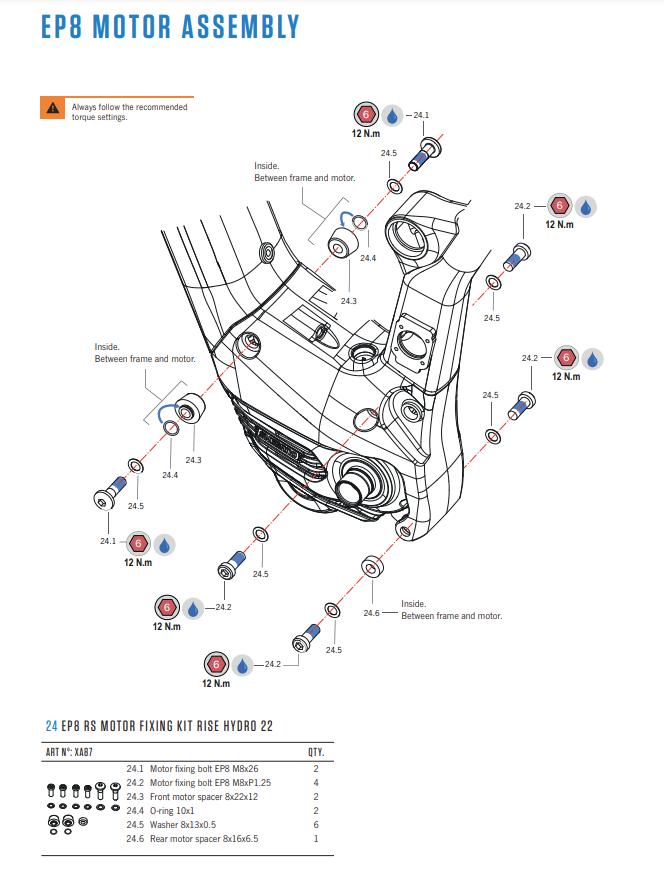
8) With a rag, clean the splined motor spindle. Check for cracks near the hole in the spindle. Clean the spines on the chainring. Place a light coating of lubricant on the spindle splines and chainring splines. Slide the chainring all the way onto the drive spindle. Install the chainring lock ring nut and finger tighten
counter-clockwise. With your lock ring tool, turn the nut counter-clockwise to tighten the lock ring to torque specifications, 35-45 Nm.
Note: E13 has a technical service bulletin (TSB # 157, EP8 motor spindle inspection) procedure for checking the spindle for cracks.
9) Re-install your crankarm and upper chainguide arm. I use blue thread locker on the two clamp bolts and tighten to torque specifications. I also use a very small amount of blue thread locker on the threaded crank arm fixing cap.
Note: E13 has a technical service bulletin (TSB # 156, Alloy crank arms) in regards to installation and proper torque on E13 alloy crank arms.
TECHNICAL SERVICE BULLETIN #156.2 e*spec Shimano™ alloy crank tech update Product(s) included: e*thirteen e*spec Shimano EP8 alloy cranks. Abstract e*spec Shimano EP8/EP800 alloy cranks were dev...

support.ethirteen.com
10) Install the chain and lower the chain guide top piece into position and tighten.
11) Go ride and never buy a couch.


