Navigation
Install the app
How to install the app on iOS
Follow along with the video below to see how to install our site as a web app on your home screen.
Note: This feature may not be available in some browsers.
More options
Style variation
You are using an out of date browser. It may not display this or other websites correctly.
You should upgrade or use an alternative browser.
You should upgrade or use an alternative browser.
DJI increases Peak power to 1000w in Turbo Mode
- Thread starter Plyphon
- Start date


Yeah - here in NZ, it's largely a moot point. eBikes aren't regulated like in Europe and the Ununited States, so we get to do what we want, so this is probably good news for anyone with a DJI bike.

As a customer. I want the 1000 peak watts. Most customers have bought the DJI for the higher peak power. So maybe they are listening to customers instead of bureaucrats. What a novel idea ...... 


Plummet
Flash Git
I wonder what level of power output should it be considered a motorbike and not ridden on mtb tracks.
This will be the ultimate limitation.
Also at what level of additional power do you start burning through components that where once designed for legs only?
This will be the ultimate limitation.
Also at what level of additional power do you start burning through components that where once designed for legs only?
It still only has a continuous power output of 250 watts. So I'm thinking a substantial amount more.I wonder what level of power output should it be considered a motorbike and not ridden on mtb tracks.

Amflow PL Electric Mountain Bike - Power to the Peak - Amflow (United Kingdom)
This superlight full-power electric mountain bike Amflow PL is equipped with the DJI Avinox Drive System, delivering 105 N·m of torque, versatile geometry, fast charging, and much more. The ultimate balance of power, range, and weight has arrived.
 www.amflowbikes.com
What is your top speed capped at?Yeah - here in NZ, it's largely a moot point. eBikes aren't regulated like in Europe and the Ununited States, so we get to do what we want, so this is probably good news for anyone with a DJI bike.
Brad

DJI carving out market share where previously it had none.
I don't have a DJI, but my Shimano-powered bike is capped at 45kmh.What is your top speed capped at?
Brad
In NZ, we don't have an arbitrary cap on motor-assist speed, so it could theoretically be as high as the motor system could handle.
Most bikes are capped at 32kmh from factory, though. Just no law preventing uncapping - it's just warranty issues you have to worry about.
Plummet
Flash Git
I think power is limited to 300w continious output. Rise above that and you are no longer a power assisted bicycle.I don't have a DJI, but my Shimano-powered bike is capped at 45kmh.
In NZ, we don't have an arbitrary cap on motor-assist speed, so it could theoretically be as high as the motor system could handle.
Most bikes are capped at 32kmh from factory, though. Just no law preventing uncapping - it's just warranty issues you have to worry about.
From that, my biggest takeaway is this:I think power is limited to 300w continious output. Rise above that and you are no longer a power assisted bicycle.
The research report sets out an indicative regulatory framework for low-powered vehicles in New Zealand, based on the international experience. In summary this framework recommends:
Including any low-powered vehicles intended for or primarily used by mobility impaired users within the definition of a mobility device
classifying e-bikes and other low-powered vehicles based on their speed capability
setting a maximum power-assisted speed and size for vehicles using footpaths
relaxing the maximum power limits for e-bikes and other low-powered vehicles designed for road use
introducing minimum age limits and driver licensing for higher speed e-bikes and lowpowered vehicles
using existing road user rules to promote user behaviours that minimise conflict with existing path users.
So it looks like it's mostly about shared-path and road use - where non-powered bicycles are often going faster than anyone else outside of cars - the amount of non-powered mamils I see roaming in packs on roads and paths at well in excess of 32kmh (the usual limit for an eMTB from the factory) is astounding.
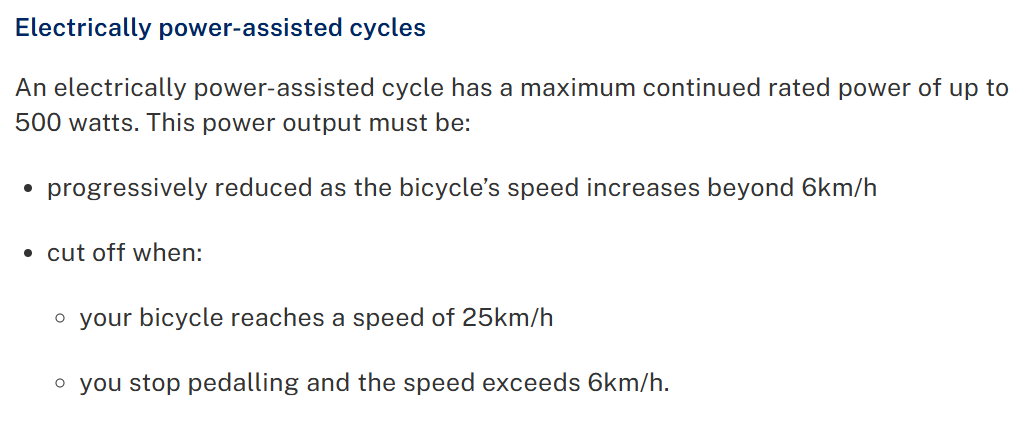
In NSW it's 500 watts continuous. But as most EMTBs are EU certified. Most are 250 watt continuous. The 6kph is there to allow walk mode.

JP-NZ
E*POWAH Elite World Champion
From that, my biggest takeaway is this:
The research report sets out an indicative regulatory framework for low-powered vehicles in New Zealand, based on the international experience. In summary this framework recommends:
Including any low-powered vehicles intended for or primarily used by mobility impaired users within the definition of a mobility device
classifying e-bikes and other low-powered vehicles based on their speed capability
setting a maximum power-assisted speed and size for vehicles using footpaths
relaxing the maximum power limits for e-bikes and other low-powered vehicles designed for road use
introducing minimum age limits and driver licensing for higher speed e-bikes and lowpowered vehicles
using existing road user rules to promote user behaviours that minimise conflict with existing path users.
So it looks like it's mostly about shared-path and road use - where non-powered bicycles are often going faster than anyone else outside of cars - the amount of non-powered mamils I see roaming in packs on roads and paths at well in excess of 32kmh (the usual limit for an eMTB from the factory) is astounding.
NZ is in line for some government intervention on these laws soon. Whether that is good or bad will be interesting.
I would love DOC to open up more trails to EMTB's but this "power race" is doing nothing to make it any easier.
Plummet
Flash Git
How many are not open to E's. I only know of West coast SI epic trails longer than battery life where old bastards have had to be rescued because of flat batteries and lack of fitness.NZ is in line for some government intervention on these laws soon. Whether that is good or bad will be interesting.
I would love DOC to open up more trails to EMTB's but this "power race" is doing nothing to make it any easier.
Otherwise its mtb/emtb or not bikes at all. Typically "national park" is a no-go for mtbs. But "Forest park" mtbs are not excluded....
JP-NZ
E*POWAH Elite World Champion
Indeed National Parks, currently Poulter Valley/Arthurs Pass is one of the only EMTB able rides within a National Park in NZ.How many are not open to E's. I only know of West coast SI epic trails longer than battery life where old bastards have had to be rescued because of flat batteries and lack of fitness.
Otherwise its mtb/emtb or not bikes at all. Typically "national park" is a no-go for mtbs. But "Forest park" mtbs are not excluded....
Tracks like the Paparoa, Heaphy, Abel Tasman etc would be great to get ebikes on IMO. Understandably DOC doesn't look to kindly on them.
Plummet
Flash Git
yeah, but most of those yourl burn your battery before the track is complete unless you can get a charge in mid way through. Better off to hit the long ones on the mtb where you charge yourself back up with bacon sandwiches.Indeed National Parks, currently Poulter Valley/Arthurs Pass is one of the only EMTB able rides within a National Park in NZ.
Tracks like the Paparoa, Heaphy, Abel Tasman etc would be great to get ebikes on IMO. Understandably DOC doesn't look to kindly on them.
JP-NZ
E*POWAH Elite World Champion
Heaphy sure, but you could also make a day trip in/out of it in a day depending on how you feel.yeah, but most of those yourl burn your battery before the track is complete unless you can get a charge in mid way through. Better off to hit the long ones on the mtb where you charge yourself back up with bacon sandwiches.
You can definitely ride the Paparoa in a day (in my bucket list) and the OGR in a day too (already done but will definitely do again).
And in such a short time frame.DJI carving out market share where previously it had none.
Think it’s brilliant the way they have given the finger to the established brands who feel they can just rock up when they feel like it, and roll out a donkey’s to good paying customers.
Last edited:
I certainly do not "want the maximum speed and power they can get regardless of regulation" because that would almost certainly result in me being no longer to ride on the huge network of Bridleways.im pretty sure the bike is not really legal in many places, but one would have to sue them. most customers want the maximum speed and power they can get regardless of regulation anyway.
"In total there are over 76,000 separate bridleway routes with a total length of over 25,000 miles in England and Wales."
"cyclists have the legal right to use bridleways, but they must give way to pedestrians and those on horseback. This right is established by Section 30 of the Countryside Act 1968. While cycling on bridleways is permitted, it's crucial to be aware of local regulations and byelaws, as these can impact the use of bridleways."

Bridle path - Wikipedia
Last edited:
They fully comply with EU and Australian regulations. Infact in my state, Ebikes can have a maximum of 500 watts of continuous power. So I'm hoping DJI produce a larger motor for the Australian market. As long as they maintain the speed cutout at 25kph. There won't be any blow-back here.
I've used the 500 watt bafang motor. You can programme it to peak well over 1000 watts. And it absolutely rips. Up to 25kph anyway. The only downside to programming your bike to peak higher, is it does reduce the life of the battery significantly. I think my record is 3 months. Heat is not a batteries friend. So I used much larger capacity batteries. But that does add weight.
The greater heat cycles through the motor also doesn't help. They tend to absorb moisture more. And corrosion sets in. The price you pay for performance.
I've used the 500 watt bafang motor. You can programme it to peak well over 1000 watts. And it absolutely rips. Up to 25kph anyway. The only downside to programming your bike to peak higher, is it does reduce the life of the battery significantly. I think my record is 3 months. Heat is not a batteries friend. So I used much larger capacity batteries. But that does add weight.
The greater heat cycles through the motor also doesn't help. They tend to absorb moisture more. And corrosion sets in. The price you pay for performance.
If you are killing batteries in 3 months something is seriously wrong with the quality of those packs either with the components or cells used. Without knowing more about the motor and battery you've used it's really hard to say but using quality parts 1000w+ is no issue even for modern cells even for a relatively small pack (<400wh). Not sure if this is still an issue for you but I would look into replacing the cells inside for some nice modern ones. For example the Molicel P30B (assuming a 18650 pack) which can handle 100w (each cell!) and are rated to only loose 15% capacity after 500 cycles at 3c or about 33w/e (aka fully draining a battery in 20 minutes). And those are not even that new anymoreI've used the 500 watt bafang motor. You can programme it to peak well over 1000 watts. And it absolutely rips. Up to 25kph anyway. The only downside to programming your bike to peak higher, is it does reduce the life of the battery significantly. I think my record is 3 months. Heat is not a batteries friend. So I used much larger capacity batteries. But that does add weight.
I killed one pack that was rated up to 15 Amps, by allowing peak currents up to 40 Amps. 15 Amps X 36 Volts = 540 watts. Which is adequate for a 500 watt motor. But not if you increase peak power over 1000 watts.If you are killing batteries in 3 months something is seriously wrong with the quality of those packs either with the components or cells used.
A battery pack has a certain internal resistance. As heat generated is proportional to the square of the current multiplied by the resistance. Double the current and you generate four times the heat in your battery pack. At peak current, I was running nearly 3 times it's rated current. Which means generating nearly 10 times the rated heat in the battery pack.
Ask any battery tech. Heat kills LiPo battery cells real quick. Especially nearly 10 times the rated heat it can dissipate.
I changed to a battery rated to 40 Amps, and the battery is still working perfectly. But to achieve the same voltage at the higher current rating. A battery needs more cells in parallel, so each cell is providing less current, which made the new battery nearly 50% heavier and much bulkier. But as I said. That's what you need if you want to improve performance of a certain rated motor.
Obviously if you run the motor for too many cycles above it's rated power. It will also melt down. That's where software can help.
Last edited:
Similar Threads
-
-

-

-

-
 Wireless mode switcher red light - battery replacement procedure?
- Started by steve_sordy
- Replies: 27