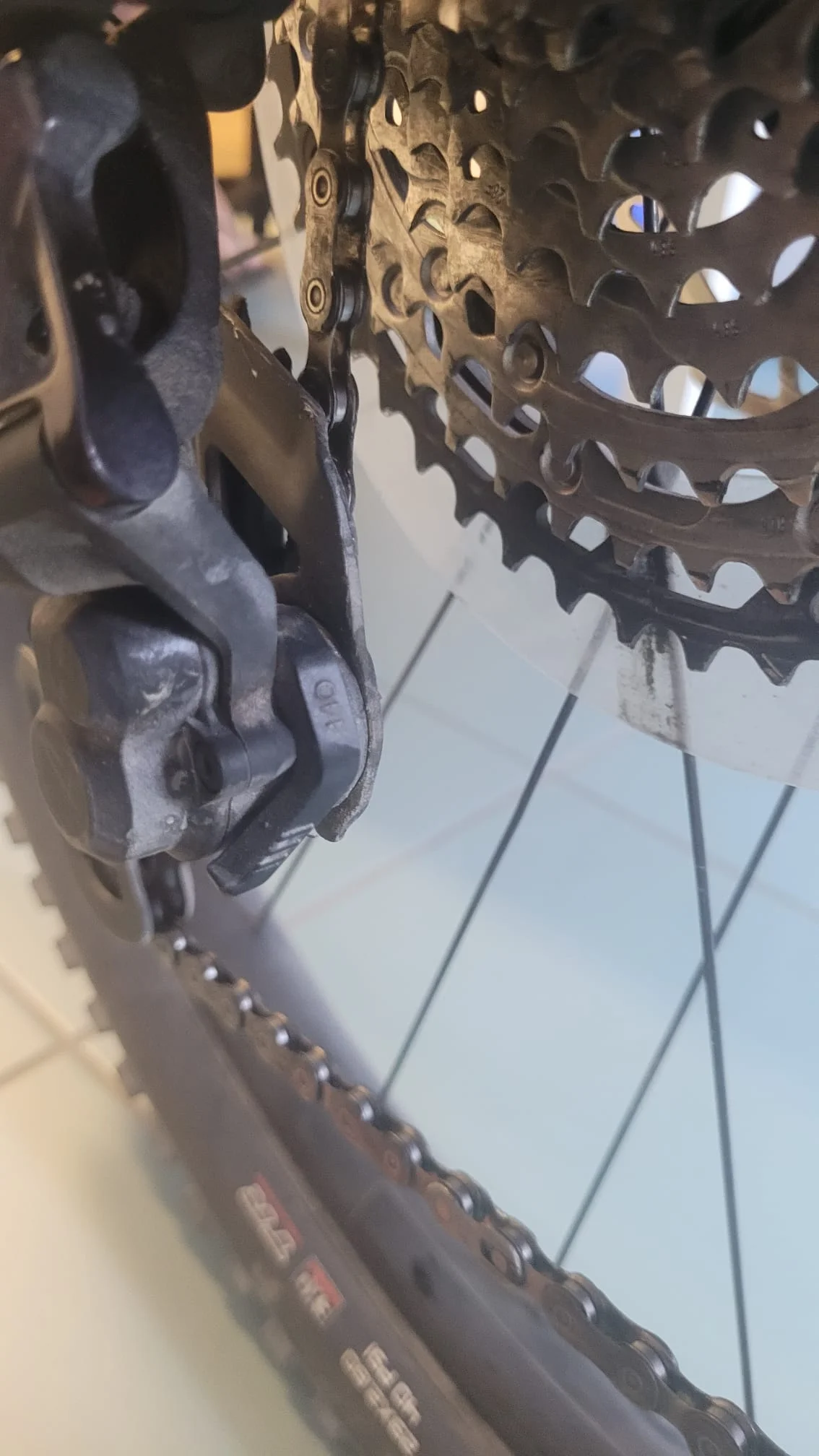
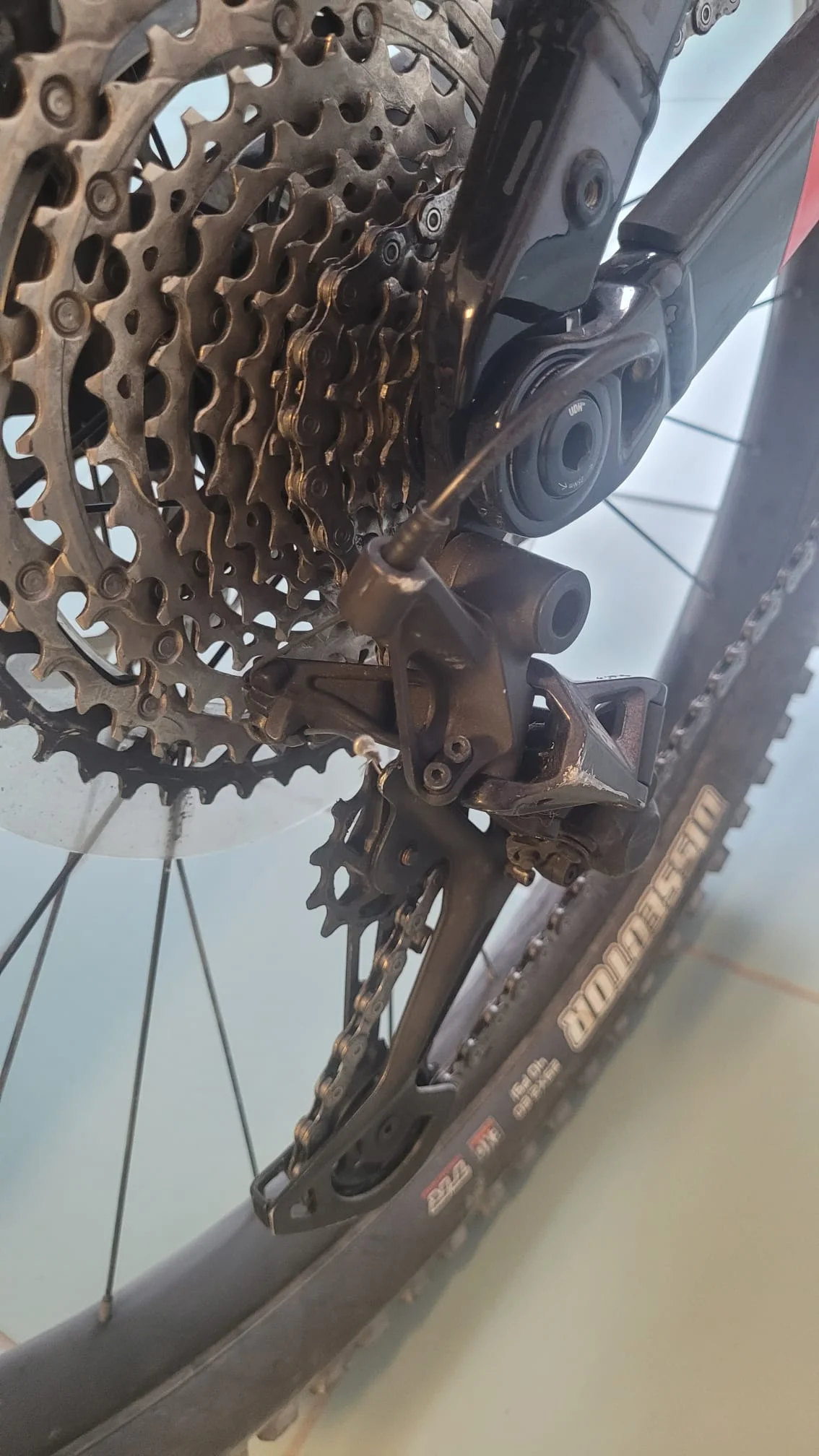
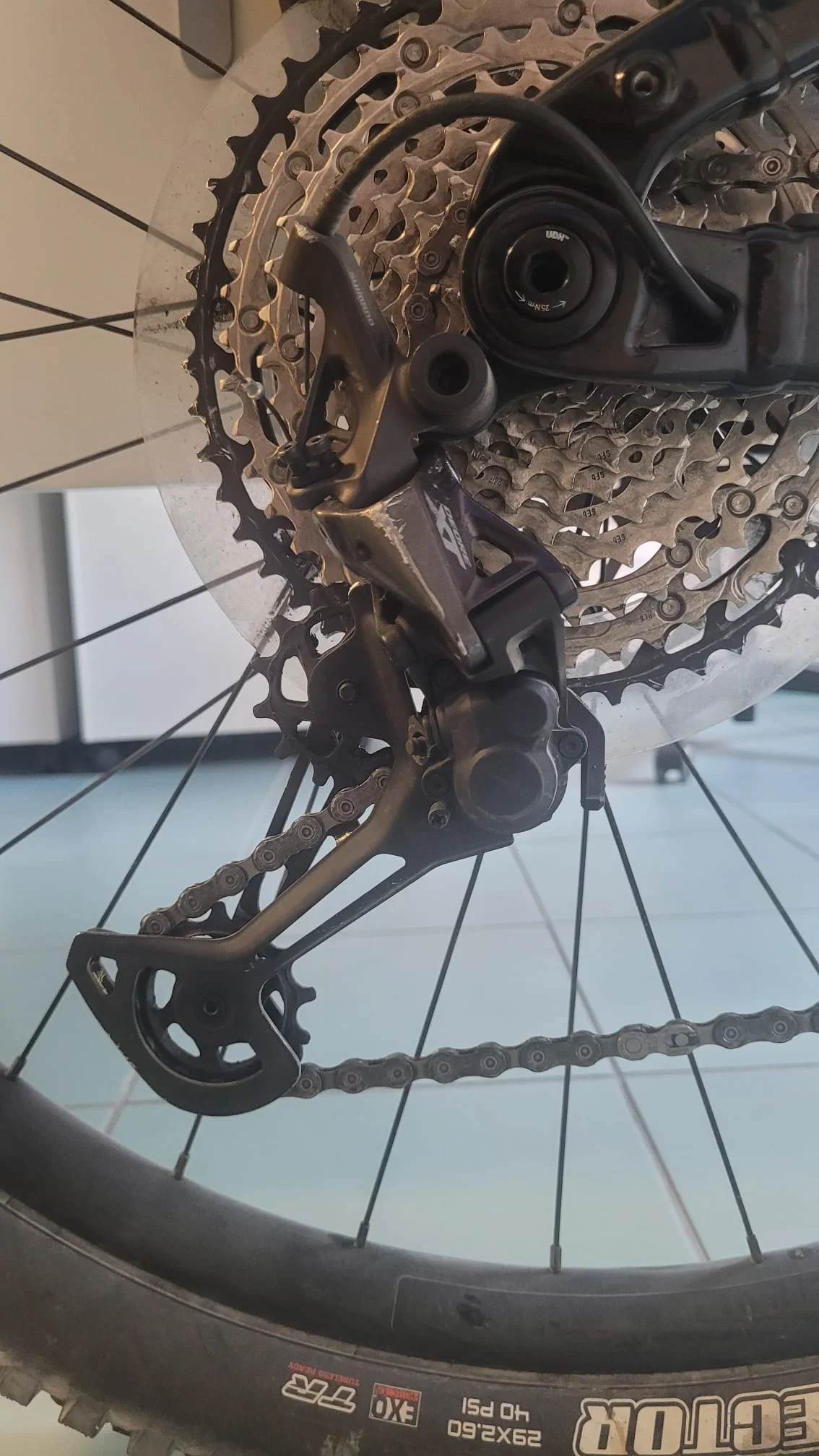
The little lever is the clutch and it is to reduce the amount that the lower strand of chain whips up and down when riding over rough ground. If you look at photos of biikes going over rough ground (in bike mags for ex.) you can frequently see that the lower strand is in a horizontal "S" shape, albeit a bit stetched out. That loop in the chain under certain circumstances can reach the ring and come off. Chain devices were an early solution to that and still appear on bikes (I have one on my bike). If you push the lower mech arm towards the front of the bike, with the lever in the on or off position, you will feel the resistance to motion change. Because it stiffens the resistance to movement, it also makes the shifter a bit stiffer and some don't like that. The only time I notice is when the shifter cable needs renewing.
The chain does not look new, but if it was, I would propose that quite often, new chains do not run on old cassettes (depends upon how worn they are). Yes they work in the garage with a light load, but once you put pressure on the chain skips over the teeth. It is really quite disconcerting. Once you get to the stage where you are doing your own chain and cassette renewals, you need to know this. Always keep the old chain until you have run the new one for real. If the new one skips, your cassette is toast and you need to buy a new one. In the meantime, refit the old chain and run it and the cassette for a while longer. But not too long becasue worn chains also wear out the ring! So don't leave it too long before you fit a new cassette and refit the new chain.
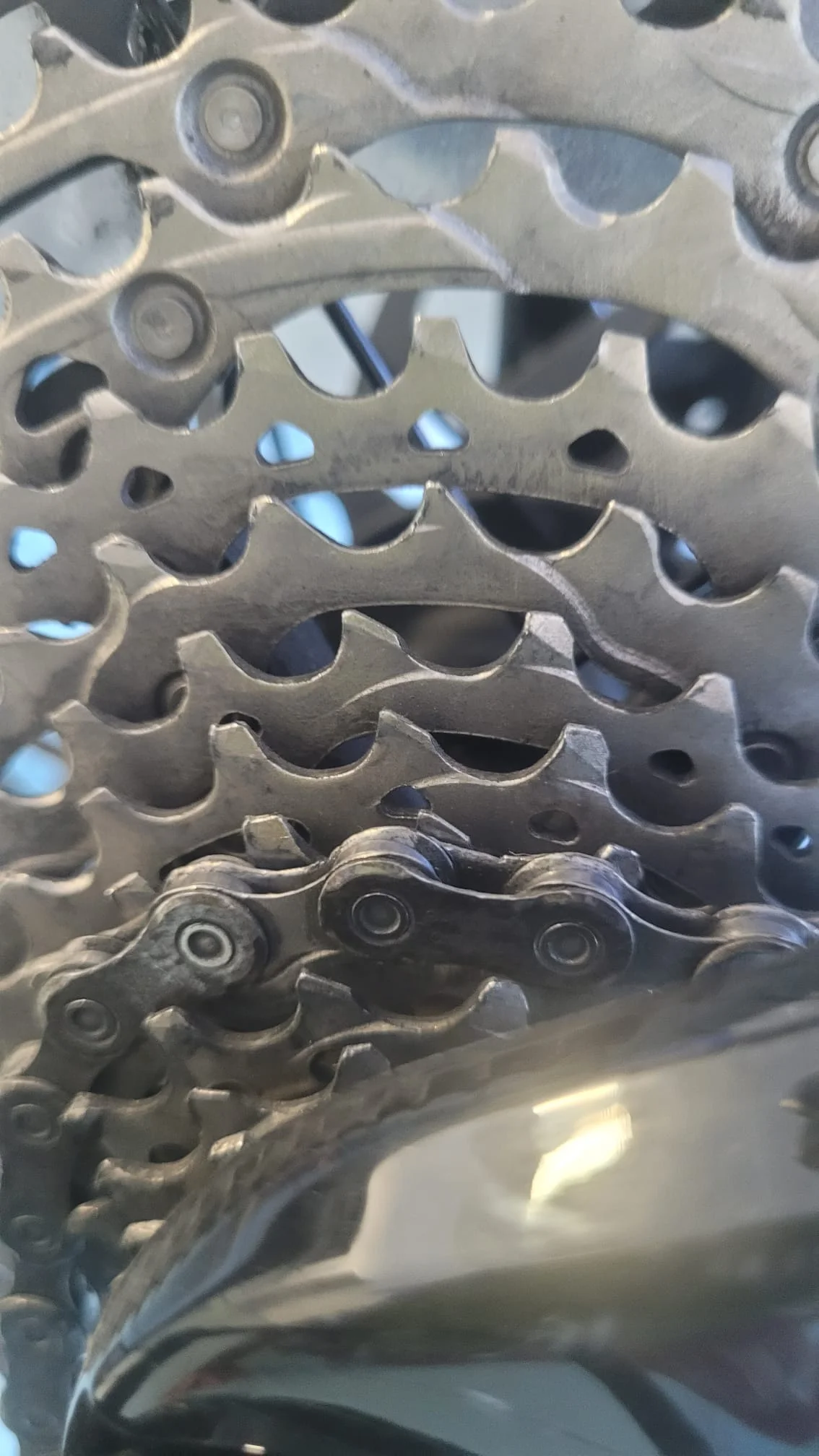
Cassette teeth always look odd, even on when new! All the teeth look different to each other, and if you look carefully , some have ledges on the side of the teeth. Those ledges are shifting ramps that help the chain to move from one ring to the next. They are not on every tooth, but more widely spaced than that, 4 or 5 teeth approximately on the large rings. The teeth are different shapes to help that process. I once put a 20T single speed front ring on in place of a 20T granny on a triple ring, because it was all I could get. It worked fine except when I tried to shift into or away from it. All the teeth were the same and there were no shifting ramps.
That cassette is worn, I can see burrs on the teeth. Burrs are caused by heavy loads. The chain forces the metal of the tooth face out of the way and over the edge of the tooth, causing a characeristic burr. Those burrs can snag on the chain and impede smooth shifting. If you want to, you could file them off without damaging anything and that would improve shifting. But what has happened to the tooth face? The tooth face has had metal removed to form the burr and it gets hollow as a consequence. That hollowing will eventually form what is called a "shark fin". Shark fins are a characteristic of a badly worn gear. Shark finned teeth can hang on to the chain instead of allowing it to smoothly leave the gear, causing jams that can have you off or at least damage the gears, maybe snap a chain or even gouge the frame. But I can't see any shark fins in the photograph you have provided.
The pic below shows both burrs and shark fins. To my shame the old gear (at the front) was mine. It is from a triple gear and it was the granny ring. In my defence, it was a long time ago when I didn't know about this stuff. The shark fins are very distictive. Once you've seen them, never forgotten. The burrs are pretty obvious too.
Other have assisted with the B-screw adustment. It is an important adjustment, so take care with it.
What I am interested to know is what has been done to the bike that would cause your problems? What problems did you have that prompted you to take the bike in for a service?
By the way, judging by the deep scratches, your mech looks to have had several impacts to it. On 11 and 12-speed gearing, the mech is closer to the ground and can receive more impacts. These can bend the mech hanger. The hanger is so short that it never looks bent (if it does you are in trouble!). But even a very small bend can cause the shifting to deteriorate and be unfixable by the usual adjustments to cable tension. You need a mech hanger gauge & adjustment tool. One tool does both. They can be expensive to buy, but they are very quick to use, so the LBS can do the check and fix very cheaply. They can cure seemingly intractable shifting problems. I never had to use a mechnhager tool until I got into 11 and then 12 speed gears. After 3 lots of adjustments by the LBS, at £10-£15 per go, I bought my own tool. Well worth the money!