

robikinkela
Active member
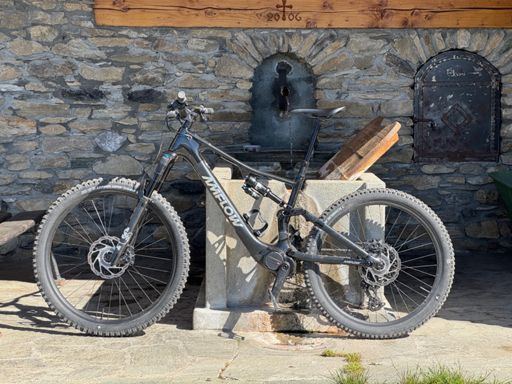
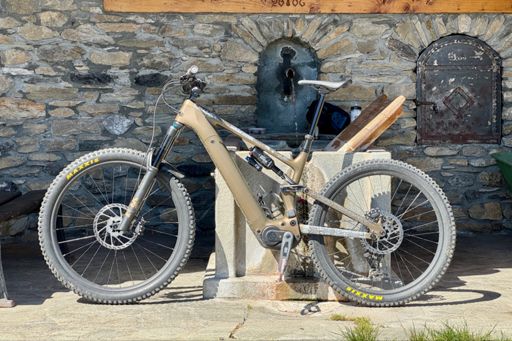
Today I tested the Amflow PX carbon and then, not content, I rode the same route again with my Levo expert G4. It was interesting to ride the exact same sections on two different e-bikes because this way you get a precise sense of the differences, both positive and negative, and you do so with a "fresh" perception of what happened. If you're interested, you can find the two tracks here:
 www.strava.com
 www.strava.com
The route included, among other things, a rather difficult technical climb that was the subject of a power stage in a past edition of the All Around eMTB Valle d'Aosta (see segment) and a typical descent of our area, with fast sections but above all tight turns on very rough and dry terrain (for this period), with many rocks, some of them large, in the way, plus various steps and ledges.
Let's start with the settings for the two bikes: on the Amflow (thanks director), I used only two settings: ECO on pedalable sections—assist 3, 40 Nm torque, and 350 W max power—and AUTO—assist 7-9, 80 Nm torque, and 750 W max power (long overrun). This proved to be a really good setting, perfectly adequate for doing anything on steep terrain while still feeling like you're pedaling the ebike rather than being carried up by the motor (by the way, I wonder what the point of more power is?). On the Levo, instead of ECO, I use the 0/100 of the dynamic microtune, while on climbs I used 80/100 instead of AUTO, which, in my opinion, has too much of an on/off behavior when the cadence isn't constant.
AMFLOW vs LEVO
Uphill, I found the Amflow to be better than the Levo, no big deal, not enough to make you cry miracle (the Levo remains an excellent bike), but I climbed better with the Chinese bike and struggled less. The Avinox pulls well and, likely thanks to its much-vaunted tone wheel, offers slightly better traction than the Levo; for this reason with the PX I had the clear impression of being able to choose the most advantageous lines, which allowed me to overcome obstacles more cleanly, obviously paying attention to shifting the weight on the handlebars to improve the balance (I would like to try it with the long chainstay or with the 29" rear). Even when restarting after the hairpin bends uphill at very low speed I never had the slightest problem, great work on the electronics, hats off. The Amflow AUTO works better than the Levo's, it is less on/off when the pedaling cadence varies, personally on the Specialized I prefer to use the dynamic microtune depending on the need for assistance, in this case 80/100 during the entire technical climb with shuttle and the rest at zero. Among other things, the last part of the same also involved overcoming a rather high rock, about a meter, with very little run-up, and the Levo stalled just when I needed maximum thrust, it's not the first time it's happened to me, the motor stalls sometimes when you exceed a certain cadence, and the It's just what I needed most. Needless to say, the Chinese bike felt like I was on a trials bike...
Having also ridden the first Amflow model, I expected this uphill behavior, but what surprised me is that the Chinese bike is also fun on the downhills; I think they've done a great job with the frame as well. If I had to use an adjective, I'd say "fun." You can clearly feel the fact that it weighs 2.5 kg less than the Levo. Curiously, despite being 186 cm tall, I felt very comfortable with the size L. The Specialized is more planted and stable, but honestly, I didn't find the PX unsuitable for some nice blasts on rough terrain, not to mention that it offers more liveliness and playfulness and pulls up more easily in the occasional bunny hop. Don't be misunderstood: the Levo is quite effective on the downhills, but it's more tiring in the long run and requires a more motorcycle-like ride with the wheels more firmly attached to the ground; however, it seemed more balanced in the small sections. Jumps.
I've had the chance to use the walk bike a couple of times, and here too, it's a clear victory for Amflow. It's hard to believe that Specialized, after so many years, hasn't managed to make a proper walk bike. It's a little better than the Gen 3, but we're not there yet...
Finally, the consumption at the end of the ride, trying to use the same assists as much as possible and mimicking roughly the same effort on the pedals: Amflow consumed 81% of the 700W battery, or 567W/h, and the Levo 71% of the 840W, or 596W/h.
In the end, being honest, I can't help but congratulate Amflow for coming up with a product that, in my opinion, is truly spot-on. Kudos to them and the others: wake up!
28 - 2026 Ho provato la cinesina | Strava
View Robi Kinkela's E-Mountain Bike Ride on April 16, 2026 | Strava
www.strava.com
29 - 2026 Bis con la mia | Strava
View Robi Kinkela's E-Mountain Bike Ride on April 16, 2026 | Strava
www.strava.com
The route included, among other things, a rather difficult technical climb that was the subject of a power stage in a past edition of the All Around eMTB Valle d'Aosta (see segment) and a typical descent of our area, with fast sections but above all tight turns on very rough and dry terrain (for this period), with many rocks, some of them large, in the way, plus various steps and ledges.
Let's start with the settings for the two bikes: on the Amflow (thanks director), I used only two settings: ECO on pedalable sections—assist 3, 40 Nm torque, and 350 W max power—and AUTO—assist 7-9, 80 Nm torque, and 750 W max power (long overrun). This proved to be a really good setting, perfectly adequate for doing anything on steep terrain while still feeling like you're pedaling the ebike rather than being carried up by the motor (by the way, I wonder what the point of more power is?). On the Levo, instead of ECO, I use the 0/100 of the dynamic microtune, while on climbs I used 80/100 instead of AUTO, which, in my opinion, has too much of an on/off behavior when the cadence isn't constant.
AMFLOW vs LEVO
Uphill, I found the Amflow to be better than the Levo, no big deal, not enough to make you cry miracle (the Levo remains an excellent bike), but I climbed better with the Chinese bike and struggled less. The Avinox pulls well and, likely thanks to its much-vaunted tone wheel, offers slightly better traction than the Levo; for this reason with the PX I had the clear impression of being able to choose the most advantageous lines, which allowed me to overcome obstacles more cleanly, obviously paying attention to shifting the weight on the handlebars to improve the balance (I would like to try it with the long chainstay or with the 29" rear). Even when restarting after the hairpin bends uphill at very low speed I never had the slightest problem, great work on the electronics, hats off. The Amflow AUTO works better than the Levo's, it is less on/off when the pedaling cadence varies, personally on the Specialized I prefer to use the dynamic microtune depending on the need for assistance, in this case 80/100 during the entire technical climb with shuttle and the rest at zero. Among other things, the last part of the same also involved overcoming a rather high rock, about a meter, with very little run-up, and the Levo stalled just when I needed maximum thrust, it's not the first time it's happened to me, the motor stalls sometimes when you exceed a certain cadence, and the It's just what I needed most. Needless to say, the Chinese bike felt like I was on a trials bike...
Having also ridden the first Amflow model, I expected this uphill behavior, but what surprised me is that the Chinese bike is also fun on the downhills; I think they've done a great job with the frame as well. If I had to use an adjective, I'd say "fun." You can clearly feel the fact that it weighs 2.5 kg less than the Levo. Curiously, despite being 186 cm tall, I felt very comfortable with the size L. The Specialized is more planted and stable, but honestly, I didn't find the PX unsuitable for some nice blasts on rough terrain, not to mention that it offers more liveliness and playfulness and pulls up more easily in the occasional bunny hop. Don't be misunderstood: the Levo is quite effective on the downhills, but it's more tiring in the long run and requires a more motorcycle-like ride with the wheels more firmly attached to the ground; however, it seemed more balanced in the small sections. Jumps.
I've had the chance to use the walk bike a couple of times, and here too, it's a clear victory for Amflow. It's hard to believe that Specialized, after so many years, hasn't managed to make a proper walk bike. It's a little better than the Gen 3, but we're not there yet...
Finally, the consumption at the end of the ride, trying to use the same assists as much as possible and mimicking roughly the same effort on the pedals: Amflow consumed 81% of the 700W battery, or 567W/h, and the Levo 71% of the 840W, or 596W/h.
In the end, being honest, I can't help but congratulate Amflow for coming up with a product that, in my opinion, is truly spot-on. Kudos to them and the others: wake up!


