Orbea Lifetime Warranty - only on paper

Patrik

Member
Joined
Oct 10, 2022
Messages
17
Reaction score
4
Location
Slovakia
Got a '22 Orbea Wild FS a few years ago, have ridden roughly 2500 km on it in total, plenty of jumps and such.

The aluminium rear triangle has developed a crack on the right seatstay at the weld next to the cassette.
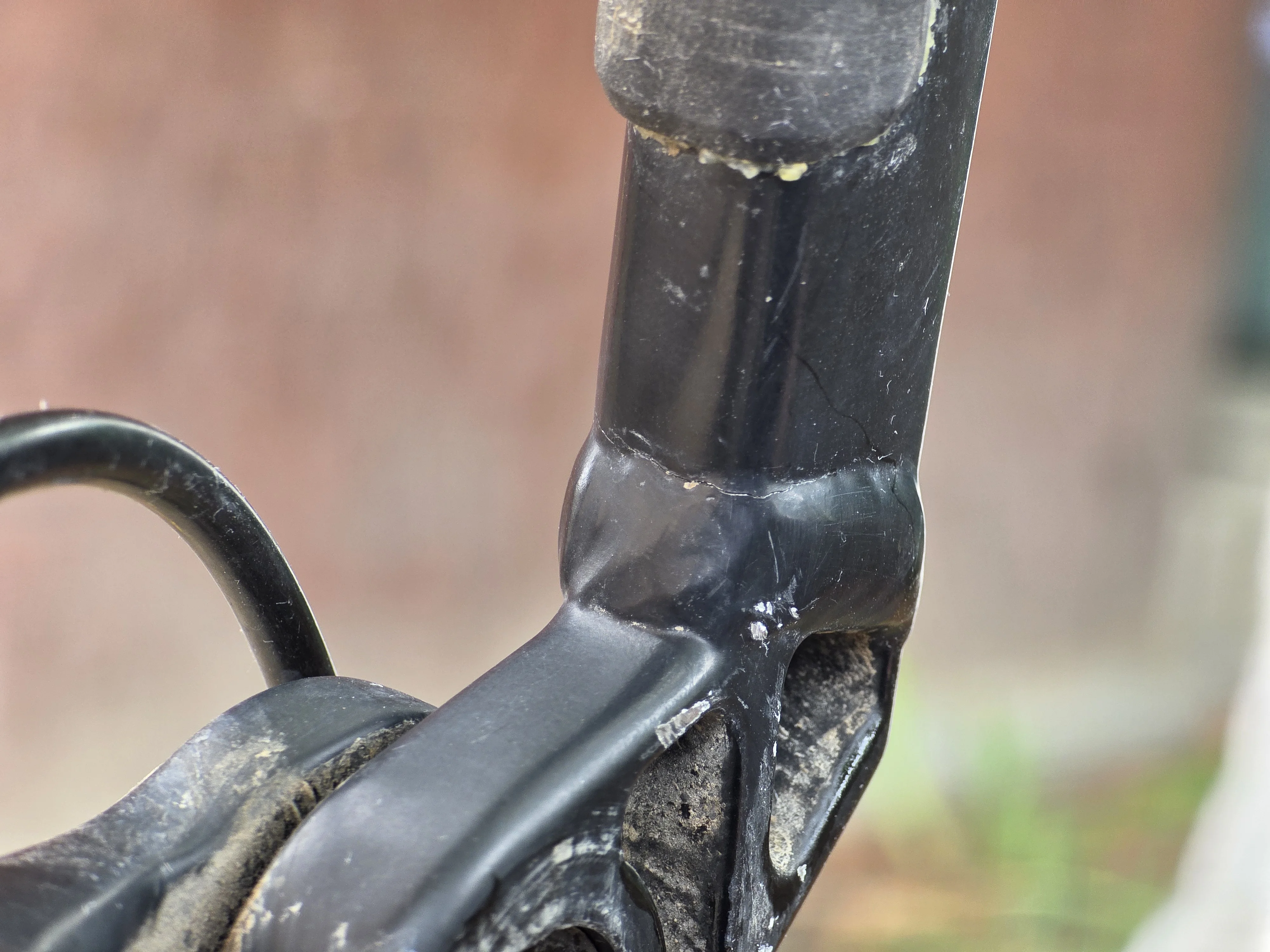
1000037795.webp

1000037794.webp


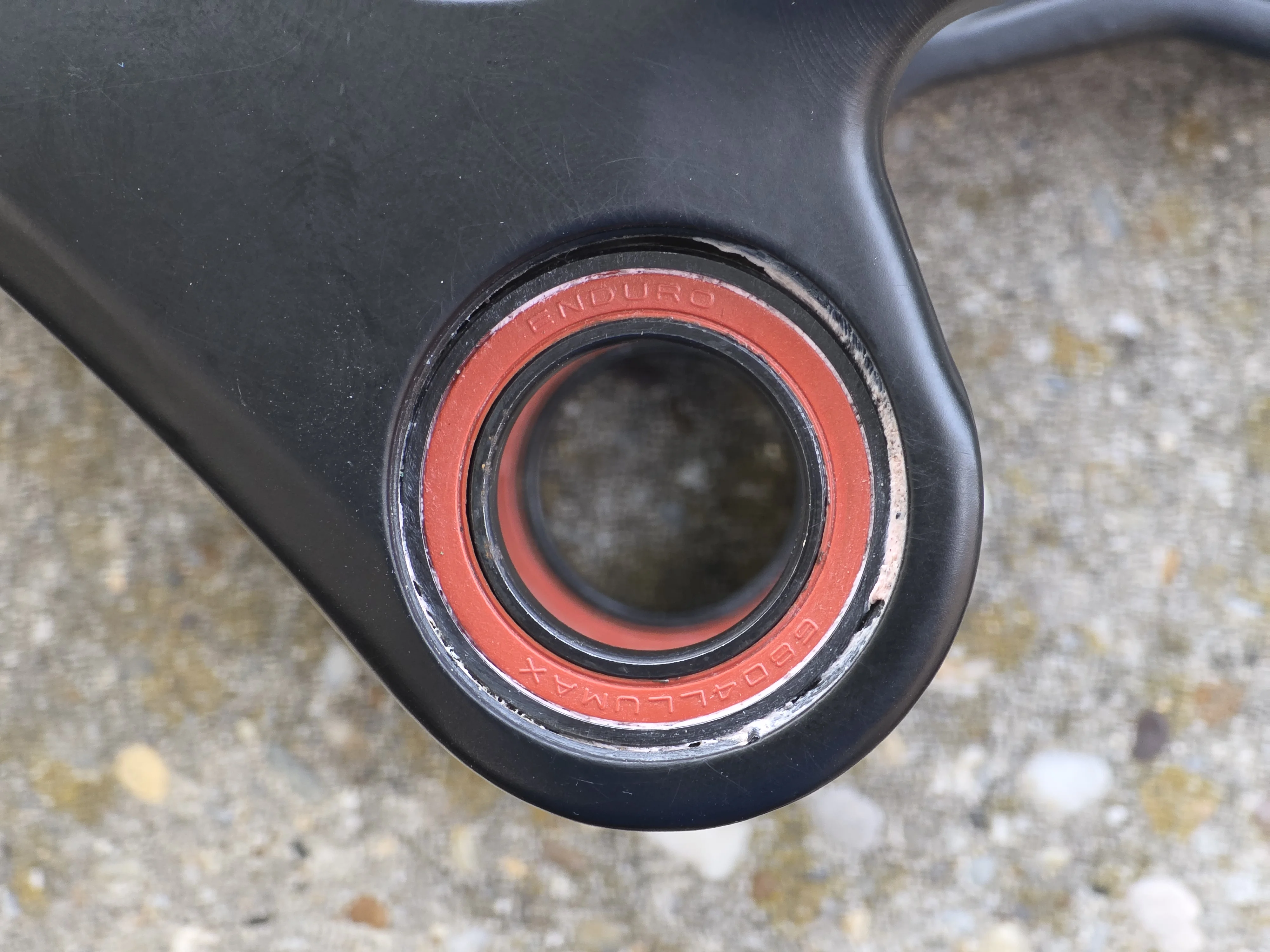
The rocker link arm progressively bent slightly (the rear section bent upward), and I've noticed the bearing holes/seats on the rocker link arm have oval holes, probably not what you want for round bearings...
1000037793.webp

1000037792.webp


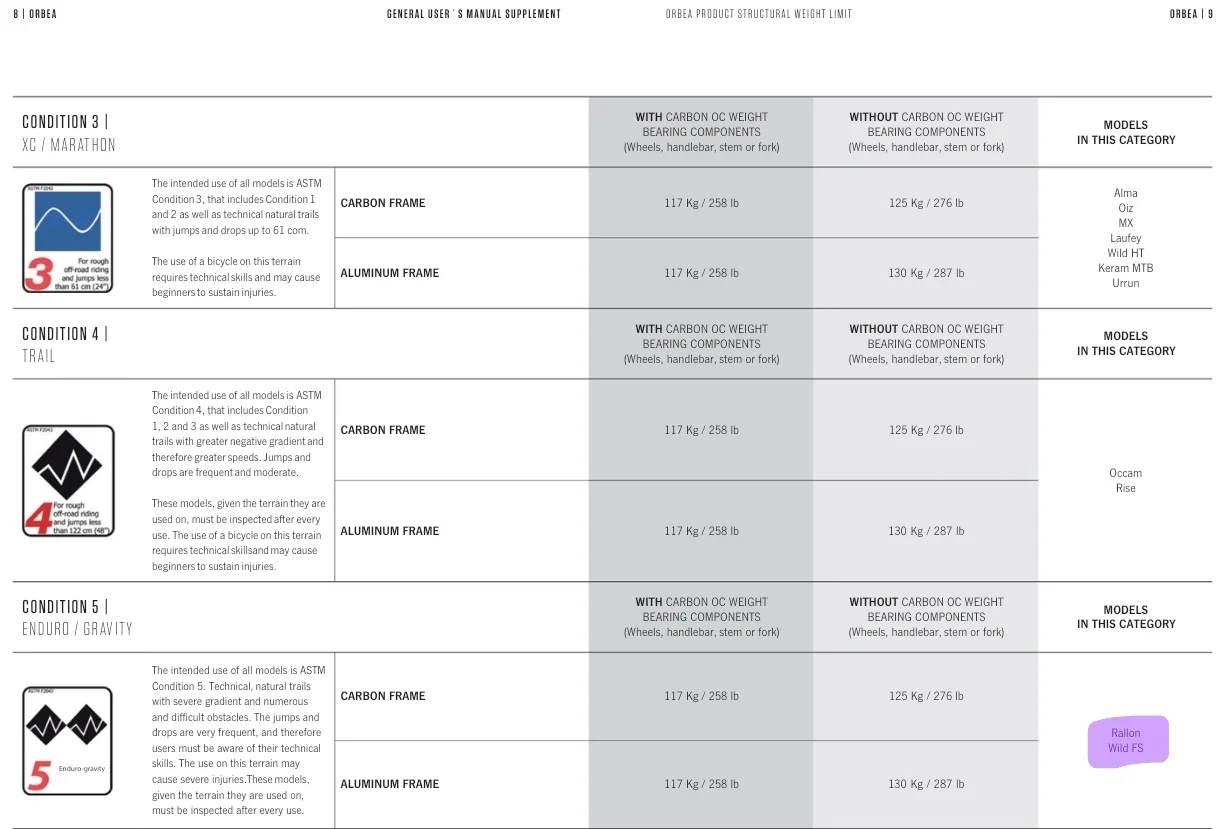
Notice that the bike is officially ASTM category 5 rated, which is a downhill bike standard, meaning Orbea allows you to hit jumps etc. and it shouldn't bend/break.
1000037784.webp


Talked to my dealer about these issues, they sent some photos to Orbea, but Orbea refused the warranty claim, stating that rear triangles are not covered by the lifetime warranty and neither is crash damage.

That's strange. Their very own lifetime warranty policy explicitly says that rear triangle is included, quote:

Coverage​


The lifetime warranty applies to all Orbea-manufactured frames and rigid forks. It covers breakages or cracks caused by manufacturing defects, without time limitation.


In dual-suspension bicycles, the term “frame” includes chainstays, seatstays, links, and front triangles, excluding suspension forks and components considered spare parts.


The original purchaser is entitled to repair or replacement of the affected frame and/or rigid fork.

I also have no idea why they think this is a crash damage, there are just minor scratches on the frame, nothing you wouldn't expect on an enduro bike that's actually being used as one.
Sure, there were some minor tipovers, but the bike has never see a major direct impact, plus it still wouldn't explain any of the issues the frame has.

My dealer agrees this should've been covered by the lifetime warranty, but there isn't much they can do, as it's Orbea's decision now that the statutory warranty period is over.
The best offer they were able to get from Orbea was 250 euros for a replacement seatstay, but I believe they're still trying to negotiate.

When I bought the bike, the lifetime warranty on the frame has been a major decisive factor for me.
I certainly wouldn't have paid the insane full price knowing that warranty only exists on paper.

I'm disappointed.
 
EMTB PRO
25% off e*thirteen, Peaty’s & more with PRO
Member-only deals from e*thirteen, Peaty’s, PEMBREE and Magicshine · ad-free browsing · PRO badge · Living Intelligence Reports
See the deals →
From £1.99/month
Did you register your bike for the "lifetime" warranty?
I believe so. There was a blue sticker on the top tube IIRC, I scanned that and did something on a website that showed up, can't remember the details, it's been years.
They didn't explicitly say that the bike doesn't have a lifetime warranty enabled, so I suppose that registration went through.
 
I believe so. There was a blue sticker on the top tube IIRC, I scanned that and did something on a website that showed up, can't remember the details, it's been years.
They didn't explicitly say that the bike doesn't have a lifetime warranty enabled, so I suppose that registration went through.
You should contact them directly and see if you can get anywhere with it.
I found small cracks in the seat tube and the rear triangle on my 2021 Wild. Since there are no spare frames or replacement parts left for that generation, they're replacing it with a new 2026 model.

If you're in the EU, there are strong consumer protection laws that may apply to your case.
 
I believe so. There was a blue sticker on the top tube IIRC, I scanned that and did something on a website that showed up, can't remember the details, it's been years.
They didn't explicitly say that the bike doesn't have a lifetime warranty enabled, so I suppose that registration went through.
if you sign into Orbea's website - go to home and there is a 'registered bikes' page
whether you registered it or not that is pretty crap
lets hope your LBS can get the new parts from them at least!
 
You should contact them directly and see if you can get anywhere with it.
I found small cracks in the seat tube and the rear triangle on my 2021 Wild. Since there are no spare frames or replacement parts left for that generation, they're replacing it with a new 2026 model.

If you're in the EU, there are strong consumer protection laws that may apply to your case.
Consumer protection laws in the EU are completely useless.
Nobody respects them, so you have to take every case to court, and that takes many many years - courts have too much work, so they keep pushing cases further and further into the future, way past legal limits, but unfortunately, there are no repercussions for the courts, so...

Plus it's often more expensive to sue than to take the losses, because even if you win, if the costs you incurred in association with the proceedings are higher than the disputed value, you're not entitled to be compensated by the loosing party. Ask me how I know.

I tried contacting Orbea directly. My dealer suggested that and gave me a number to someone in Orbea's HQ, who, after realizing I'm not a dealer, connected me to their customer support line, where they told me warranty claims must go through the dealer.

Cool that they gave you a 2026 model as a replacement.
I was given no such offer, but I also don't really want the newer frame if it can be avoided.
I love my two removable batteries, which is not possible with the new frame.
Those 1125Wh I have right now (625 internal + 500 external battery) are perfect for 4h of shuttling local trails.
 
Last edited:
That's crap. They advertise a Lifetime Warranty and they need to honour it.

It's is difficult in reality to continue to provide spares long term - once they stop making a frame (which I don't believe they do in house) there will be a finite stock of spares. Once those are used up it's not going to be economic for them to make more* but since they've offered you a paid for part it suggests that's not the issue anyway.

When it comes to crash damage it's tough - I've had a paid for replacement front frame on my Rise but it was after a crash that put me in hospital. no contest and I wasn't going to argue with it.

Neither the weld or the linkage look like impact damage, but the force to distort that linkage must have been huge. I've never seen that before. Feels like it would have been a huge bottom out event on the rear (that probably did for both). But that doesn't mean you didn't ride out of it..

Stuff like this is reputational though - very few people are going to use the frames beyond their limits so the cost of honouring their warranties isn't large in the bigger scheme of things. (it's much harder for small boutique companies to swallow those costs).

*thats when it gets difficult now. It was always the case that a few standards might have changed if you were given a replacement frame, but now the motor and battery are unlikely to fit the new frame design. I had a Giant road bike with lifetime warranty crack during Covid. They simply didn't have any replacement frames to offer a the time and I got a refund on the complete purchase price of a 5+ year old bike(!). But over that period their road bikes had changed from QR to bolt through axles and from post mount to direct mount disc brakes so would probably have been difficult anyway. I was still way out of pocket as I'd got the bike on sale, prices had gone up a lot in the intervening years and short supply meant there were no new bargains to be had
 
Last edited:
Consumer protection laws in the EU are completely useless.
Nobody respects them, so you have to take every case to court, and that takes many many years - courts have too much work, so they keep pushing cases further and further into the future, way past legal limits, but unfortunately, there are no repercussions for the courts, so...

Plus it's often more expensive to sue than to take the losses, because even if you win, if the costs you incurred in association with the proceedings are higher than the disputed value, you're not entitled to be compensated by the loosing party. Ask me how I know.

I tried contacting Orbea directly. My dealer suggested that and gave me a number to someone in Orbea's HQ, who, after realizing I'm not a dealer, connected me to their customer support line, where they told me warranty claims must go through the dealer.

Cool that they gave you a 2026 model as a replacement.
I was given no such offer, but I also don't really want the newer frame if it can be avoided.
I love my two removable batteries, which is not possible with the new frame.
Those 1125Wh I have right now (625 internal + 500 external battery) are perfect for 4h of shuttling local trails.
Exactly. The EU set up a consumer legal assistance service for disputes within the EU, but it’s useless. They simply query the company at fault without having any enforcement power. I submitted a "crash replacement" request to 3T, following their procedure (contacting them directly), but they never answered any of my inquiries. I got my retailer (RCZ) involved; 3T replied to them by suggesting I buy a whole new bike. I then contacted the EU consumer service. Several months later, they finally told me that 3T wasn't responding to them and there was nothing they could do. I asked for advice on taking legal action (which they had mentioned as an option at the start if there was no resolution), but they stopped replying. Promises—or guarantees—only bind those who believe them.
 
I then contacted the EU consumer service. Several months later, they finally told me that 3T wasn't responding to them and there was nothing they could do. I asked for advice on taking legal action (which they had mentioned as an option at the start if there was no resolution), but they stopped replying.
Yea, I had a similar experience.
German online retailer ignored me for half a year after receiving a product for warranty claim, so I contacted ECC in Slovakia, they told me the retailer is ignoring them as well, that they have no legal power to do anything about it, but they at least helped me bring it to court, now the court has been ignoring it for years...
 
Neither the weld or the linkage look like impact damage, but the force to distort that linkage must have been huge. I've never seen that before. Feels like it would have been a huge bottom out event on the rear (that probably did for both). But that doesn't mean you didn't ride out of it..
Yea, I had a few firm landings in the past, managed to slightly shear the hollow aluminium trunnion bolts twice, but both times I rode it out and was perfectly fine, so was rest of the bike - no wheel flat spots, not even a flat tyre or anything.

After 2nd time, I didn't bother asking Orbea for a replacement, I got a custom titanium ones made instead, which was suggested to me by a local retailer who has seen many sheared hollow trunnion bolts, they even keep some spares in stock, just not for my bike.

I've never had such failures on my other bikes, some of which have seen way harder landings that were actually painful for my ankles/wrists. Heck, my downcountry/trail bike has lived through what felt like a bigger hit.

Besides, it's ASTM category 5 bike, it should take a few overshot jumps without bending or cracking...

I'm guessing Orbea designed it as a light duty all mountain bike, while marketing it as a downhill sled, which it clearly was not engineered for.

The big dead weight of roughly 28kg with the 2nd battery installed might also have to do something with it.
Bike's dead weight landing produces much much higher forces than the same mass when part of a rider, who is suspended by his legs/arms, I guess that might also have to do something with it.

20250112_172336.webp
 
Last edited:
Doubt that, there is a lot more flex in the whole system than that one milimeter of bolt shear you see, couldn't have made a difference.

More like you hide one symptom of a weak frame, just for another symptom to appear later anyway.

BTW, the Ti bolts are also hollow, they're roughly twice as strong in shear compared to the OEM ones.
I did some math and the OEM ones were barely strong enough to handle forces occuring at mild bottom outs, with basically no safety margins.
 
Doubt that, there is a lot more flex in the whole system than that one milimeter of bolt shear you see, couldn't have made a difference.

More like you hide one symptom of a weak frame, just for another symptom to appear later anyway.

BTW, the Ti bolts are also hollow, they're roughly twice as strong in shear compared to the OEM ones.
I did some math and the OEM ones were barely strong enough to handle forces occuring at mild bottom outs, with basically no safety margins.

I'd love to be able to buy those Ti ones.

I wonder if they are listed online for purchase or what?
 
I'll try to explain mathematically why those alu trunnion bolts were insufficient in the first place.
I'll have to simplify here a lot to make this understandable for non-engineers, especially the landing forces, but the numbers should be roughly correct.

The trunnion bolts are size M10 with 1mm thread pitch. The Orbea ones have a 5mm through-hole.
M10x1 thread has a minor diameter of 9mm. This gives us a cross section of 63mm2.
But remember, there is that 5mm through-hole, so we have to subtract 20mm2, giving us a total cross section of 43mm2.
Let's assume 6061-T6 aluminium is used for the bolts as it is the most common alu type.
It has 160 MPa shear strength. This number tells you how much force can certain cross sectional area of the given material handle.
Knowing the bolt's cross section area and the material shear strength, we can calculate what the bolts can withstand.
160 MPa * 43 mm2 = 6880N.
There are two bolts, so assuming they're loaded symmetrically, we can estimate that they can handle 14kN at best.

Orbea says the frame is designed for total system weight of up to 150kg.
At 1G on Earth, that is roughly 1.5kN of force.
Since we have two wheels, with the usual weight distribution being 60-40%, we can use 0.6*1.5=0.9kN on the back wheel.
Suspension travel is 160mm, which you get from 65mm shock, meaning there is approx. 2.46 leverage ratio.
That number is how much the force on the rear wheel is multiplied before it reaches the shock.
0.9kN * 2.46 = 2.214 kN - this is the force acting on the shock when the rider is just sitting on the bike.

Your normal landing G-force will be somewhere between 3-5Gs.
7-10Gs is not uncommon for a bottom out, pretty much all mountain bikes are designed to withstand that occasionaly.
Higher than that, you better have an enduro/downhill bike.
Especially DH bikes will see 15+Gs briefly from time to time if you overshoot the crap out of or case a big jump.

Now let's calculate how much margin there is on those bolts.
At a rather soft 3G landing, we're working with a force of 3 * 2.214kN = 6.6kN on the shock.
Seems good, we have factor of safety of over 2x, but remember, this is for your PERFECT, SOFT landing.

Now let's say we have firmer landing, not ankle breaking hard, just firm, I'll use 7G.
At a 7G landing, the force climbs to 7 * 2.214kN = 15.5kN, now we're shearing bolts.

Alright, so we know the bike is definitelly too weak to handle big dudes if they're going to jump.
That's despite Orbea saying it's ASTM cat. 5 with a max permissible total weight of 150kg (i.e. rider up to ~125kg/~275lb)
There is no point with further math at that weight, since we're already past the actual structural limit.

I'll continue with a more realistic scenario, where the rider weights 80kg and is carrying 5kg of gear, for a total of 85kg or ~190lb.

At that weight, the force at 7Gs is ~11kN. The bolts should hold that, but there isn't much margin of safety.
At 10Gs, which would be your "oh shit I'm past the landing and still in the air!" kind of event, we're at almost 16kN and breaking them bolts once again, even with an average weight rider.
At 15Gs, which is probably on the upper end of what most riders will ever experience, those bolts ain't holding a small girl.

So yea... the bike is objectively underbuilt for its purpose (ASTM classification) and rider weight rating.
 
Doesn't that assume however, that the shock doesn't move at all?

In reality that peak G force is spread out over the time it takes to compress the shock, greatly reducing instantaneous forces on all components.

Furthermore, when the bolts are clamped, I'm not certain all of those forces are transmitted to the bolts. At a minimum you have sky high friction where the bolt is clamped preventing it from 'shearing'. I'd almost think that the OEM trunnion bolts would have to be loose for that to even be a possibility of occurring.

Are your spacers all OEM on the inside of that shock mount. I remember noticing that the Wild's parts were different than I had seen before and I had to reuse OEM hardware when I installed my own shock. If that were 'loose' in there, I'd expect these problems to be more prevalent.

I'm not an engineer, and my advanced math is rusty, but just looking at the problem that is what I'm seeing.

What's the math on the single upper shock bolt?

PS. I huck my Wild daily, landing on flat from a solid 2 meters up (the largest jump on the behind my house trail). Truthfully it's the g-outs that really put the most load in to the bike.
 
Last edited:
I'll try to explain mathematically why those alu trunnion bolts were insufficient in the first place.
I'll have to simplify here a lot to make this understandable for non-engineers, especially the landing forces, but the numbers should be roughly correct.

The trunnion bolts are size M10 with 1mm thread pitch. The Orbea ones have a 5mm through-hole.
M10x1 thread has a minor diameter of 9mm. This gives us a cross section of 63mm2.
But remember, there is that 5mm through-hole, so we have to subtract 20mm2, giving us a total cross section of 43mm2.
Let's assume 6061-T6 aluminium is used for the bolts as it is the most common alu type.
It has 160 MPa shear strength. This number tells you how much force can certain cross sectional area of the given material handle.
Knowing the bolt's cross section area and the material shear strength, we can calculate what the bolts can withstand.
160 MPa * 43 mm2 = 6880N.
There are two bolts, so assuming they're loaded symmetrically, we can estimate that they can handle 14kN at best.

Orbea says the frame is designed for total system weight of up to 150kg.
At 1G on Earth, that is roughly 1.5kN of force.
Since we have two wheels, with the usual weight distribution being 60-40%, we can use 0.6*1.5=0.9kN on the back wheel.
Suspension travel is 160mm, which you get from 65mm shock, meaning there is approx. 2.46 leverage ratio.
That number is how much the force on the rear wheel is multiplied before it reaches the shock.
0.9kN * 2.46 = 2.214 kN - this is the force acting on the shock when the rider is just sitting on the bike.

Your normal landing G-force will be somewhere between 3-5Gs.
7-10Gs is not uncommon for a bottom out, pretty much all mountain bikes are designed to withstand that occasionaly.
Higher than that, you better have an enduro/downhill bike.
Especially DH bikes will see 15+Gs briefly from time to time if you overshoot the crap out of or case a big jump.

Now let's calculate how much margin there is on those bolts.
At a rather soft 3G landing, we're working with a force of 3 * 2.214kN = 6.6kN on the shock.
Seems good, we have factor of safety of over 2x, but remember, this is for your PERFECT, SOFT landing.

Now let's say we have firmer landing, not ankle breaking hard, just firm, I'll use 7G.
At a 7G landing, the force climbs to 7 * 2.214kN = 15.5kN, now we're shearing bolts.

Alright, so we know the bike is definitelly too weak to handle big dudes if they're going to jump.
That's despite Orbea saying it's ASTM cat. 5 with a max permissible total weight of 150kg (i.e. rider up to ~125kg/~275lb)
There is no point with further math at that weight, since we're already past the actual structural limit.

I'll continue with a more realistic scenario, where the rider weights 80kg and is carrying 5kg of gear, for a total of 85kg or ~190lb.

At that weight, the force at 7Gs is ~11kN. The bolts should hold that, but there isn't much margin of safety.
At 10Gs, which would be your "oh shit I'm past the landing and still in the air!" kind of event, we're at almost 16kN and breaking them bolts once again, even with an average weight rider.
At 15Gs, which is probably on the upper end of what most riders will ever experience, those bolts ain't holding a small girl.

So yea... the bike is objectively underbuilt for its purpose (ASTM classification) and rider weight rating.


Your 6061 aluminum example is unsuitable for bolts, it's a fairly soft alloy, after all you need to redo the calculation using 7050 or 7075, or perhaps even 5083. ;)
 
Doesn't that assume however, that the shock doesn't move at all?

In reality that peak G force is spread out over the time it takes to compress the shock, greatly reducing instantaneous forces on all components.
The forces I mentioned are residual forces after accounting for suspension travel of properly sprung shock absorber etc.
If I didn't account for that, the resulting forces would be infinite.
I did oversimplify my post by using Gs instead of the actual complex math that's behind it, as Gs are rather intuitive for most people.
Furthermore, when the bolts are clamped, I'm not certain all of those forces are transmitted to the bolts. At a minimum you have sky high friction where the bolt is clamped preventing it from 'shearing'. I'd almost think that the OEM trunnion bolts would have to be loose for that to have occurred at a minimum.
You're right regarding the friction between the shock and the spacer, but the clamped area is so small it's basically a statistical error.
It has no effect on the strength of the bolt in shear - there is plenty of unsupported length of the thread, which allows for relatively high shear amount, as that is linearly proportional to the length.
Are your spacers all OEM on the inside of that shock mount.
Yes.
PS. I huck my Wild daily, landing on flat from a solid 2 meters up (the largest jump on the behind my house trail).
Strange.
When I hucked mine to almost-flat from ~1.5m height, that was the first time I sheared them bolts.

Truthfully it's the g-outs that really put the most load in to the bike.
Incorrect.
The force is just acting longer, so you feel it more, but landing jumps generates much higher forces for brief amount of time.
 
Your 6061 aluminum example is unsuitable for bolts, it's a fairly soft alloy, after all you need to redo the calculation using 7050 or 7075, or perhaps even 5083. ;)
You'd be surprised what alloys bike mfgs use where it really doesn't belong. But even if those were in fact made out of 7075, that extra 50% strength in shear still wouldn't do it.
 
I'm so soured to Orbea I don't think I'd even buy a water bottle from them. They're just not the kind of company I want to support. A good company would at least provide a discount on a replacement bike/frame. To just effectively say GFY to OP is horrendous.
 
We had 2 Orbea issues and both times were denied warranty - That brand venture lasted 3 months lol.

I Dont care much for trends or coolness, just stuff that works and has good support.
Trek here have been amazing, they are more interested in keeping you as a customer for your next bike than worrying about denying a claim, losing a customer/getting smashed online for being a bad company.

We have 3 current rails and various other non Electric treks. nothing but praise for them here.

On the flip side, I'd never buy anther giant here, Giant NZ are thieves and will do whatever possible to get out of a warranty( we went legal route and that fixed it almost overnight)

Some shops, which I probably shouldnt name are dreadful in Service or any help but will happily sell you a new bike :rolleyes:

Despite the Frame quality and very questionable Engineering of canyon bikes, their remote customer service an support was really good when needed.
 
We had 2 Orbea issues and both times were denied warranty - That brand venture lasted 3 months lol.

I Dont care much for trends or coolness, just stuff that works and has good support.
Trek here have been amazing, they are more interested in keeping you as a customer for your next bike than worrying about denying a claim, losing a customer/getting smashed online for being a bad company.

We have 3 current rails and various other non Electric treks. nothing but praise for them here.

On the flip side, I'd never buy anther giant here, Giant NZ are thieves and will do whatever possible to get out of a warranty( we went legal route and that fixed it almost overnight)

Some shops, which I probably shouldnt name are dreadful in Service or any help but will happily sell you a new bike :rolleyes:

Despite the Frame quality and very questionable Engineering of canyon bikes, their remote customer service an support was really good when needed.
Those are a couple of good points...some brands are really known for their great warranty service (Trek, Santa Cruz, Specialized), but it can also vary regionally, depending on if they have a local distributor in the region, and if the local distributor has a similar value system to the headquarters. Here in the US, I tend to think of Giant as having good warranty support, but it sounds like in NZ it is a whole different ballgame due to the bikes being sold by what is effectively a whole different company with different values, and less of a concern for potential damage to the brand's reputation. That lack of concern about brand damage is probably particularly true for large distributors that have a few different brands that they sell in a local region, as they're not as invested in any one of them.

I was frankly surprised to hear that the OP is dealing with Orbea HQ, as I had initially assumed that Orbea had a local distributor who was doing him dirty, similar to what you describe with Giant NZ. That really is BS about Orbea, especially considering it is Cat 5 rated and there is warranty literature specifically calling out the rear triangle as being part of the frame. Calling the failure "Crash damage" seems like a real cop out if there is no evidence of a crash. I have never looked in depth at what forces are actually put on a frame in the Cat 5 test, but now I am curious if even Cat 5 forces are being exceeded a fair number of riders, OR is it possible that they submitted a preproduction version of this bike for Cat 5 approval, and then some inferior materials (weaker alloys) were substituted in to the production run.

Either way, it would make me think twice about buying one, given that they are charging premium prices. If it was a cheap Chinese brand, or a discount brand with iffy corporate stability like YT, then I would tend to think that corners will be cut somewhere, caveat emptor, and all that, but Orbea is charging similar prices to the premier brands I mentioned above, so I would expect similarly premium warranty service.
 
I had to run the calcs as a brain teaser, it's a dynic scenario so think it's more appropriate to deal with energy equations. I assumed 100kg total mass, 2m vertical drop, this yields total energy to dissipate of ~2kJ, if I assume an impact duration of 0.04s, you could argue with a lot of assumptions 13kN (edit, forgot there were 2 bolts, so ~6.5kN) peak load on the bolt.

But you're assuming the entire system is fully rigid, but what is a good approximation of what share everything else does if it's considered as elastic, that's quite a rabbit hole. My gut feeling is you could see a good 20-30% reduction in that peak force on the bolt.

But forgetting that, what's going to be the key driver for the bolt issues is going to be stress concentration at the thread root. If the bolt shank could be longer, so the support is provided at the shank, not the thread, the bolts would probably be fine.
 
Last edited:
But all this discussion goes out the window if the bolts are tight, there should be no shear load on the bolts.

Which points to frame alignment issues if you can't get the bolts tight.

So id be more inclined to mess with spacers so the sock eye is a tight fit in the shock link before doing anything to the bolts.

Saying that, the clamping force for M10. @ 10Nm is ~3-5kN depending on your assumption for friction coefficient.
 
Last edited:
If the bolt shank could be longer, so the support is provided at the shank, not the thread, the bolts would probably be fine.
That's correct. The bolt should have a shank reaching till the end of the internal bearing spacer, but it doesn't, there is a lot of unsupported length, which greatly amplifies the shear.

But all this discussion goes out the window if the bolts are tight, there should be no shear load on the bolts.

Which points to frame alignment issues if you can't get the bolts tight.

So id be more inclined to mess with spacers so the sock eye is a tight fit in the shock link before doing anything to the bolts.

Saying that, the clamping force for M10. @ 10Nm is ~3-5kN depending on your assumption for friction coefficient.
Bolts are tight, you cannot move the shock laterally at all when those are tightened, so they're properly clamping the shock's trunnion surfaces against the bearing spacers.

While 3-5kN of frictional force derived from clamping force isn't unrealistic assumption, the problem is that you're asking 2mm thick circle with a minor radius of 10mm to hold that, which is unrealistic.

I had to run the calcs as a brain teaser, it's a dynic scenario so think it's more appropriate to deal with energy equations. I assumed 100kg total mass, 2m vertical drop, this yields total energy to dissipate of ~2kJ, if I assume an impact duration of 0.04s, you could argue with a lot of assumptions 13kN peak load on the bolt.
Correct, energy equations are what you need, and what I actually used to come up with those G-forces used for previous examples.

I think you're optimistic with 2kJ though.
If we assume rider with a max permissible weight lands from 3m (overshot mid-sized jump, realistically something you can ride out and expect a DH-rated bike to survive), you're dealing with roughly 4.5kJ to dissipate.
No matter what assumptions regarding the deceleration profile we use, including bending of rider's arms/legs, flex in bike's components, shock tuning etc., it'll still produce way more force than the bolts can handle.

I'm not going into this any further, I think we have beat the bolts to death already, it's not what this topic is about, and Orbea did actually approve warranty claim for the bolts.
 
Last edited:
Just used as an interesting puzzle to see how it pans out in reality.

I think we agree reserve factors likely aren't ideal. It's certainly witnessed with some regularity, shock bolts bending, with the first reaction being they're loose, but on further thought, an M8 or M10 bolt tightened 10-12Nm actually can't create enough clamping force at more extreme loads (assuming all loads are dissipating through that bolted joint).
 
Got a '22 Orbea Wild FS a few years ago, have ridden roughly 2500 km on it in total, plenty of jumps and such.

The aluminium rear triangle has developed a crack on the right seatstay at the weld next to the cassette.
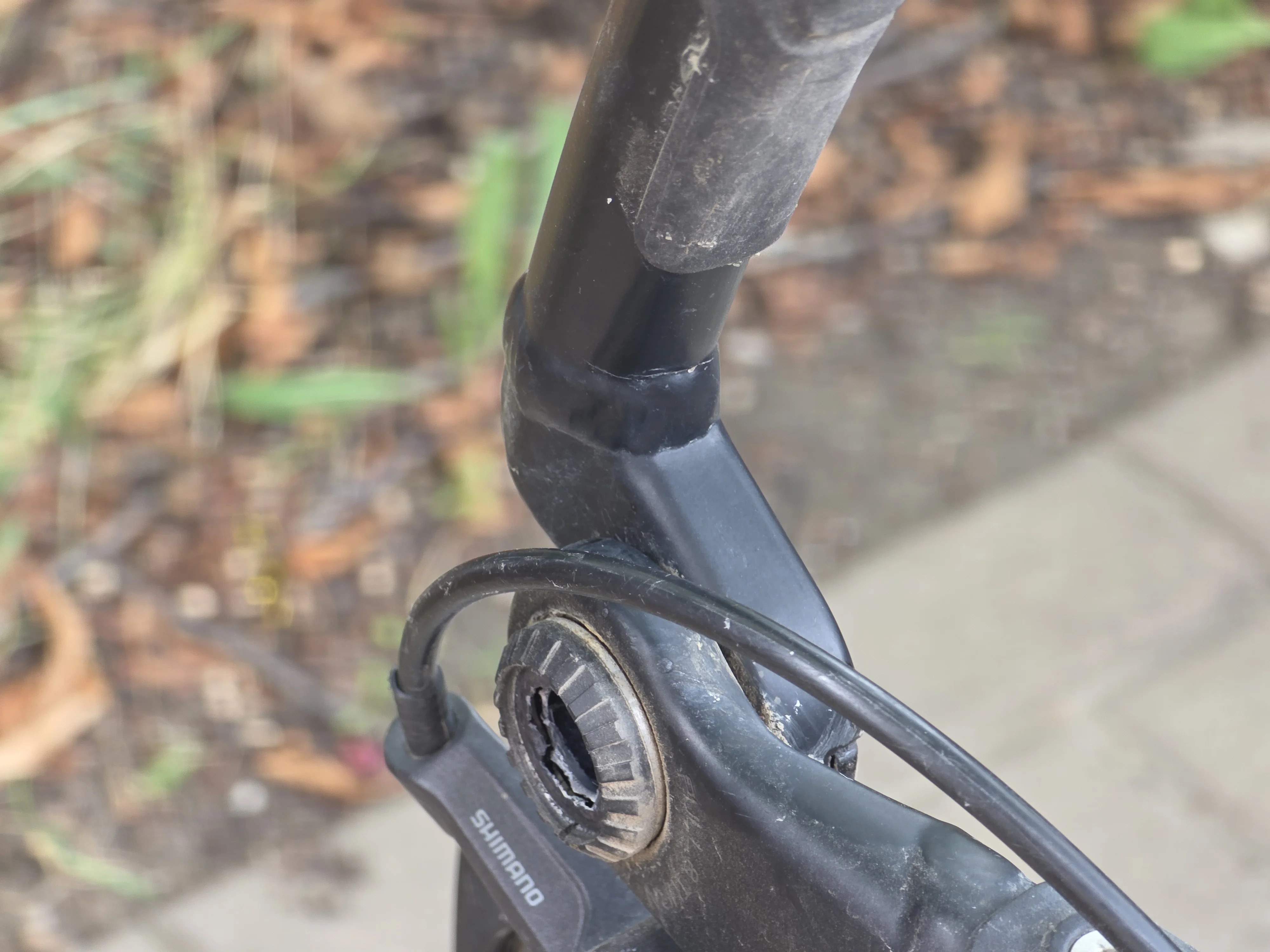
View attachment 188260
View attachment 188261

The rocker link arm progressively bent slightly (the rear section bent upward), and I've noticed the bearing holes/seats on the rocker link arm have oval holes, probably not what you want for round bearings...
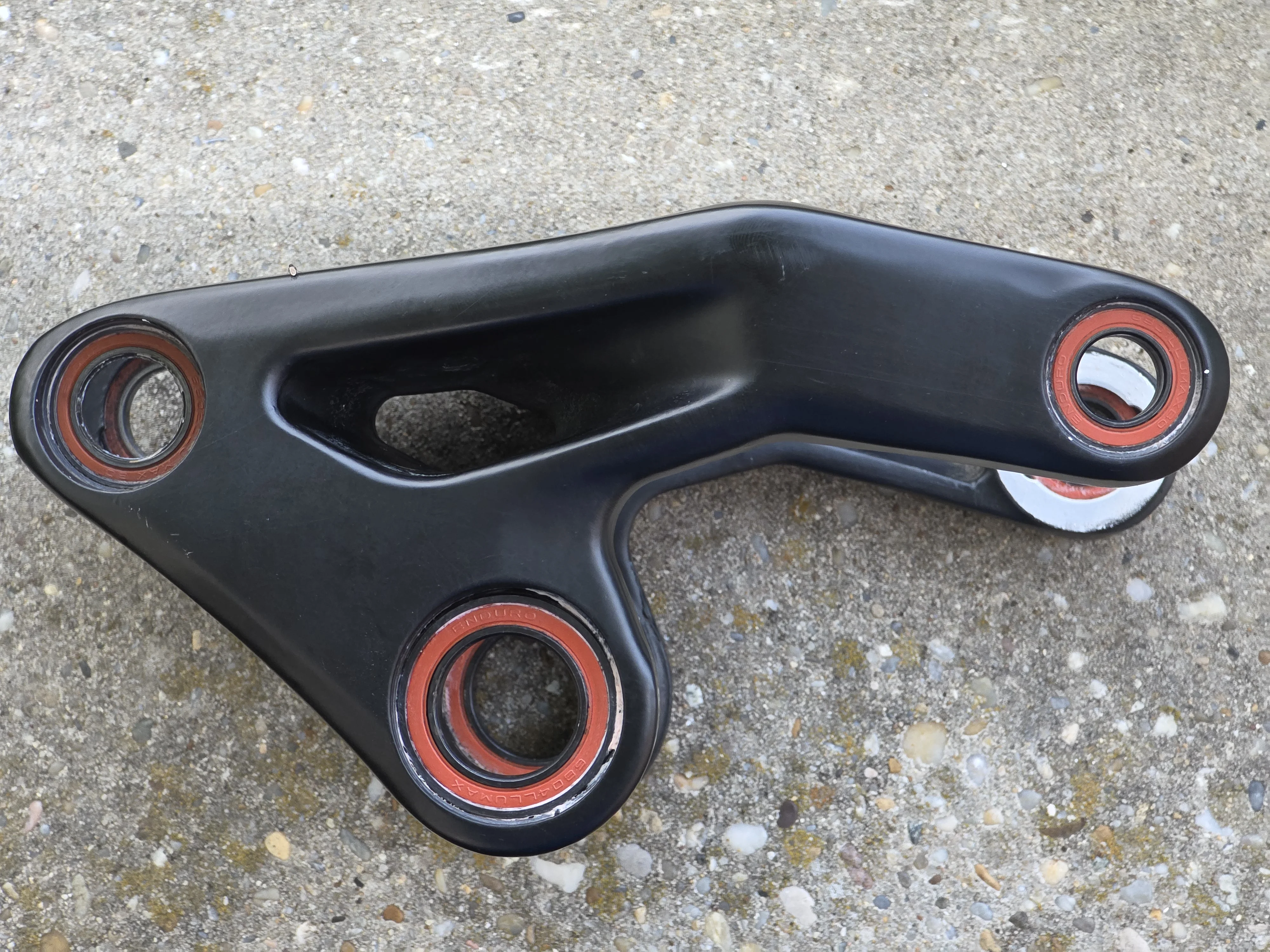
View attachment 188262
View attachment 188263

Notice that the bike is officially ASTM category 5 rated, which is a downhill bike standard, meaning Orbea allows you to hit jumps etc. and it shouldn't bend/break.
View attachment 188264

Talked to my dealer about these issues, they sent some photos to Orbea, but Orbea refused the warranty claim, stating that rear triangles are not covered by the lifetime warranty and neither is crash damage.

That's strange. Their very own lifetime warranty policy explicitly says that rear triangle is included, quote:


I also have no idea why they think this is a crash damage, there are just minor scratches on the frame, nothing you wouldn't expect on an enduro bike that's actually being used as one.
Sure, there were some minor tipovers, but the bike has never see a major direct impact, plus it still wouldn't explain any of the issues the frame has.

My dealer agrees this should've been covered by the lifetime warranty, but there isn't much they can do, as it's Orbea's decision now that the statutory warranty period is over.
The best offer they were able to get from Orbea was 250 euros for a replacement seatstay, but I believe they're still trying to negotiate.

When I bought the bike, the lifetime warranty on the frame has been a major decisive factor for me.
I certainly wouldn't have paid the insane full price knowing that warranty only exists on paper.

I'm disappointed.
High Rock Ruti

2021 Pole Voima two cracked rear suspension rocker arms they had one, Leo said okay, also $250, now he's gone silent. Worse yet "nothings covered gone bankrupt" worser still he's ignoring us now. BTW 7050 aluminum cannot be welded.

$10,000 usd down the drain.

Warm Regards Ruti

PS
2016 Pivot Shuttle rear cracked seat stay "trail damage" not even scratched paint "discounted" $750 usd, at least it still runs, and, that bike was ground breaking at the tine and still rides really well.

Good thing I have 6 other EMTB's

New Pivot shuttle amped, fabulous bike, that Avinox drive system is the best I've ever ridden, the 800 wattery is the way to go, Orbea wild with 625 watt is not enough......can't wait for a cracked frame, you know from the peace of mind of a "lifetime warranty"
 
I cracked a Giant Trance carbon frame when it was 8 years old.
100% covered by warranty.
Giant, and the LBS were superb.

I’ve bought 2 more since. (A Pro 1, and a Pro 0).
 
Keep reading
    Browse all

    Similar Threads

    Free account
    Join 42,563
    eMTB riders
    One tap. No forms. Fewer ads.
    or sign up with email
    Back
    Top