
Hey all, I have just over 400 miles on my 4 month old YT Decoy. It has Shimano 6100 chain, cassette and 36T 12 speed. I am diligent about cleaning and lubricating my setup, so am hoping I am doing something wrong and don't actually need an entire new chain, cassette etc. Chain is skipping in high gears. I have lost my chain stretch tool, but my question is: should I just order a new chain? If so, should I get 7100, or 8100 chain? Could the cassette be shot at 400 miles?!? Has anybody had this experience? Thanks in advance!
Navigation
Install the app
How to install the app on iOS
Follow along with the video below to see how to install our site as a web app on your home screen.
Note: This feature may not be available in some browsers.
More options
Style variation
You are using an out of date browser. It may not display this or other websites correctly.
You should upgrade or use an alternative browser.
You should upgrade or use an alternative browser.
Problems with Shimano chain
- Thread starter sandspit
- Start date


Don't know where you ride but 400 miles is very low mileage to have problems with Shimano Deore transmission.
Buy a new chain stretch tool (such as Park Tool CC-2). Then watch videos on Shimano derailleur indexing so you can do this yourself. Until you have done so don't mess with derailleur adjustment.
Buy a new chain stretch tool (such as Park Tool CC-2). Then watch videos on Shimano derailleur indexing so you can do this yourself. Until you have done so don't mess with derailleur adjustment.

Unlikely I'd say. If it's skipping in the higher gears only, I would check the B screw adjustment. Shimano 12 speed derailleurs have a mark on the wheel side of the cage that you should align about 5-6mm from the teeth of the largest sprocket. If that doesn't work, adjusting the clutch & likely winding off the tension a quarter turn can help, as can servicing the clutch itself. As noted, a chain check tool is a wise investment in general to keep across chain wear.Could the cassette be shot at 400 miles
B screw adjustment illustrated about 8 minutes into this video:
Just to say that last week adjusted my XT B screw only 1-2mm higher to exactly align the spacing plus a turn more cable tension, made it ultra slick again.B screw adjustment illustrated about 8 minutes into this video:
Last edited:

It could be a worn chain despite the low mileage. I used to buy cheap chains for my mtb and managed about 550 miles on each on each one and a new cassette after the third chain. Then I got a good deal on a bike and it came with a top end transmission. That just went on and on, I got over 3000 miles on the transmission. I now know (as do others on here) that money spent on chains is seldom wasted, so go 8100 (Shimano XT) or equivalent Sram. Also, the more expensive chains have special coatings and resist rust for longer.Hey all, I have just over 400 miles on my 4 month old YT Decoy. It has Shimano 6100 chain, cassette and 36T 12 speed. I am diligent about cleaning and lubricating my setup, so am hoping I am doing something wrong and don't actually need an entire new chain, cassette etc. Chain is skipping in high gears. I have lost my chain stretch tool, but my question is: should I just order a new chain? If so, should I get 7100, or 8100 chain? Could the cassette be shot at 400 miles?!? Has anybody had this experience? Thanks in advance!
if you want to know for certain whether it's the chain at fault, remove it and lay it on a flat surface. (I use the kitchen worktop with newspaper in between). Stretch it out and with a metal tape, measure 100 links from pin centre to pin centre. A new chain will measure 50" exactly. A worn chain will be longer. For example, if the chain is 50-3/8", the percentage length extension will be 3/8 divided by 50 = 0.0075. Times by 100 = 0.75% That is the level at which the chain should be scrapped (preferably earlier than that). Other percentages can be calculated. I tend to change mine before 0.6%. The higher the figure, the faster the chain wears away the rest of the transmission. I use a quick link to join the chain, so it makes removal and refitting so much easier than it would be using a rivet.
Worn chains are longer because the pitch is no longer 0.500" and they don't sit well in the gear teeth of the rest of your transmission. Instead of just sitting there, they slide up and down and wear away the teeth. But as this is your first chain, the cassette may not be too bad, if you are lucky. You should probably get a spare chain anyway. When you replace the chain, if the new one skips as well, then it is highly likely that the cassette is toast as well. In which case, put the old chain back on and run it until you can't stand the skipping anymore and then replace the cassette and put your new chain on that. The ring also wears, but at a much slower rate, you should get two cassettes per ring. But that is only a rule of thumb, not one of the laws of physics!
Last edited:

I agree there may be some wear on the chain after 400 miles but I doubt enough to cause the problem. It is far more likely to be indexing and since it is rare for B tension to change the most likely issue is cable tension...especially if no adjustment to that has been done from new. Cable tension invariably slackens after a bit of use simply because the outer cable compresses a little and cable stops also settle. Usually a bout 1 complete turn anticlockwise of the knurled cable adjuster on the shifter is enought to rectify the problem. ( also ensure the mech clutch is ON!) .
- Thread starter
- #7
Thank you. That is kind of what I figured, I think I will grab another chain - probably another 6100 for now, and then in another 400 miles upgrade the cassette and chain to 8100. I will let everyone know how it goes. I shouldn't complain: I am a fit rider, and have a 500w motor too, so I realize that is a lot of force going through the drivetrain. I will also probably take a look at the derailleur clutch like Rusty mentioned, I haven't had a rear derailleur yet that had one, so another potential source of trouble.It could be a worn chain despite the low mileage. I used to buy cheap chains for my mtb and managed about 550 miles on each on each one and a new cassette after the third chain. Then I got a good deal on a bike and it came with a top end transmission. That just went on and on, I got over 3000 miles on the transmission. I now know (as do others on here) that money spent on chains is seldom wasted, so go 8100 (Shimano XT) or equivalent Stam. Also, the more expensive chains have special coatings and resist rust for longer.
if you want to know for certain whether it's the chain at fault, remove it and lay it on a flat surface. (I use the kitchen worktop with newspaper in between). Stretch it out and with a metal tape, measure 100 links from pin centre to pin centre. A new chain will measure 50" exactly. A worn chain will be longer. For example, if the chain is 50-3/8", the percentage length extension will be 3/8 divided by 50 = 0.0075. Times by 100 = 0.75% That is the level at which the chain should be scrapped (preferably earlier than that). Other percentages can be calculated. I tend to change mine before 0.6%. The higher the figure, the faster the chain wears away the rest of the transmission. I use a quick link to join the chain, so it makes removal and refitting so much easier than it would be using a rivet.
Worn chains are longer because the pitch is no longer 0.500" and they don't sit well in the gear teeth of the rest of your transmission. Instead of just sitting there, they slide up and down and wear away the teeth. But as this is your first chain, the cassette may not be too bad, if you are lucky. You should probably get a spare chain anyway. When you replace the chain, if the new one skips as well, then it is highly likely that the cassette is toast as well. In which case, either put the old chain back on and run it until you can't stand the skipping anymore and then replace the cassette and put your new chain on that. The ring also wears, but at a much slower rate, you should get two cassettes per ring. But that is only a rule of thumb, not one of the laws of physics!

Not sure if anyone has mentioned it. But if the bike just suddenly started skipping gears, check you haven't bumped the derailleur and bent your hanger. This is the No.1 cause of chain skipping during a ride. That and B-screw moving.
I have a Derailleur Hanger Alignment and Adjustment tool I keep in the car for my mates, as I have SRAM Eagle Transmission and no hanger. It is my most used tool by my buddies.
I have a Derailleur Hanger Alignment and Adjustment tool I keep in the car for my mates, as I have SRAM Eagle Transmission and no hanger. It is my most used tool by my buddies.
- Thread starter
- #9
Not sure if anyone has mentioned it. But if the bike just suddenly started skipping gears, check you haven't bumped the derailleur and bent your hanger. This is the No.1 cause of chain skipping during a ride. That and B-screw moving.
I have a Derailleur Hanger Alignment and Adjustment tool I keep in the car for my mates, as I have SRAM Eagle Transmission and no hanger. It is my most used tool by my buddies.
So, the answer is yes: I did eat a large branch that broke one of my pulleys (see attached), I couldn't find the part, so I bought a whole new derailleur and swapped the cog. I completely aligned everything though (I'm pretty sure), and it only jumps in high gears under extreme load. This alignment tool, could you throw a link my way? It aligns the hanger/derailleur? Thank you all again for the help!Not sure if anyone has mentioned it. But if the bike just suddenly started skipping gears, check you haven't bumped the derailleur and bent your hanger. This is the No.1 cause of chain skipping during a ride. That and B-screw moving.
I have a Derailleur Hanger Alignment and Adjustment tool I keep in the car for my mates, as I have SRAM Eagle Transmission and no hanger. It is my most used tool by my buddies.
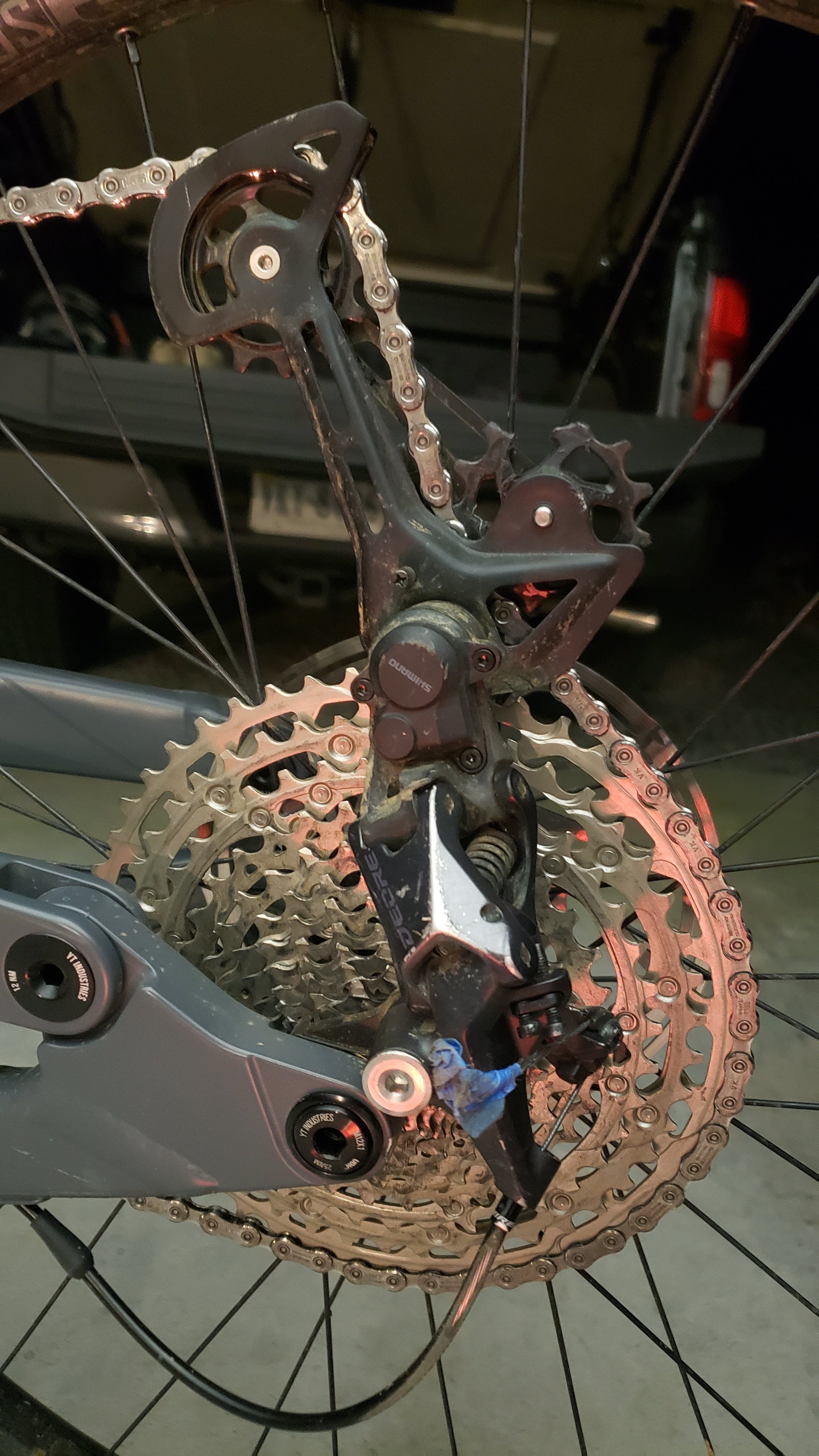

I also installed the 8100 Shimano chain and XT 12 speed cassette. Money well spent.It could be a worn chain despite the low mileage. I used to buy cheap chains for my mtb and managed about 550 miles on each on each one and a new cassette after the third chain. Then I got a good deal on a bike and it came with a top end transmission. That just went on and on, I got over 3000 miles on the transmission. I now know (as do others on here) that money spent on chains is seldom wasted, so go 8100 (Shimano XT) or equivalent Stam. Also, the more expensive chains have special coatings and resist rust for longer.
if you want to know for certain whether it's the chain at fault, remove it and lay it on a flat surface. (I use the kitchen worktop with newspaper in between). Stretch it out and with a metal tape, measure 100 links from pin centre to pin centre. A new chain will measure 50" exactly. A worn chain will be longer. For example, if the chain is 50-3/8", the percentage length extension will be 3/8 divided by 50 = 0.0075. Times by 100 = 0.75% That is the level at which the chain should be scrapped (preferably earlier than that). Other percentages can be calculated. I tend to change mine before 0.6%. The higher the figure, the faster the chain wears away the rest of the transmission. I use a quick link to join the chain, so it makes removal and refitting so much easier than it would be using a rivet.
Worn chains are longer because the pitch is no longer 0.500" and they don't sit well in the gear teeth of the rest of your transmission. Instead of just sitting there, they slide up and down and wear away the teeth. But as this is your first chain, the cassette may not be too bad, if you are lucky. You should probably get a spare chain anyway. When you replace the chain, if the new one skips as well, then it is highly likely that the cassette is toast as well. In which case, either put the old chain back on and run it until you can't stand the skipping anymore and then replace the cassette and put your new chain on that. The ring also wears, but at a much slower rate, you should get two cassettes per ring. But that is only a rule of thumb, not one of the laws of physics!

But I use the AXS GX SRAM derailer. It’s kinda a hack system but it’s worked well for me (4 years) with regular maintenance. (Chain, cassette replacement etc. )
No, it tells you whether or not your hanger & deraiileur are aligned to begin with. It's probably very pertinent that you damaged the drivetrain with a stick. No amount of adjustment or new chains will fix that if it has bent the mech and/or hanger even by a few degrees. First principles are a straight mech hanger & derailleur. Everything after that is fine tuning.It aligns the hanger/derailleur?
At this point, if you suspect your drivetrain is bent & adjusting/replacing parts doesnt work, then the cheapest option is to have a shop check it. Far cheaper to use their alignment gauge than buy one for a one off use chasing an everyday problem shops deal with all the time.
I’ve broken a few NX derailers but the derailer hanger was also bent. It’s a sacrificial alloy component that can only be straightened (derailer alignment tool) a few times before it breaks.
I’m just spit-balling here but that upper broken jockey wheel looks like the B screw needs adjustment.
The cable adjuster, at the shifting control, can also be called a barrel adjuster. (Fine tunes the cable tension and derailer alignment.
I’m just spit-balling here but that upper broken jockey wheel looks like the B screw needs adjustment.
The cable adjuster, at the shifting control, can also be called a barrel adjuster. (Fine tunes the cable tension and derailer alignment.
My guess is that the mech or the hanger, or both, are bent.So, the answer is yes: I did eat a large branch that broke one of my pulleys (see attached), I couldn't find the part, so I bought a whole new derailleur and swapped the cog. I completely aligned everything though (I'm pretty sure), and it only jumps in high gears under extreme load. This alignment tool, could you throw a link my way? It aligns the hanger/derailleur? Thank you all again for the help!
Last edited:
- Thread starter
- #14
No, it tells you whether or not your hanger & deraiileur are aligned to begin with. It's probably very pertinent that you damaged the drivetrain with a stick. No amount of adjustment or new chains will fix that if it has bent the mech and/or hanger even by a few degrees. First principles are a straight mech hanger & derailleur. Everything after that is fine tuning.
At this point, if you suspect your drivetrain is bent & adjusting/replacing parts doesnt work, then the cheapest option is to have a shop check it. Far cheaper to use their alignment gauge than buy one for a one off use chasing an everyday problem shops deal with all the ti
So I guess the idea that I could align/straighten the hanger or derailleur by eye is 'ambitious" at best? Ok, so I guess it's off to the LBS!No, it tells you whether or not your hanger & deraiileur are aligned to begin with. It's probably very pertinent that you damaged the drivetrain with a stick. No amount of adjustment or new chains will fix that if it has bent the mech and/or hanger even by a few degrees. First principles are a straight mech hanger & derailleur. Everything after that is fine tuning.
At this point, if you suspect your drivetrain is bent & adjusting/replacing parts doesnt work, then the cheapest option is to have a shop check it. Far cheaper to use their alignment gauge than buy one for a one off use chasing an everyday problem shops deal with all the time.
In the absence of an alignment tool, yes. As Stihldog says, the hanger is there to save the frame if you hit something out on the trail. In that sense, it's the system working as intended. Alignment tools are not very expensive but you'll barely ever need one, so while you can easily do your own alignment/diagnosis with one, I'd say it would sit in the toolbox for years on end unneeded, so might as well give the LBS a few bucks to get theirs out!
The good news is you're running a Deore derailleur. They're solid stuff but if it came to it, a new one can be had here for about £50 & hangers are typically £10-£20ish, so all in, you could be up & running again with shiny new parts for around $100, give or take the Trump tariffs!
The good news is you're running a Deore derailleur. They're solid stuff but if it came to it, a new one can be had here for about £50 & hangers are typically £10-£20ish, so all in, you could be up & running again with shiny new parts for around $100, give or take the Trump tariffs!
OK. First thing. That's a UDH Derailleur Hanger. Get yourself a spare. Just google SRAM UDH Hanger. Every LBS should carry them.This alignment tool, could you throw a link my way?
This is the alignment tool. I got it from Aliexpress. Feel free to pay 5 times more and buy from a LBS.

ZTTO MTB Rennrad Haken Ausrichtung Schaltwerk Ausrichtung Fahrrad Heckhaken 360° ° Rotation Ausrichtung Kalibrierung Werkzeug Radfahren Reparatur Werkzeug - AliExpress 18
Smarter Shopping, Better Living! Aliexpress.com
 www.aliexpress.com
Second thing. The derailleur cage could be bent. I would replace the derailleur. 12S Deore Derailleurs are not that expensive. Like USD$40.

Shimano DEORE RD-M6100 SGS Shadow+ 12-Gang-MTB-Schaltwerk SGS langer Käfig - AliExpress 18
Smarter Shopping, Better Living! Aliexpress.com
www.aliexpress.com
Oh BTW. Just saw that you are in America. Current Tariff things may have you paying much more if you buy from China.
Last edited:

Twisted Fork
Active member
If you do replace your derailleur hanger, make sure you don’t do what I just did recently and absent-mindedly wind it counter clockwise to loosen it. It has a reverse thread on it, so trying to spin it out counter clockwise shears the shank off in the frame with surprisingly little force. That was 3 hours of hellish drilling, prying and swearing to get the old one out that I’d rather not ever have to repeat.
In my case, the skipping problem was actually the derailleur clutch was too stiff from poor lubrication and mild corrosion, causing the chain to lose tension in the higher gears. A full strip down, cleaning and lube of the clutch mechanism cleared it right up. Takes some time to do it right, but now that I know how to do it, that will become part of my annual maintenance schedule.
In my case, the skipping problem was actually the derailleur clutch was too stiff from poor lubrication and mild corrosion, causing the chain to lose tension in the higher gears. A full strip down, cleaning and lube of the clutch mechanism cleared it right up. Takes some time to do it right, but now that I know how to do it, that will become part of my annual maintenance schedule.
Last edited:
- Thread starter
- #18
It's ironic how, since I couldn't get the pulleys alone for less than $30 USD, I bought an entire new replacement derailleur for $55, which I will install once I get another hanger. Thanks for all the input!In the absence of an alignment tool, yes. As Stihldog says, the hanger is there to save the frame if you hit something out on the trail. In that sense, it's the system working as intended. Alignment tools are not very expensive but you'll barely ever need one, so while you can easily do your own alignment/diagnosis with one, I'd say it would sit in the toolbox for years on end unneeded, so might as well give the LBS a few bucks to get theirs out!
The good news is you're running a Deore derailleur. They're solid stuff but if it came to it, a new one can be had here for about £50 & hangers are typically £10-£20ish, so all in, you could be up & running again with shiny new parts for around $100, give or take the Trump tariffs!

Amber Valley Guy
Well-known member
How did you go from a definite chain problem to a smashed jockey wheel, to buying a new rear mech, to admitting a stick went through it, to swapping only the jockey wheel when you had a brand new mech to replace it with, to it's a Shimano chain problem?????
- Thread starter
- #20
Well, frankly the pulley was broken at approximately 300 miles. I replaced it with a pulley from the new, un-installed derailleur. I eyed-out straightening of the bent derailleur. Everything ran fine for approximately 150 more miles. Then, only under extreme load, in higher gears, the chain started jumping the rear cogs. To this day, the gears switch perfectly, from to 10T to the 51T, no hesitation, or over guiding. Although I had taken 12 years away from riding (spine injury), it was acting just like the stretched chains/worn sprockets of old. The closest LBS is an hour away, and hours are not reliable, so here I am leaning on you guys, and Amazon.
- Thread starter
- #21
Thank you! What did you use to lubricate the derailleur clutch BTW? I think that clutch is an issue.If you do replace your derailleur hanger, make sure you don’t do what I just did recently and absent-mindedly wind it counter clockwise to loosen it. It has a reverse thread on it, so trying to spin it out counter clockwise shears the shank off in the frame with surprisingly little force. That was 3 hours of hellish drilling, prying and swearing to get the old one out that I’d rather not ever have to repeat.
In my case, the skipping problem was actually the derailleur clutch was too stiff from poor lubrication and mild corrosion, causing the chain to lose tension in the higher gears. A full strip down, cleaning and lube of the clutch mechanism cleared it right up. Takes some time to do it right, but now that I know how to do it, that will become part of my annual maintenance schedule.

I think title of your post is highly misleading. We all know that your problem is not shimano chain…Hey all, I have just over 400 miles on my 4 month old YT Decoy. It has Shimano 6100 chain, cassette and 36T 12 speed. I am diligent about cleaning and lubricating my setup, so am hoping I am doing something wrong and don't actually need an entire new chain, cassette etc. Chain is skipping in high gears. I have lost my chain stretch tool, but my question is: should I just order a new chain? If so, should I get 7100, or 8100 chain? Could the cassette be shot at 400 miles?!? Has anybody had this experience? Thanks in advance!
If you put the clutch on I.e move the lever to its left most position, then push the derailleur cage with your fingers forward toward the front of the bike, you'll feel the resistance the clutch provides. If it's not much, then your clutch needs tension winding on & vice versa.
There is a gauge you can buy to set this but practically no one bothers, just do it by feel. However, if the clutch feels notchy when you push it then it probably needs a service which consists of removing the cover, removing the clutch barrel from the band that surrounds it & cleaning & lubing the outside ONLY of the clutch barrel. Under no circumstances lube the inside.
Any general grease will do.
There is a gauge you can buy to set this but practically no one bothers, just do it by feel. However, if the clutch feels notchy when you push it then it probably needs a service which consists of removing the cover, removing the clutch barrel from the band that surrounds it & cleaning & lubing the outside ONLY of the clutch barrel. Under no circumstances lube the inside.
Any general grease will do.
Twisted Fork
Active member
I just used the light grease that came with my OneUp dropper post for now. Seemed that a heavier general purpose grease might be a bit too tacky, but probably wouldn’t be terrible either. Make sure you download the Shimano maintenance guide (or I’m sure there’s decent YouTube videos out there) because there are certain parts that must not be greased , or the clutch will slip.Thank you! What did you use to lubricate the derailleur clutch BTW? I think that clutch is an issue.
Last edited:
- Thread starter
- #25
I can assure you, I wasn't trying to be misleading.I think title of your post is highly misleading. We all know that your problem is not shimano chain…
Twisted Fork
Active member
In my case, I had to disassemble a bit further to remove the plate axle and tension spring, as that’s where the corrosion was happening. The plate axle was binding in the housing shaft. I used general purpose grease on the spring end of the plate axle where it sits in the housing shaft for a better moisture seal and the lighter grease on the cam unit and outer surface of the roller clutch.However, if the clutch feels notchy when you push it then it probably needs a service which consists of removing the cover, removing the clutch barrel from the band that surrounds it & cleaning & lubing the outside ONLY of the clutch barrel. Under no circumstances lube the inside.
- Thread starter
- #28
I guess this gets at my original question: if it were an alignment issue, wouldn't the increased tension on the chain make a misalignment less likely to manifest under load?My bike is now skipping in 12th gear on a new chain but only under load, making it hard to replicate in the stand. I have to take my own advice & work out whether it's a worn sprocket or a misalignment.
Not really. Alignment problems are exacerbated with load. The reason I mention the stand is you can usually see if a misalignment is present by looking closely at how the chain engages with a sprocket as it comes off the alignment pulley. If it's off centre, you should see the chain trying to climb onto the next sprocket or drop onto the one below. If it's well aligned & skipping under load, chances are you have wear.
fasterjason
Member
If by 12th gear you mean 10 tooth cog with a new chain, then I would wager worn cog.My bike is now skipping in 12th gear on a new chain but only under load, making it hard to replicate in the stand. I have to take my own advice & work out whether it's a worn sprocket or a misalignment.
Similar Threads
-
The Amflow and a Rusty Chain (A Penguin Classic © for Cantankerous Old Men).
- Started by Gareth-OJ
- Replies: 85
-
-
How to tell if modern cassette is worn out?
- Started by billium
- Replies: 11
-

-
