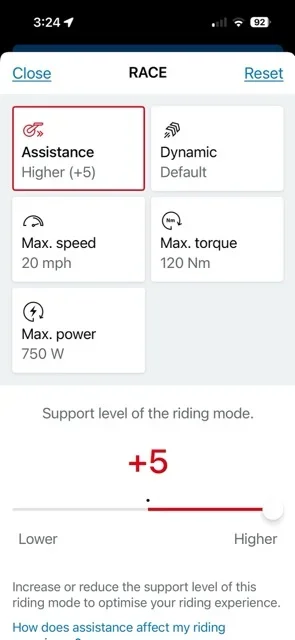
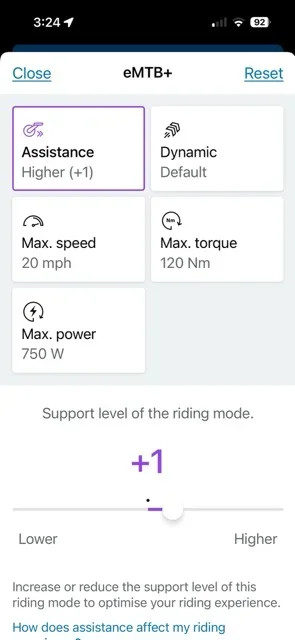
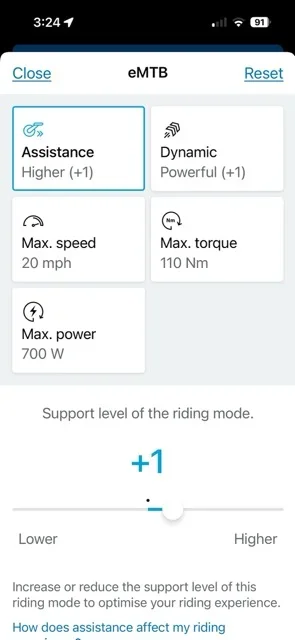
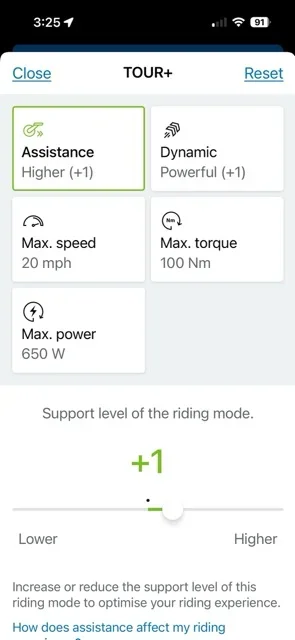
No 3: I am intrigued that you say that "dynamic control is only available in .... turbo and emtb+ modes...." I don't have emtb+ but I do have the Dynamic slider across the board (Turbo to Eco).
This info is from the footnotes section of the detail description for Turbo and eMTB+ riding modes, I highlighted some parts in bold:
"With the
built-in dynamic control you ride with
full control in eMTB+ and Turbo mode, even if you've increased your performance values. In steep, bumpy riding situations, you have superior propulsion and on loose or damp surfaces it
functions like traction control. If the trail and your riding style change dynamically, the
sensor technology recognizes this and the software intelligently compensates for it. This maintains the dynamics, while the handling of the drive unit is confident and lively – and still fully controllable. This allows you to overcome challenging sections with ease. Dynamic control works optimally with the built-in sensors – without having to install additional cables, sensors, or sensor discs on the swing arm and rear wheel.
Dynamic control is only available for the Performance Line CX (BDU384Y) and Performance Line CX-R."
Or is "Dynamic" on the app, different to the "Dynamic Control" that you quote Bosch as saying in your post?
Yes, "dynamic" and "dynamic control" are two different things. The dynamic from the app slider is controlling how quickly the motor reacts to you pushing on the pedals. From an older OEM technical manual I have from Bosch I know that with all motors available in 2018 (including the CX gen4 non-smart) Bosch stated an average of 300 milliseconds reaction time. This might have improved slightly for the newest generation motors. The dynamic slider controls these 300 milliseconds to make the response to pedal input faster or slower.
The dynamic control feature was introduced with the performance update 1.0 that brought us 100 Nm, 750 W and the eMTB+ mode in late 2025.
As I mentioned before it does make sense to include this sort of traction control to the two highest powered modes which can easily get the rear wheel spinning in technical uphills. With modes like Eco or Tour this won't happen because they simply don't add enough motor power.
What I believe I need is access to a link that takes me to all the Bosch stuff that describes all these things, what the different modes do, their power & torque curves etc. The more detail the better.
The best collection you will find is on the Bosch website under Products-> Riding Modes.
This page received a complete overhaul at the end of 2025 taking all the new features and performance options into account.
You will find all 12 riding modes, plus Off at the top of the page with their max. support, battery consumption and type of support curve (constant, dynamic or automatic). Tap the "read more" link on each one to open an overlay with more details about intended purpose, features and important footnotes about any restrictions.
After reading through these scroll further down the page until you see the header "Riding Modes Compared". Below that is an interactive line graph showing the motor power on the Y-Axis and rider input power on the X-Axis for any mode you choose. Comparing the different lines quickly shows how different the various modes react to rider power and give you a good starting point selecting the max. four modes (plus Off) to activate on your bike.
Keep in mind that the power curves shown are based on the slider for support in the default (0) position.