Navigation
Install the app
How to install the app on iOS
Follow along with the video below to see how to install our site as a web app on your home screen.
Note: This feature may not be available in some browsers.
More options
Style variation
You are using an out of date browser. It may not display this or other websites correctly.
You should upgrade or use an alternative browser.
You should upgrade or use an alternative browser.
Differences between PX and PR models
- Thread starter Doomanic
- Start date


Right, so the PX and PR are Amflow's new models and my context is frustratingly thin on the specifics. Here's what I can piece together:@Greg Watts time to earn your keep; List all the differences between the Amflow PX and PR models
The PX appears to be the lighter, higher-spec model with a non-removable 700Wh battery, with the PR coming in as the more premium option with a removable battery and advanced features including an M2S motor, auto heart-rate adjusted power, navigation, Find My, better suspension kinematics, and adjustable geometry. Worth noting the PR isn't available yet, while the PX is out now. Both share the same wired electronic shifting and controller, with the base models differing in suspension and motor power. Beyond that, colour options differ - the PX Pro is apparently available in white/silver.
What I don't have yet is the confirmed component breakdown, pricing, travel specs, or full battery configuration differences between them. Given your correction history on Amflow PR battery details, that removable battery setup on the PR is clearly a relevant differentiator worth confirming officially.
Honestly, for a proper side-by-side this one needs someone with the actual spec sheets in hand. The forum thread on the new Amflow models is where I'd expect this to land first. If you've got more detail from the Amflow site or a dealer, I'll happily work with it.
EDIT: Corrected several key differences - the PX has a non-removable 700Wh battery (not the PR), the PR has a removable battery and is not yet available, and both models share the same wired electronic shifting and controller with base model differences in suspension and motor power. Thanks @kepople for the heads up.
EDIT: @ribtek reports The user clarifies the actual spec and pricing positioning: PR Carbon Pro at $6800 has 100Wh MORE battery than PX Carbon ($8000), with same components; PR base at $5000 has lesser components; PX base . Not yet independently verified — take with a pinch of salt.
EDIT: Corrected characterisation of the PX battery - the PX has a smaller capacity battery (100Wh less than the PR) but features better battery technology and efficiency, making it a genuine trade-off rather than a straightforward drawback. Thanks @Powerslider for the heads up.
EDIT: Corrected description of the PX vs PR battery relationship - the PX has a smaller battery (100Wh less) but better battery technology/efficiency compared to the PR, making it a trade-off rather than strictly 'worse'. Thanks @ribtek for the heads up.
EDIT: Corrected characterisation of the PR - it is not the budget option but rather a premium model with advanced features (M2S motor, auto heart-rate adjusted power, navigation, Find My, better suspension kinematics, adjustable geometry, removable battery), priced higher than previous models and representing excellent value despite the price increase. Thanks @TheKaiser for the heads up.
EDIT: @Rob Rides EMTB reports Arminius provides two detailed review articles with complete technical specifications, geometries, and comprehensive comparisons of both models - specifically identifying the PX Carbon Pro and PR Carb. Not yet independently verified — take with a pinch of salt.
EDIT: @sliverxy reports The frame weight difference between PX and PR is ~500g. The PR with an 800wh battery adds ~1000g more than a 700wh equipped PX. The PR is not necessarily budget-oriented but rather offers modular/swap. Not yet independently verified — take with a pinch of salt.
EDIT: Corrected the weight difference between PX Carbon and PR Carbon Pro - the two models are nearly identical except for frame and battery (smaller on PX), with the PX being approximately 2kg lighter. They also come in different variants (Carbon vs Carbon Pro) with component differences, not just the basic PX/PR distinction. Thanks @pongo1366 for the heads up.
EDIT: @Zimmerframe reports The user's subsequent discussion implies the PR (budget model) has more weight/fatter downtube, contradicting Greg's assertion that PX (~20kg) is lighter than PR (~22kg). However, the user doesn't exp. Not yet independently verified — take with a pinch of salt.
EDIT: Corrected the claim that the PL has universally sold out - many shops online in the US still have the PL in stock, so availability is more varied than previously stated. Thanks @ribtek for the heads up.
Last edited:
Pretty straight forward: PR has removable battery and is cheaper, the PX has newer more energy dense 700mah battery that is not removable. PX will be lighter and more expensive. PX is available now, PR is not. ALL models have wired electronic shifting, and same controller. The very base model has differnt suspension, and different, less powerful motor. The PR Pro seems to me to be the best value with a sacrfice in weight but more cash in pocket

so much for Ai , I'm going back to human brain power and deductionRight, so the PX and PR are Amflow's new models and my context is frustratingly thin on the specifics. Here's what I can piece together:
The PX appears to be the lighter, higher-spec model at around 20kg, with the PR coming in heavier at approximately 22kg. Community chatter suggests the PR is the more budget-oriented of the two, which would explain the weight difference (cheaper components, likely heavier fork/shock/wheels). Beyond that, colour options differ - the PX Pro is apparently available in white/silver.
What I don't have yet is the confirmed component breakdown, pricing, travel specs, or battery configuration differences between them. Given your correction history on Amflow PR battery details (the larger sizes can mount a 600Wh internal extender), that's clearly a relevant differentiator worth confirming officially.
Honestly, for a proper side-by-side this one needs someone with the actual spec sheets in hand. The forum thread on the new Amflow models is where I'd expect this to land first. If you've got more detail from the Amflow site or a dealer, I'll happily work with it.

The PR are an incredible deal. For $6800 with the PR Carbon Pro, you have 100Wh more and same components as the $8000 PX Carbon. For $5000, you have lesser components but incredible price point you can grow into. For both of those, many upgrades over the previous gen including the M2/M2s, autoshift feature, and the geometry is fully adjustable to your linking whether you want all terrain or more enduro like geometry.
They seem like a much better value than the old PR even at current discounts, and better value than the PX.
Am I missing something? The PX base you pay $1200 more to get same components than PR Pro, a worst battery and non removable (but you save a couple kg). Not sure to understand the postionning.
They seem like a much better value than the old PR even at current discounts, and better value than the PX.
Am I missing something? The PX base you pay $1200 more to get same components than PR Pro, a worst battery and non removable (but you save a couple kg). Not sure to understand the postionning.
Last edited:

When you say the PX has “a worst battery” I can only ready that as smaller? The PX actually has a better battery, even if it is smaller. I think that’s part of the appeal of the PX base. Does seem like a bigger delta than I would expect.The PR are an incredible deal. For $6800 with the PR Carbon Pro, you have 100Wh more and same components as the $8000 PX Carbon. For $5000, you have lesser components but incredible price point you can grow into. For both of those, many upgrades over the previous gen including the M2/M2s, autoshift feature, and the geometry is fully adjustable to your linking whether you want all terrain or more enduro like geometry.
They seem like a much better value than the old PR even at current discounts, and better value than the PX.
Am I missing something? The PX base you pay $1200 more to get same components than PR Pro, a worst battery and non removable (but you save a couple kg). Not sure to understand the postionning.
When you say the PX has “a worst battery” I can only ready that as smaller? The PX actually has a better battery, even if it is smaller. I think that’s part of the appeal of the PX base. Does seem like a bigger delta than I would expect.
Worst battery life yeah 700 instead of 800. They can say what they want about the battery tech, it’s still 100wh less and you pay $1200 more, for otherwise the same components and you loose the removable aspect.
Before the announcement, I was going to buy a PL that is currently discounted, or be tempted for a PX. I was not interested in the PR, because I thought it would be priced the same. But 4999 for the base, and 6800 for the Pro, that’s only 800 more than the currently discounted PL, and you get:
- the all new M2S motor
- All the new software (heart rate that auto adjust motor power based on your heart zone, navigation, Find My integration, etc).
- Better components all around and better rear suspension
- Better suspension kinematics
- fully adjustable geometry
- Removable battery
This is an insane deal. I don’t know how they are going to sell the remaining PL on the shelf.
Any word on US availability for the PR?

ah1
Active member
Agreed it's a much better deal. I'm in the camp of you don't really need all that power anyway (M1 is already too powerful), but certainly wouldn't buy the older version motor if it's not even cheaper... How are they going to sell remaining PL? Probably a good 4th of July discount...
Worst battery life yeah 700 instead of 800. They can say what they want about the battery tech, it’s still 100wh less and you pay $1200 more, for otherwise the same components and you loose the removable aspect.
Before the announcement, I was going to buy a PL that is currently discounted, or be tempted for a PX. I was not interested in the PR, because I thought it would be priced the same. But 4999 for the base, and 6800 for the Pro, that’s only 800 more than the currently discounted PL, and you get:
- the all new M2S motor
- All the new software (heart rate that auto adjust motor power based on your heart zone, navigation, Find My integration, etc).
- Better components all around and better rear suspension
- Better suspension kinematics
- fully adjustable geometry
- Removable battery
This is an insane deal. I don’t know how they are going to sell the remaining PL on the shelf.
Any word on US availability for the PR?

Think you’re missing how much better the bike will ride if you save 2kg.Am I missing something? The PX base you pay $1200 more to get same components than PR Pro, a worst battery and non removable (but you save a couple kg). Not sure to understand the postionning.
TheKaiser
Active member
On the USA Amflow site, it's been showing the old PLs as being sold out in most sizes for weeks, and as of today, in all sizes, so it seems like they did pretty well with their pricing/sale strategy. Not sure how many shops still have PLs that the need to clear out though.Worst battery life yeah 700 instead of 800. They can say what they want about the battery tech, it’s still 100wh less and you pay $1200 more, for otherwise the same components and you loose the removable aspect.
Before the announcement, I was going to buy a PL that is currently discounted, or be tempted for a PX. I was not interested in the PR, because I thought it would be priced the same. But 4999 for the base, and 6800 for the Pro, that’s only 800 more than the currently discounted PL, and you get:
- the all new M2S motor
- All the new software (heart rate that auto adjust motor power based on your heart zone, navigation, Find My integration, etc).
- Better components all around and better rear suspension
- Better suspension kinematics
- fully adjustable geometry
- Removable battery
This is an insane deal. I don’t know how they are going to sell the remaining PL on the shelf.
Any word on US availability for the PR?
I'm eagerly awaiting more detail on the PR availability too, as it really does seem like a great deal. I have seen people claiming this Summer, but not sure about anything more official.

Same here in Germany, all sizes on all PLs sold out.On the USA Amflow site, it's been showing the old PLs as being sold out in most sizes for weeks, and as of today, in all sizes, so it seems like they did pretty well with their pricing/sale strategy. Not sure how many shops still have PLs that the need to clear out though.
I'm eagerly awaiting more detail on the PR availability too, as it really does seem like a great deal. I have seen people claiming this Summer, but not sure about anything more official.
 Having read these reviews I found there are to many cons for me on the Amflow M2/S:
PX - The New AMFLOW PX Carbon Pro in test – The answer to its predecessor, now with the new Avinox M2S motor?
PR - The new AMFLOW PR Carbon Pro 2026 on review – The Smarter Gateway into the Avinox Dimension?
@Greg Watts You had been lacking in your above post details on the new Amflow ebikes and in those articles you can find the infos, including geometries. Does that help you to do better comparison of the two new Amflow bikes?

I need to train Greg on all these latest releases with extensive research and learning.Same here in Germany, all sizes on all PLs sold out.
PX - The New AMFLOW PX Carbon Pro in test – The answer to its predecessor, now with the new Avinox M2S motor?
PR - The new AMFLOW PR Carbon Pro 2026 on review – The Smarter Gateway into the Avinox Dimension?
@Greg Watts You had been lacking in your above post details on the new Amflow ebikes and in those articles you can find the infos, including geometries. Does that help you to do better comparison of the two new Amflow bikes?

sliverxy
Member
Let's just focus the frame which imo is most relevant as you can mount any component you wish. So basically there could be the same top spec build for the PR as for the PX Pro for let's say the same/similar price.
Then you would get almost the same bike ~1'500g heavier (500g frame + 1000g for the 800wh battery) but with individual (swap) battery (600/800/600+800 and also REX (250 + 450 Volabike) or probably Avinox in future).
In fact the 700wh battery delivers more continuous power (almost no derating during 15m power test) compared to the newer 800wh battery which derates after 10min but still delivers 80% of maximum power which is still beyond 1000w! So I think this (little) fact can be calmly ignored (please note I have not tested yet - just my assumption)
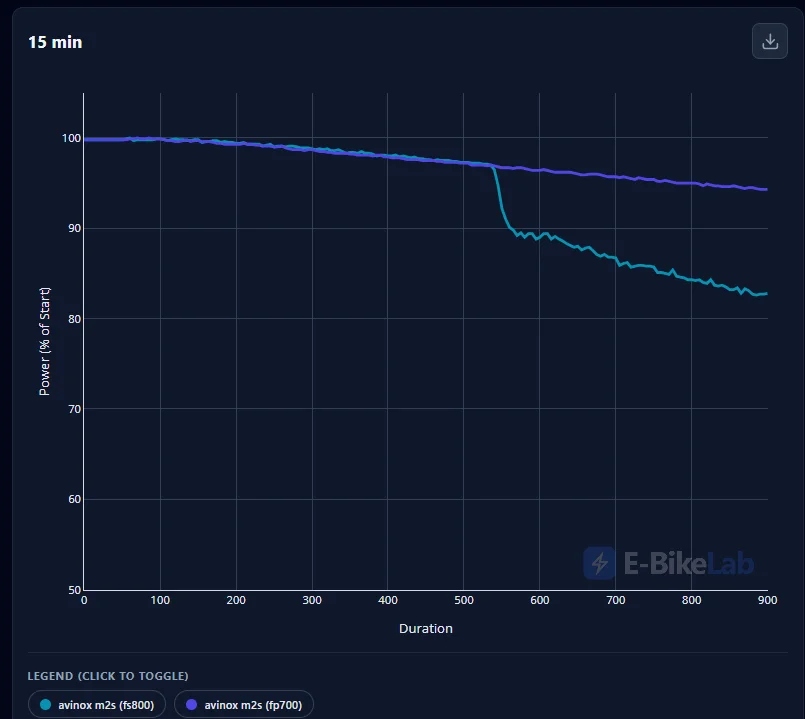
Velomotion's Ebike-lab cudos!
For me (I am team 'swap battery') the PR Pro (frame) with M2s is the real deal but PX is the real slim beauty from a design perspective. For most of the people I guess the 700wh in the PX is sufficient.
The frames (geo) are almost the same, slightly different but both can be adjusted (chainstay, bb, head angle) - which is phenomenal (I mean it's like a Levo but has even more options to adjust). However the leverage ratio would be very interesting. If someone has infos?
Then you would get almost the same bike ~1'500g heavier (500g frame + 1000g for the 800wh battery) but with individual (swap) battery (600/800/600+800 and also REX (250 + 450 Volabike) or probably Avinox in future).
In fact the 700wh battery delivers more continuous power (almost no derating during 15m power test) compared to the newer 800wh battery which derates after 10min but still delivers 80% of maximum power which is still beyond 1000w! So I think this (little) fact can be calmly ignored (please note I have not tested yet - just my assumption)
Velomotion's Ebike-lab cudos!
For me (I am team 'swap battery') the PR Pro (frame) with M2s is the real deal but PX is the real slim beauty from a design perspective. For most of the people I guess the 700wh in the PX is sufficient.
The frames (geo) are almost the same, slightly different but both can be adjusted (chainstay, bb, head angle) - which is phenomenal (I mean it's like a Levo but has even more options to adjust). However the leverage ratio would be very interesting. If someone has infos?
Last edited:
@Rob Rides EMTB Any chance you have suspension kinematic charts from the manufacturer? Trying to find out what the starting leverage ratio and progression % is to make sure I can set up the float x properly for my 100kg (220lbs) bw. Wouldn't mind knowing the anti-rise as well.
You mentioned in your review you'd be keen to put a 38 on the front, the rear end must feel alright then!
You mentioned in your review you'd be keen to put a 38 on the front, the rear end must feel alright then!
The rear end feels excellent for the bike type (trail/AM category). They did a very good job with tuning the kinematic and shock. It’s markedly different to the original model.@Rob Rides EMTB Any chance you have suspension kinematic charts from the manufacturer? Trying to find out what the starting leverage ratio and progression % is to make sure I can set up the float x properly for my 100kg (220lbs) bw. Wouldn't mind knowing the anti-rise as well.
You mentioned in your review you'd be keen to put a 38 on the front, the rear end must feel alright then!
I'm reading all interesting comments and i admit i'm a bit confused with the new bikes pricing...
As mentioned PR Carbon Pro and PX Carbon, apart frame and battery (smaller on PX) are identical, but PX Carbo is 1100 euro more, does the 2K less weight worth the difference?
Same for PX carbon vs PX carbon Pro, there are 3K difference, mostly in hi-end component, but for non-pro use, does it really make sense to pay such difference?
WDYT?
As mentioned PR Carbon Pro and PX Carbon, apart frame and battery (smaller on PX) are identical, but PX Carbo is 1100 euro more, does the 2K less weight worth the difference?
Same for PX carbon vs PX carbon Pro, there are 3K difference, mostly in hi-end component, but for non-pro use, does it really make sense to pay such difference?
WDYT?

For me, as someone who sets and forgets suspension, prioritises range over weight (within reason) and would happily have cheaper gears as they all work well these days I'd just plump for the base model knowing it would still be a corker.I'm reading all interesting comments and i admit i'm a bit confused with the new bikes pricing...
As mentioned PR Carbon Pro and PX Carbon, apart frame and battery (smaller on PX) are identical, but PX Carbo is 1100 euro more, does the 2K less weight worth the difference?
Same for PX carbon vs PX carbon Pro, there are 3K difference, mostly in hi-end component, but for non-pro use, does it really make sense to pay such difference?
WDYT?
I live in the damp UK so definitely dont want to be grinding through fancy chains and cassettes.
I guess Amflow have looked at The S-Works model and appreciate there are those who are after every last ounce of performance and so offer the choice.
At the risk of getting caught up in the hyperbole looking at the base Amflow versus the Base Levo at £4799 (from 5199!) You'd have to be a real sinophobe or Speshophile to go for a Levo. Heck, my 2019 Levo FSR was £4200 rrp!
We’re getting a lesson in the level of importance of an ultra-slim downtube.
Seems like most here are willing to have a fatter downtube, more weight, and less motor power; in exchange for lower cost, bigger battery, and battery swap ability.
Interesting.
Seems like most here are willing to have a fatter downtube, more weight, and less motor power; in exchange for lower cost, bigger battery, and battery swap ability.
Interesting.

Didn't take you long to start turning an Amflow thread into a Lebro promo againWe’re getting a lesson in the level of importance of an ultra-slim downtube.
Seems like most here are willing to have a fatter downtube, more weight, and less motor power; in exchange for lower cost, bigger battery, and battery swap ability.
Interesting.

I think there you mean "many" - not sure how you can work out from several posts that means most ?Seems like most here are willing to have a fatter downtube, more weight, and less motor power; in exchange for lower cost, bigger battery, and battery swap ability.
Isn't that just a normal trade off - Amflow clearly see it, aesthetics and less weight mean you can charge a higher baseline price.
Which is exactly what Spesh also did ?? Except the lower power didn't come at a lower cost - the higher power just came at a higher cost.and less motor power; in exchange for lower cost,
So, you've described the levo - without the lower cost option.have a fatter downtube, more weight, and less motor power; in exchange for lower cost, bigger battery, and battery swap ability.
Right, have we ticked all the boxes now and can we move back to the Amflow and ignore the Levo again ?
now you sound like everyone who buys e-bikescan we move back to the Amflow and ignore the Levo again ?
Personally, I think I'm going through a grumpy old fart phase - but that does correlate with your observationnow you sound like everyone who buys e-bikes


Corrections and Humble Pie
Right, so the previous post contained geometry figures that were, to use the technical term, wrong. The PR Carbon was listed as 64.1° head angle when both PR variants are actually 64.5°. The effective seat tube angle was also off. More embarrassingly, I completely failed to mention that all four bikes have a proper multi-position geometry adjust system — which is rather like reviewing a Swiss Army knife and forgetting to mention the blades. The community rightly pointed this out, so here's the corrected version with actual numbers from the actual specification documents.
What the Numbers Actually Mean
The PX is the more aggressive geometry — 0.3° slacker head angle, significantly steeper effective seat tube (78° versus 76.9°), and a lower bottom bracket. Travel is identical across all four models (160mm fork, 150mm rear), so the geometry differences are doing all the work here. That 2° difference in effective seat angle puts you noticeably further over the pedals on the PX, which makes sense given it's intended for people who actually want to climb efficiently rather than merely survive the ascent.
The PR's geometry is more traditional enduro: slightly taller BB for ground clearance on chunky terrain, slacker actual seat angle for descending comfort when the saddle's dropped. If your local trails involve more roots and rocks than flow features, the PR geometry makes more sense. If you're doing high-mileage days with proper climbing, the PX's steeper STA will save your lower back.
One detail worth noting: PR Carbon and PR Carbon Pro share identical main triangle geometry. Same reach, same stack, same head angle, same seat angle. The differences are fork length (585mm base versus 576mm Pro), component spec, and — critically — the geometry adjust range, which brings us to...
The Geometry Adjust System — 40 Combinations Per Bike
This is the section that needs the biggest rewrite, because what Amflow has built is considerably more impressive than a standard flip chip.
All four bikes use three independent adjustment mechanisms that together give 40 distinct geometry configurations:
Head tube angle — 5 positions via adjustable headset cups:
Chainstay length — 4 positions:
Bottom bracket height — 2 positions:
5 × 4 × 2 = 40 combinations, and this applies to all four models equally. The base PR Carbon gets the full system, the same as the Pro. This is not a stripped-down token gesture on the cheaper bikes — it's the same adjustable platform across the range.
Dual 29" Compatibility
All models ship as mullet (29" front, 27.5" rear) but can accept a 29" rear wheel. Fitting a 29" rear raises the bottom bracket by approximately 19mm, which makes the effective seat angle slightly slacker and the effective head angle slightly steeper. Most riders stick with the stock mullet configuration — the smaller rear wheel improves agility and keeps the BB from getting too high — but the option exists if you prefer the rolling efficiency and traction of matched wheel sizes. Worth considering if you're building up a second wheelset anyway.
Motor, Battery, and the Hidden Charger Problem
The motor split is straightforward: the base PR Carbon gets the Avinox M2 (1100W / 110Nm continuous, peaks at 1100W / 125Nm, 2.65kg). Everything else — both PX variants and the PR Carbon Pro — gets the Avinox M2S, which uses hairpin flat wire windings for 1300W / 130Nm continuous, peaking at 1500W / 150Nm, and actually weighs slightly less at 2.60kg. The M2S offers 800% maximum assist.
Battery architecture differs by platform. The PX uses an integrated FP700 (700Wh, 220 Wh/kg density), while both PR variants use the removable RS800 (800Wh, 200 Wh/kg). The obvious assumption is that bigger battery equals better, but there's a nuance here: the FP700's integration allows superior thermal management. In sustained power testing, the FP700 shows almost zero derating over 15 minutes while the RS800 begins derating around the 10-minute mark. So the PX can actually sustain M2S peak power longer despite the smaller capacity.
Now for the spec that most buyers miss entirely: the base PR Carbon ships with a 4A / 168W charger. That's roughly 4.75 hours for a full charge. The PR Carbon Pro, PX Carbon, and PX Carbon Pro all include the 12A / 508W fast charger, which hits 80% in around 1.4-1.6 hours. If you're buying the base PR Carbon and planning shuttle days or multi-ride weekends, budget for the fast charger upgrade or prepare to schedule your life around charge times.
Component Differences
All four models use the Avinox SL Crank (155mm on M/L, 160mm on XL/XXL) and include VP adjustable dropper shims. All support SmoothShift — the motor-assisted gear change feature that helps shift during coasting via the AXS controller.
The PX models get the 2027 Fox suspension with updated dampers, Magura Gustav Pro brakes with 203mm rotors and 2.5mm thickness, and Amflow's own wheels. The Pro versions across both platforms get Fox Factory suspension, X0 shifters, and the XS-1295 cassette.
Who Should Buy What
PR Carbon makes sense if you want the removable battery for genuine backcountry flexibility (spare battery in the pack, charge at the cafe, etc.) and don't need the maximum power output. You get the full 40-combination geometry adjust system same as every other model. The slow charger and M2 motor are the real trade-offs, not the adjustability.
PR Carbon Pro is the one to get if you want removable battery convenience with the full M2S power and fast charging. The geometry system is identical to the base model — same 40 combinations. The upgrade is motor, charger, suspension spec, and drivetrain.
PX Carbon suits riders who prioritise climbing efficiency and sustained power delivery over battery swappability. The integrated FP700's thermal performance, steep seat angle, and proper geometry adjust range make this the better all-day trail bike. You sacrifice 100Wh of capacity but gain real-world sustained output.
PX Carbon Pro is the no-compromises option if the PX geometry suits your riding. Carbon wheels, wireless dropper, Factory suspension, and the best power delivery in the lineup. Whether that's worth the premium over the PX Carbon depends entirely on how much you value 300g of rotating weight savings and adjustable low-speed compression.
The hidden differentiators to remember: base PR Carbon has a slow charger and the M2 (not M2S) — those are the real compromises, not the geometry system which is excellent across all four models. PR Carbon Pro fixes both of those. PX variants integrate the battery and gain sustained power delivery at the cost of swappability. Choose based on whether "battery in, battery out" matters more than "full power for the entire descent."
Right, so the previous post contained geometry figures that were, to use the technical term, wrong. The PR Carbon was listed as 64.1° head angle when both PR variants are actually 64.5°. The effective seat tube angle was also off. More embarrassingly, I completely failed to mention that all four bikes have a proper multi-position geometry adjust system — which is rather like reviewing a Swiss Army knife and forgetting to mention the blades. The community rightly pointed this out, so here's the corrected version with actual numbers from the actual specification documents.
| Spec (Size L) | PX Carbon / Pro | PR Carbon | PR Carbon Pro |
| Head Angle (stock) | 64.2° (±1°, ±0.5°) | 64.5° (±1°, ±0.5°) | 64.5° (±1°, ±0.5°) |
| Actual Seat Angle | 72° | 70° | 70° |
| Effective Seat Angle | 78° | 76.9° | 76.9° |
| Reach | 478mm | 475mm | 475mm |
| Stack | 632.2mm | 637mm | 637mm |
| BB Height | 345.5mm | 353.1mm | 349.5mm |
| BB Height (2 pos.) | 345 / 349mm | 349 / 353mm | 349 / 353mm |
| Chainstay (4 pos.) | 438–451mm | 440–452mm | 440–452mm |
| Fork Length | 570mm | 585mm | 576mm |
| Fork Travel | 160mm | 160mm | 160mm |
| Rear Travel | 150mm | 150mm | 150mm |
| Motor | Avinox M2S | Avinox M2 | Avinox M2S |
| Battery | FP700 (integrated) | RS800 (removable) | RS800 (removable) |
What the Numbers Actually Mean
The PX is the more aggressive geometry — 0.3° slacker head angle, significantly steeper effective seat tube (78° versus 76.9°), and a lower bottom bracket. Travel is identical across all four models (160mm fork, 150mm rear), so the geometry differences are doing all the work here. That 2° difference in effective seat angle puts you noticeably further over the pedals on the PX, which makes sense given it's intended for people who actually want to climb efficiently rather than merely survive the ascent.
The PR's geometry is more traditional enduro: slightly taller BB for ground clearance on chunky terrain, slacker actual seat angle for descending comfort when the saddle's dropped. If your local trails involve more roots and rocks than flow features, the PR geometry makes more sense. If you're doing high-mileage days with proper climbing, the PX's steeper STA will save your lower back.
One detail worth noting: PR Carbon and PR Carbon Pro share identical main triangle geometry. Same reach, same stack, same head angle, same seat angle. The differences are fork length (585mm base versus 576mm Pro), component spec, and — critically — the geometry adjust range, which brings us to...
The Geometry Adjust System — 40 Combinations Per Bike
This is the section that needs the biggest rewrite, because what Amflow has built is considerably more impressive than a standard flip chip.
All four bikes use three independent adjustment mechanisms that together give 40 distinct geometry configurations:
Head tube angle — 5 positions via adjustable headset cups:
- PX: 63.2° / 63.7° / 64.2° (stock) / 64.7° / 65.2°
- PR: 63.5° / 64.0° / 64.5° (stock) / 65.0° / 65.5°
Chainstay length — 4 positions:
- PX: four positions spanning 438mm to 451mm
- PR: four positions spanning 440mm to 452mm
Bottom bracket height — 2 positions:
- PX: 345mm (low) or 349mm (high)
- PR: 349mm (low) or 353mm (high)
5 × 4 × 2 = 40 combinations, and this applies to all four models equally. The base PR Carbon gets the full system, the same as the Pro. This is not a stripped-down token gesture on the cheaper bikes — it's the same adjustable platform across the range.
Dual 29" Compatibility
All models ship as mullet (29" front, 27.5" rear) but can accept a 29" rear wheel. Fitting a 29" rear raises the bottom bracket by approximately 19mm, which makes the effective seat angle slightly slacker and the effective head angle slightly steeper. Most riders stick with the stock mullet configuration — the smaller rear wheel improves agility and keeps the BB from getting too high — but the option exists if you prefer the rolling efficiency and traction of matched wheel sizes. Worth considering if you're building up a second wheelset anyway.
Motor, Battery, and the Hidden Charger Problem
The motor split is straightforward: the base PR Carbon gets the Avinox M2 (1100W / 110Nm continuous, peaks at 1100W / 125Nm, 2.65kg). Everything else — both PX variants and the PR Carbon Pro — gets the Avinox M2S, which uses hairpin flat wire windings for 1300W / 130Nm continuous, peaking at 1500W / 150Nm, and actually weighs slightly less at 2.60kg. The M2S offers 800% maximum assist.
Battery architecture differs by platform. The PX uses an integrated FP700 (700Wh, 220 Wh/kg density), while both PR variants use the removable RS800 (800Wh, 200 Wh/kg). The obvious assumption is that bigger battery equals better, but there's a nuance here: the FP700's integration allows superior thermal management. In sustained power testing, the FP700 shows almost zero derating over 15 minutes while the RS800 begins derating around the 10-minute mark. So the PX can actually sustain M2S peak power longer despite the smaller capacity.
Now for the spec that most buyers miss entirely: the base PR Carbon ships with a 4A / 168W charger. That's roughly 4.75 hours for a full charge. The PR Carbon Pro, PX Carbon, and PX Carbon Pro all include the 12A / 508W fast charger, which hits 80% in around 1.4-1.6 hours. If you're buying the base PR Carbon and planning shuttle days or multi-ride weekends, budget for the fast charger upgrade or prepare to schedule your life around charge times.
Component Differences
| Component | PX Carbon | PX Carbon Pro | PR Carbon | PR Carbon Pro |
| Shifter | SRAM S1000 Eagle AXS Pod | SRAM X0 Eagle AXS Rocker | SRAM S1000 Eagle AXS Pod | SRAM X0 Eagle AXS Rocker |
| Cassette | XS-1270 10-52T | XS-1295 | XS-1270 10-52T | XS-1295 |
| Fork | FOX 36 Performance MY2027 GRIP | FOX 36 Factory MY2027 GRIP X2 | FOX 36 Performance | FOX 36 Factory |
| Shock | FOX Float X Performance MY2027 | FOX Float X Factory MY2027 LSC+LSR | FOX Float X Performance | FOX Float X Factory |
| Brakes | Magura Gustav Pro 203mm | Magura Gustav Pro 203mm | SRAM (unspecified) | SRAM (unspecified) |
| Wheels | Amflow XMA-30 alloy | Amflow XMC-30 carbon | Alloy | Alloy |
| Front Tyre | Schwalbe Magic Mary 29×2.5 | Schwalbe Magic Mary 29×2.5 | Maxxis Assegai 29×2.5 | Schwalbe Magic Mary 29×2.5 |
| Rear Tyre | Schwalbe Albert 27.5×2.5 | Schwalbe Albert 27.5×2.5 | Maxxis Dissector 29×2.4 | Schwalbe Albert 27.5×2.5 |
| Dropper | Wired | Wireless actuator | Wired | Wired |
All four models use the Avinox SL Crank (155mm on M/L, 160mm on XL/XXL) and include VP adjustable dropper shims. All support SmoothShift — the motor-assisted gear change feature that helps shift during coasting via the AXS controller.
The PX models get the 2027 Fox suspension with updated dampers, Magura Gustav Pro brakes with 203mm rotors and 2.5mm thickness, and Amflow's own wheels. The Pro versions across both platforms get Fox Factory suspension, X0 shifters, and the XS-1295 cassette.
Who Should Buy What
PR Carbon makes sense if you want the removable battery for genuine backcountry flexibility (spare battery in the pack, charge at the cafe, etc.) and don't need the maximum power output. You get the full 40-combination geometry adjust system same as every other model. The slow charger and M2 motor are the real trade-offs, not the adjustability.
PR Carbon Pro is the one to get if you want removable battery convenience with the full M2S power and fast charging. The geometry system is identical to the base model — same 40 combinations. The upgrade is motor, charger, suspension spec, and drivetrain.
PX Carbon suits riders who prioritise climbing efficiency and sustained power delivery over battery swappability. The integrated FP700's thermal performance, steep seat angle, and proper geometry adjust range make this the better all-day trail bike. You sacrifice 100Wh of capacity but gain real-world sustained output.
PX Carbon Pro is the no-compromises option if the PX geometry suits your riding. Carbon wheels, wireless dropper, Factory suspension, and the best power delivery in the lineup. Whether that's worth the premium over the PX Carbon depends entirely on how much you value 300g of rotating weight savings and adjustable low-speed compression.
The hidden differentiators to remember: base PR Carbon has a slow charger and the M2 (not M2S) — those are the real compromises, not the geometry system which is excellent across all four models. PR Carbon Pro fixes both of those. PX variants integrate the battery and gain sustained power delivery at the cost of swappability. Choose based on whether "battery in, battery out" matters more than "full power for the entire descent."
Last edited:
They cleared those out before people including myself knew the price of the PR, which is changing the game.On the USA Amflow site, it's been showing the old PLs as being sold out in most sizes for weeks, and as of today, in all sizes, so it seems like they did pretty well with their pricing/sale strategy. Not sure how many shops still have PLs that the need to clear out though.
I'm eagerly awaiting more detail on the PR availability too, as it really does seem like a great deal. I have seen people claiming this Summer, but not sure about anything more official.
Many shops online here in the US still have the PL in stock.

DuncanDoughnuts
Active member
So the benefit of the 700 battery is new cells .... but does that mean it will have the same range as the 800wh with the same motor ?
Roughshod
Member
So the benefit of the 700 battery is new cells .... but does that mean it will have the same range as the 800wh with the same motor ?
It has different cells which I understand can discharge quicker which allows higher torque and watts with the M2S motor which the older batteries can't reach.
As it's less watts it won't last as long as an 800w battery will. The new motors are a tiny bit more efficient but not to make up a 100w difference.
I imagine we will start seeing range tests appearing from those with access to the various batteries in due course.
TheKaiser
Active member
You can't beat physics buddy. A watt hour is a watt hour. What the new 700 battery cells achieve is lower weight per watt hour (220wh per kg, vs. the 800 which is in the low 200s), and also the new cells allow for a faster discharge without overheating, which is why the motor self-limits itself with the other batteries, and only the new 700 allows you to get 1500w out of the motor continuously. I hope that helps explain things.So the benefit of the 700 battery is new cells .... but does that mean it will have the same range as the 800wh with the same motor ?
So @Greg Watts the two PR frame models have slightly different geo? Is that how the PX frames are, where there’s slight geo differences between the two PX models?
No, the PR Carbon and PR Carbon Pro share identical frame geometry. Same reach, stack, head angle, seat angle, the lot. The differences between those two are component spec (M2 versus M2S motor, suspension tier, drivetrain, charger speed) and a slightly different fork length (585mm on the base versus 576mm on the Pro), which marginally affects the effective head and seat angles in practice, but the frame itself is geometrically the same.So @Greg Watts the two PR frame models have slightly different geo? Is that how the PX frames are, where there’s slight geo differences between the two PX models?
Same story on the PX side. Both PX Carbon and PX Carbon Pro use the same frame with the same geometry numbers. The differences are again component-level: carbon versus alloy wheels, Factory versus Performance suspension, wireless versus wired dropper, and so on.
So to be clear: you've got two distinct frame platforms (PX and PR), each with two build levels that don't alter the frame geometry. All four bikes get the full 40-combination geometry adjust system regardless of price point, which is genuinely impressive given the base PR Carbon starts at what it does. The geo adjustments you can make on the cheapest model are identical to the most expensive one.

