Beanzz,
Bike setup and upgrades are such a personal thing depending upon riding style and terrain. What I suggest and would be applicable to my riding style may not be what you desire or need. However here would by my suggestions:
The Rise M20 has three main weaknesses that keeps in from becoming a really good bike. The three weaknesses are front suspension, brakes and wheels.
Keep in mind, when a brand develops a new bike with differing models in the bike's lineup, i.e. M10 or M20, the manufacturer sets a monetary budget for each model. The build/design team has to stay within the build budget. This is often why you will see a very good component on a bike, followed by a crap component on the same bike. If a costly bling item is specified in order to catch the consumer's eye, then a cheaper and lower grade component is substituted somewhere else in the build to offset the cost of the bling item.
The Rise has a very low bottom bracket height of 336mm as compared for example to the Santa Cruz Heckler's 346mm, the Specialized Levo's 350mm, Pivot Shuttle SL's 352mm, etc. Because the Rise M20 sits so low in stock form, it tends to pedal strike like crazy when riding rocky terrain.
Upgrade One: Replace the front fork
The Rise M20's 140mm front fork and 170mm length crank arms contributes to the pedal strikes. Replace the Fox 34 140mm fork with a Fox 36 or Rockshox Lyric 150mm fork (I upgraded to a Fox 36, 160mm travel). Once again I want to add that the terrain I ride and the terrain you ride may differ. If you tend to ride flow trails, you may not strike as much.
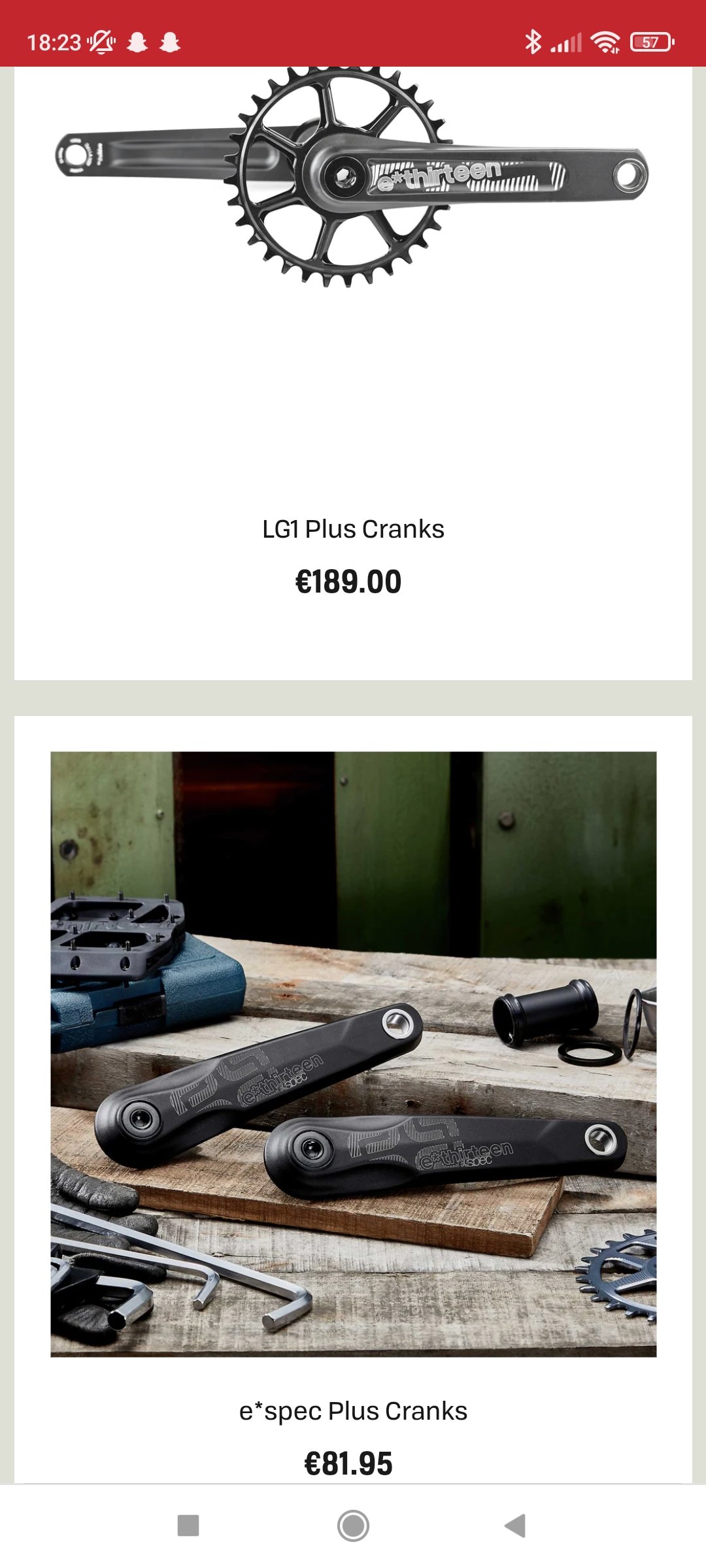
Upgrade Two: Replace the crank arms
Replace the 170mm length E13 crank arms with 160mm or 165mm length crank arms. With the installation of the 150/160mm fork and 160/165mm crank arms you will eliminate pedal strikes.
Upgrade Three: Replace the brake rotors
Your body weight and the type of terrain you ride will dictate your brake rotor setup. If you are a light rider and tend to ride flow trail, you can probably get by with the stock brake setup on the Rise. However, if you are a heavier rider and ride technical terrain on occasion, you will need to upgrade to a larger brake rotor size. I ran 203mm brake rotors front and back on my Rise M20. If you tend towards the lighter side of body weight, you can upgrade the front rotor to a 203mm and leave the rear rotor stock at 180mm.
Upgrade Four: Replace the two piston calipers with four piston calipers
The Deore two piston brake calipers are adequate if you are a lighter rider and tend to ride mellow trails. However, if you are a heavier rider and tend to ride more technical trails with longish downhill sections, you will be using the brakes frequently. I found that the Deore two piston calipers and 180mm rotors developed a tremendous amount of heat and faded badly on longish technical downhill sections. The M20's brakes in stock form are not adequate for technical terrain. Depending upon your budget, you can replace the Deore two piston with Deore four piston calipers. The Deore four piston caliper is a direct bolt on and functions just as good as the higher grade four piston calipers. My buddy weighs 17 stone and he stops just fine on his M20 with Deore four piston calipers. The Deore brake levers function well.
I wrote a three part article on Rise brake upgrades. Here is Part # 2:
This technical article is the second installment in a two part series on Shimano brake systems. Refer to “Part # 1: Shimano Brake System Service”, for information on bleeding and servicing Shimano brakes and brake pad compounds...

www.emtbforums.com
Upgrade Five: Upgrade the wheels
The Raceface ARC30 wheels that come on the Rise M20 feature alloy rims and Deore hubs. If you tend to ride mellow trails the wheels are acceptable. However if you tend to ride rocky terrain, the wheelset will not hold up. It's not robust enough. The EP8 motor develops a lot of torque. This torque is directly applied to the rear wheel hub and freehub. The Deore rear hub on the ARC30 will not last long term if you like to get rowdy on your bike.
I ran a Nobl TR37 wheelset with I9 Hydra hubs on my Rise M20. My preferred tires are the Assegai up front and Minion DHR II on the rear. I ride about 2,500 miles/4,000 Km a year. The Hydra rear hub/freehub did not hold up to the motor's torque and the amount of miles I put on my bike, on a weekly basis. I was replacing rear wheel hub/freehub bearings about every six months. There are a lot of great wheel hub manufacturers however, for the money, the DT Swiss 350 hub is pretty damn bullet proof and holds up well to eBike motors.
I've lately been gravitating towards alloy wheels. As I get older (63 Years Old) I find that carbon wheels tend to provide a harsh ride which transmits up into by arms and shoulders. I do like the compliance that alloy wheels offer. I'm currently running a set of Industry Nine Enduro S alloy wheels with 1/1 hubs. The set costs $640. Let's see how they hold up......Wahoo!
Baja Norte Mexico
View attachment 106379



 I have to say I do have a minor seed of doubt in my mind as to what bike to get as the yt decoy 29 is looking very tempting.


