STEPS E8000
Shimano's first proper eMTB flagship, launched in 2016 to take the fight to Bosch. Compact, torque-sensing and tuned for a natural pedal feel rather than raw shove. Now superseded by EP8/EP801, but still a benchmark for how a mid-drive should read your input.
Schematic illustration (not bench-plotted data): a narrow-band curve that builds to a peak around 70-90rpm then drops away steeply on either side, with very little assistance below 50 or above 105rpm. No independent dyno power-vs-cadence trace exists for this motor, so the shape reflects Shimano's published behaviour and rider reports rather than measured watts.
Shimano STEPS E8000 was the motor that made Shimano a serious eMTB player. Rated at 70Nm and 250W nominal, with around 500W on tap at peak (a figure widely cited by reviewers rather than an independently dyno-verified number), it never had the headline torque of later units, but it earned its reputation on delivery rather than numbers. The control is torque-based, not cadence-triggered, so how much you pedal directly governs how much it gives back. The result is one of the most natural, predictable mid-drives of its generation.
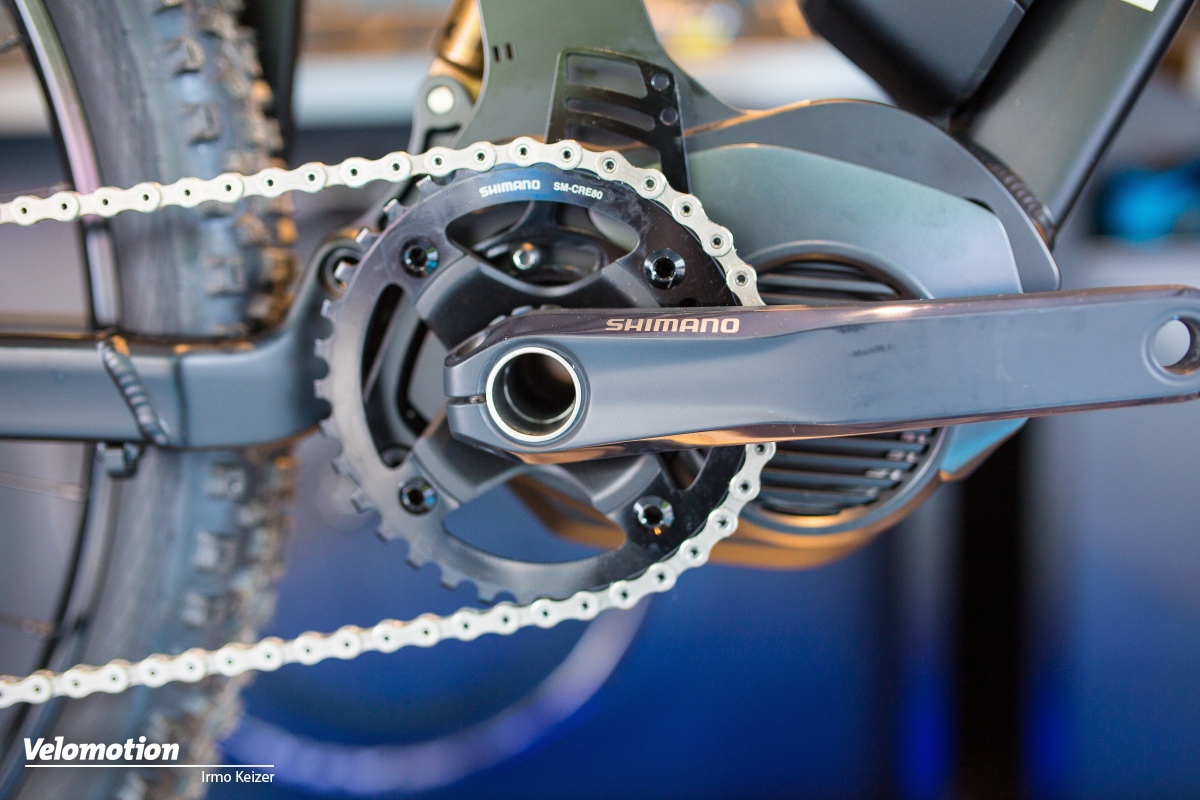
Power is happiest in a tight cadence band of roughly 70-90rpm, where it feels eager and linear. Drop below 50rpm or spin past 105rpm and assistance falls away sharply, so it rewards a tidy, rhythmic pedalling style on climbs. The compact casing kept the Q-factor close to a normal chainset and allowed shorter chainstays than rivals of the day, which is a big part of why E8000 bikes still ride so cleanly. Cooling fins help it hold output on sustained climbs.
Its weaknesses are honest ones for a 2016 design: it is audibly louder under load than the EP8 that replaced it, it carries the classic STEPS coast-clutch click on rough ground, and peak torque is now well behind modern 85-120Nm units. But for smoothness, a listed 2.88kg weight and that uncannily intuitive power feed, the E8000 still holds up. It is a connoisseur's motor, not a chest-thumper.
Sustained power & heat
How long the headline number actually lasts under sustained climbing load.
No published independent thermal de-rate data; cooling fins designed to maintain output on extended ascents.
Character
The case for and against
Strengths
- Exceptionally natural, torque-sensed power delivery
- Light for its era at a listed 2.88kg
- Compact casing allows short chainstays and standard Q-factor
- Cooling fins help hold output on long climbs
- Tunable assist character via E-TUBE custom modes
Compromises
- Audibly louder under load than the later EP8
- Coast-clutch click on rough ground
- 70Nm now well behind modern high-torque motors
- Assistance drops off sharply outside 70-90rpm