
High-speed stability
20
Shorter and steeper (1221mm, 66°) — quick to react but less planted flat-out.
Triple-butted 6061 alloy trail eMTB with 250W/85Nm motor and 630Wh battery; 29x2.6 wheels, mullet-compatible
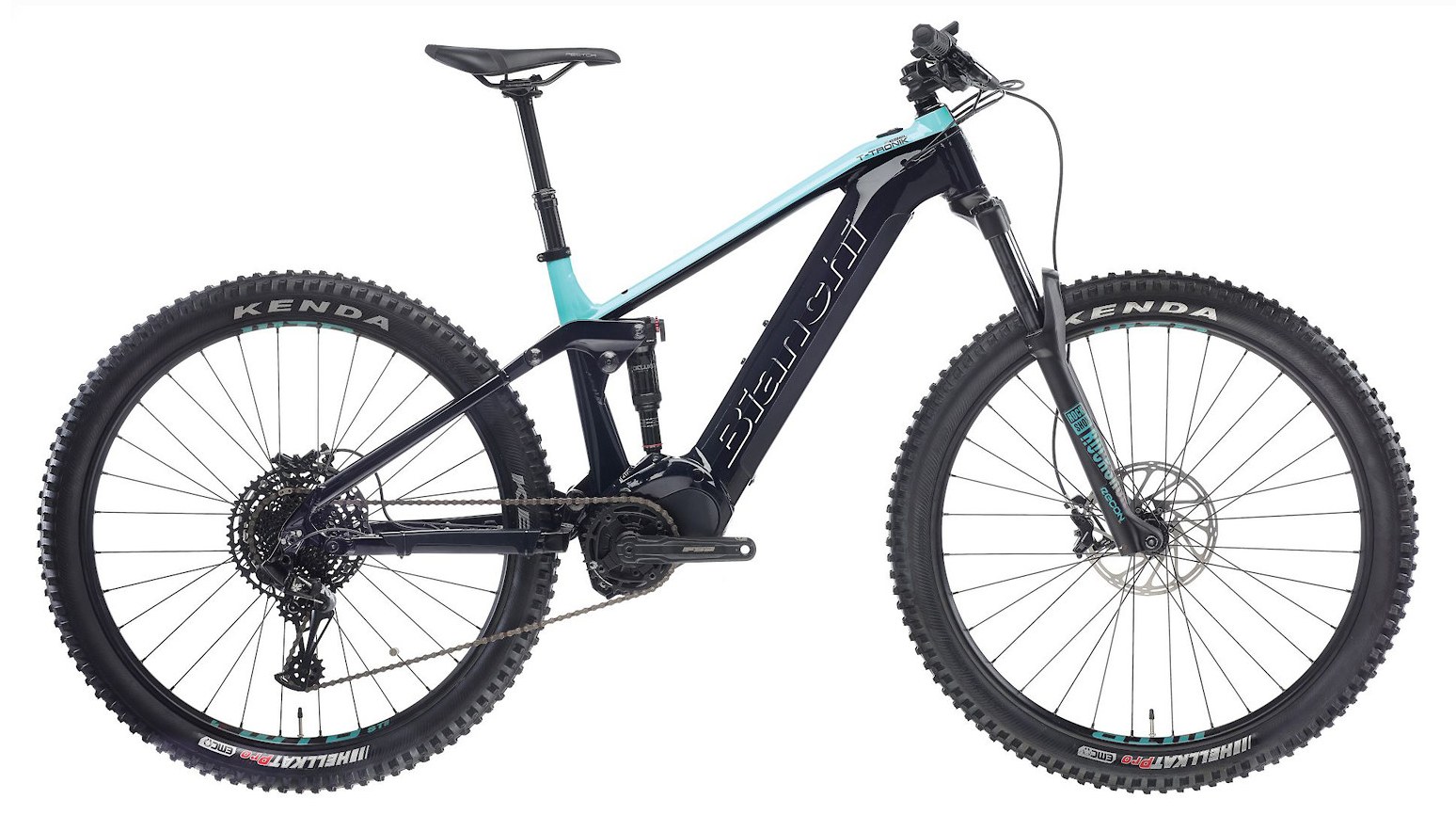
The Bianchi T-Tronik Rebel 2025 is the Italian brand's aluminium trail-enduro: 150 mm of fork travel paired with 140 mm out the back, a Shimano EP8 motor delivering 85 Nm of torque, and a 630 Wh integrated battery. At a claimed 23.5 kg with a £6,999 entry price it sits firmly in the premium-trail rather than budget bracket. With a 66.0 degree head angle and 485 mm chainstays, this is a calmer all-rounder than the modern long-and-slack enduro crowd, leaning towards versatile trail riding rather than gravity-fed bike park use.
Drive system and range. Shimano's EP8 (DU-EP800) is the proven middle-weight choice: 85 Nm of torque, 250 W rated, 500 W peak and a 2.6 kg unit weight. It is not the headline-grabbing motor of 2026 — the new Avinox and Bosch CX Gen 5 units now offer 120–150 Nm — but it remains one of the most natural-feeling drives on the market with a long warranty and dealer-network track record. The 630 Wh battery is integrated and not removable. Real-world range on EP8 builds typically lands at 1,200–1,600 metres of climbing per charge depending on rider weight, terrain and assistance mode, putting the Rebel in average rather than long-day territory by modern standards.
Geometry and handling. The 66.0 degree head angle is conservative for a bike marketed as enduro — this is firmly in modern trail territory. Reach progresses from 420 mm (S) through 440 mm (M), 460 mm (L) and 480 mm (XL), figures that feel slightly short by 2026 standards where 470–490 mm is common at size M. Chainstays are long at 485 mm and constant across sizes, which prioritises climbing traction and stability over playfulness. Wheelbase grows cleanly from 1,221 mm to 1,293 mm. The Horst Link suspension is a known-good four-bar layout. The picture overall is of a planted, calm bike that will feel familiar to anyone coming off a generation-old trail platform rather than a gravity-focused enduro.
Build and value. The single £6,999 trim is where the value proposition needs scrutinising. EP8-powered alloy bikes from established brands with comparable spec — Trek Rail Plus, Whyte E-180 family, Cube Stereo Hybrid — sit several hundred to a thousand pounds lower at equivalent trim. Buyers are paying for the Bianchi brand cachet and the celeste paintwork as much as the technical package. Across the lineup Bianchi also offers a 9.2 spec with SRAM NX/SX, but the gold-listed base trim and price here is what to compare against.
Caveats and known gripes. Forum data on the Rebel specifically is thin: @Doomanic commented on a sister T-Tronik that with Shimano EP8 reliability should be in line with other EP8 builds rather than better or worse, and noted the Bianchi styling as fairly generic. A new shopper survey from @rider shortlisted a T-Tronik FX Type Pro alongside a Specialized Turbo Levo Alloy at a €4,000 budget point, which signals price sensitivity in the segment. The 66 degree head angle, 485 mm chainstays and 23.5 kg weight mark this out as a trail bike with enduro travel rather than a modern enduro geometry sled; serious bike-park use would be better served by something slacker. The integrated 630 Wh battery is on the smaller side for 2025 and cannot be swapped, so big-day riders should look at 750–800 Wh alternatives.
Verdict. The Bianchi T-Tronik Rebel is a confident choice for trail riders who value the heritage and styling of an Italian brand and are happy with the proven EP8 platform. It is best suited to mixed all-day riding rather than aggressive enduro racing, and to buyers who are not range-anxious. Riders looking for the latest motor tech, slacker enduro geometry, or simply more performance per pound will find sharper packages from Whyte, Trek, Cube, Canyon or the newer Avinox-equipped contenders. Production status: current.

| S | M | L | XL | |
|---|---|---|---|---|
| Reach | 420 mm | 440 mm | 460 mm | 480 mm |
| Stack | 609 mm | 618 mm | 627 mm | 636 mm |
| Chainstay | 485 mm | 485 mm | 485 mm | 485 mm |
| Headtube Angle | 66° | 66° | 66° | 66° |
| Seattube Angle (eff) | 75.5° | 75.5° | 75.5° | 75.5° |
| Wheelbase | 1221 mm | 1245 mm | 1269 mm | 1293 mm |
| Front Centre | 736 mm | 760 mm | 784 mm | 808 mm |
| FC:RC | 1.52 | 1.57 | 1.62 | 1.67 |
Computed from this bike's geometry and spec — reach, wheelbase, chainstay, head and seat angles, travel, motor, battery and weight — and worked out per size, because a fixed chainstay can make an S and an XL feel very different.
Shorter and steeper (1221mm, 66°) — quick to react but less planted flat-out.
More planted than poppy — better on steep terrain than tight, fiddly singletrack.
Rear-long with a planted front in S (FC:RC 1.52) — easy to weight the front and quick to turn, though it can feel light at the back at real speed.
A workmanlike climber — expect to put in more rider effort on the steep stuff. That's 3.6 Nm/kg and ~21 W/kg of bike weight.
No single standout trait — a balanced, versatile bike.
Fine at trail pace; ease off on the really fast, rough stuff.
Shorter and steeper (1245mm, 66°) — quick to react but less planted flat-out.
More planted than poppy — better on steep terrain than tight, fiddly singletrack.
Rear-long with a planted front in M (FC:RC 1.57) — easy to weight the front and quick to turn, though it can feel light at the back at real speed.
A workmanlike climber — expect to put in more rider effort on the steep stuff. That's 3.6 Nm/kg and ~21 W/kg of bike weight.
No single standout trait — a balanced, versatile bike.
Brilliant on fast, rough, steep terrain; less fun on tight, mellow trails.
Shorter and steeper (1269mm, 66°) — quick to react but less planted flat-out.
More planted than poppy — better on steep terrain than tight, fiddly singletrack.
Rear-long with a planted front in L (FC:RC 1.62) — easy to weight the front and quick to turn, though it can feel light at the back at real speed.
A workmanlike climber — expect to put in more rider effort on the steep stuff. That's 3.6 Nm/kg and ~21 W/kg of bike weight.
No single standout trait — a balanced, versatile bike.
Brilliant on fast, rough, steep terrain; less fun on tight, mellow trails.
Shorter and steeper (1293mm, 66°) — quick to react but less planted flat-out.
More planted than poppy — better on steep terrain than tight, fiddly singletrack.
Rear-long with a planted front in XL (FC:RC 1.67) — easy to weight the front and quick to turn, though it can feel light at the back at real speed.
A workmanlike climber — expect to put in more rider effort on the steep stuff. That's 3.6 Nm/kg and ~21 W/kg of bike weight.
No single standout trait — a balanced, versatile bike.
Brilliant on fast, rough, steep terrain; less fun on tight, mellow trails.
Base £6,999 | 9.2 NX/SX Eagle 1x12 | |
|---|---|---|
| Motor | Shimano EP8 (DU-EP800) · 85 Nm · all trims | |
| Battery | Bianchi integrated 630Wh · 630 Wh · all trims | |
| Travel F/R | 150/140 mm · all trims | |
| Frame | Aluminium · all trims | |
| Fork | — | RockShox Recon Silver RL 29" Solo Air, 140mm travel |
| Shock | — | RockShox Deluxe Select+ RL |
| Headset | — | FSA Orbit 1.5 ZS |
| Stem | — | Tec Obvius, 0, 1.1/8", 31.8mm, 55mm length |
| Handlebar | — | Tec Obvius rise, AL6061-T6 double thickness, 780mm width, 31.8mm, 15mm rise, 9 backsweep |
| Grips | — | T-One Rock T-GP34 |
| Saddle | — | Velomann 2058DRN, 140mm width, steel rails |
| Seatpost | — | Telescopic dropper, 31.6mm, internal routing with remote, 100/125/150mm travel by size |
| Brakes | — | SRAM Guide T, 4 pistons, SRAM Centerline 200mm rotors front and rear |
| Rear derailleur | — | SRAM NX Eagle 12-speed |
| Crank | — | FSA forged aluminium, 165mm, 34T Eagle chainring |
| Shifters | — | SRAM SX Eagle 12-speed |
| Cassette | — | SRAM PG-1210 Eagle, 11-50T, 12-speed |
| Chain | — | SRAM SX Eagle 12-speed |
| Drivetrain | — | SRAM NX/SX Eagle 1x12 |
| Wheels | — | WTB ST Light i30 TCS 2.0 29" with Formula hubs |
| Tyres | — | Kenda Hellkat 29x2.6 front and rear |
| Weight | 23.5 kg | — |
| Price | £6,999 | — |
Other eMTBs with the closest geometry to this one.
Suggest a correction. We review every submission before publishing.