Motor Resistance, real or imagined?

steve_sordy

Wedding Crasher
EMTB Pro
Joined
Nov 5, 2018
Messages
10,508
Reaction score
11,573
Location
Lincolnshire, UK
I broke my mech last ride out and today, while I had the mech and chain off, I spun the pedals and they moved very easily - taking a short while to slow down and stop. I decided to measure the motor resistance to pedalling and to measure it as precisely as I could without being silly about it.

Data: Motor Shimano EP8, age 3 years 8 months, 3436 miles covered, crank length 165mm Shimano Hollowtech, Vault pedals.

With the motor off and the crank and pedals horizontal, I loaded up the pedal with Allen keys until the crank moved. I recorded the weight and then tried different combinations of Allen keys to get the lightest weight that would overcome the static friction of the motor. Then I reversed the procedure to get the heaviest weight that would not move the crank. Take into account that it always takes more force to get something moving than to keep it moving. That is basic physics, not just my opinion. In other words, once pedalling, the motor resistance as measured at the crank will be less.

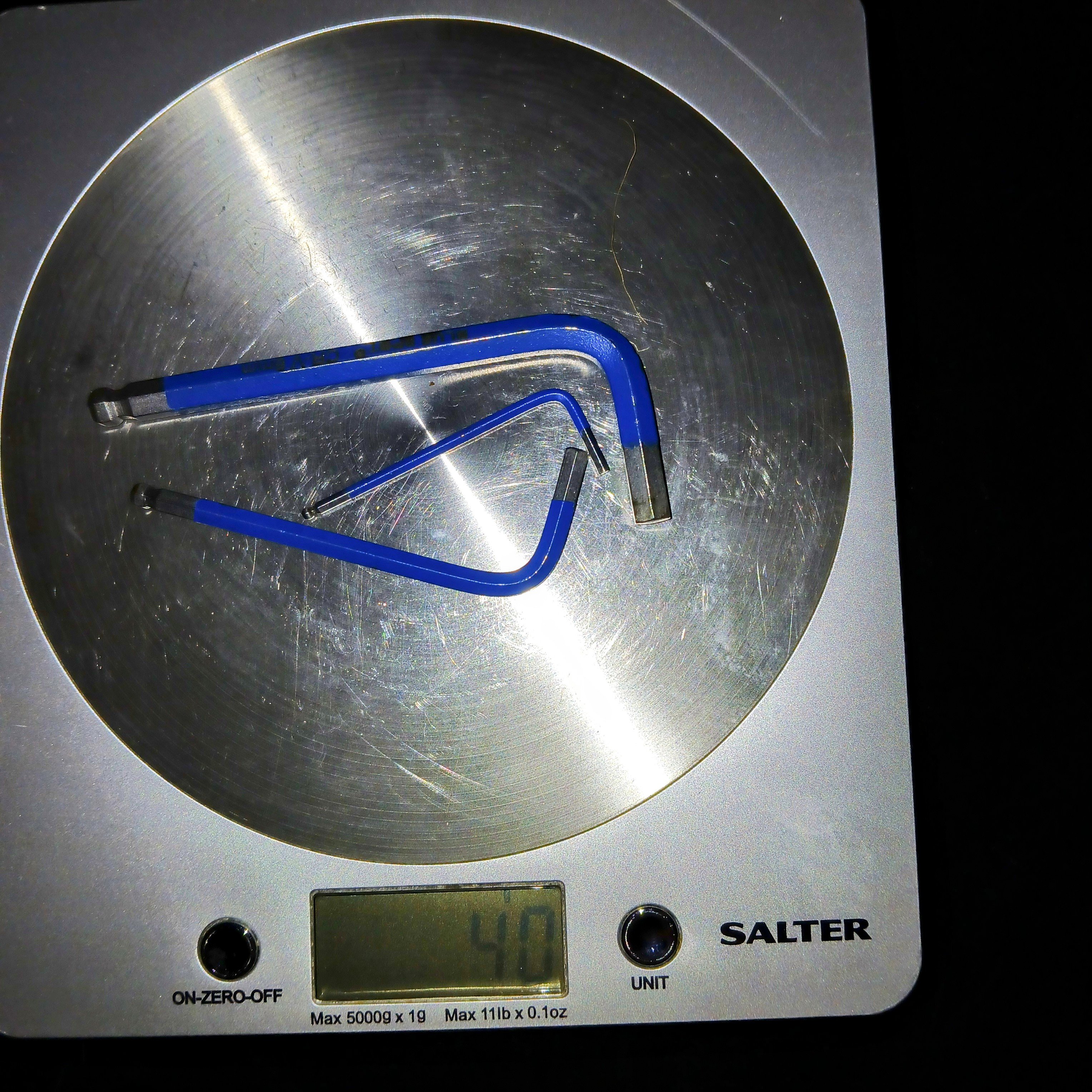
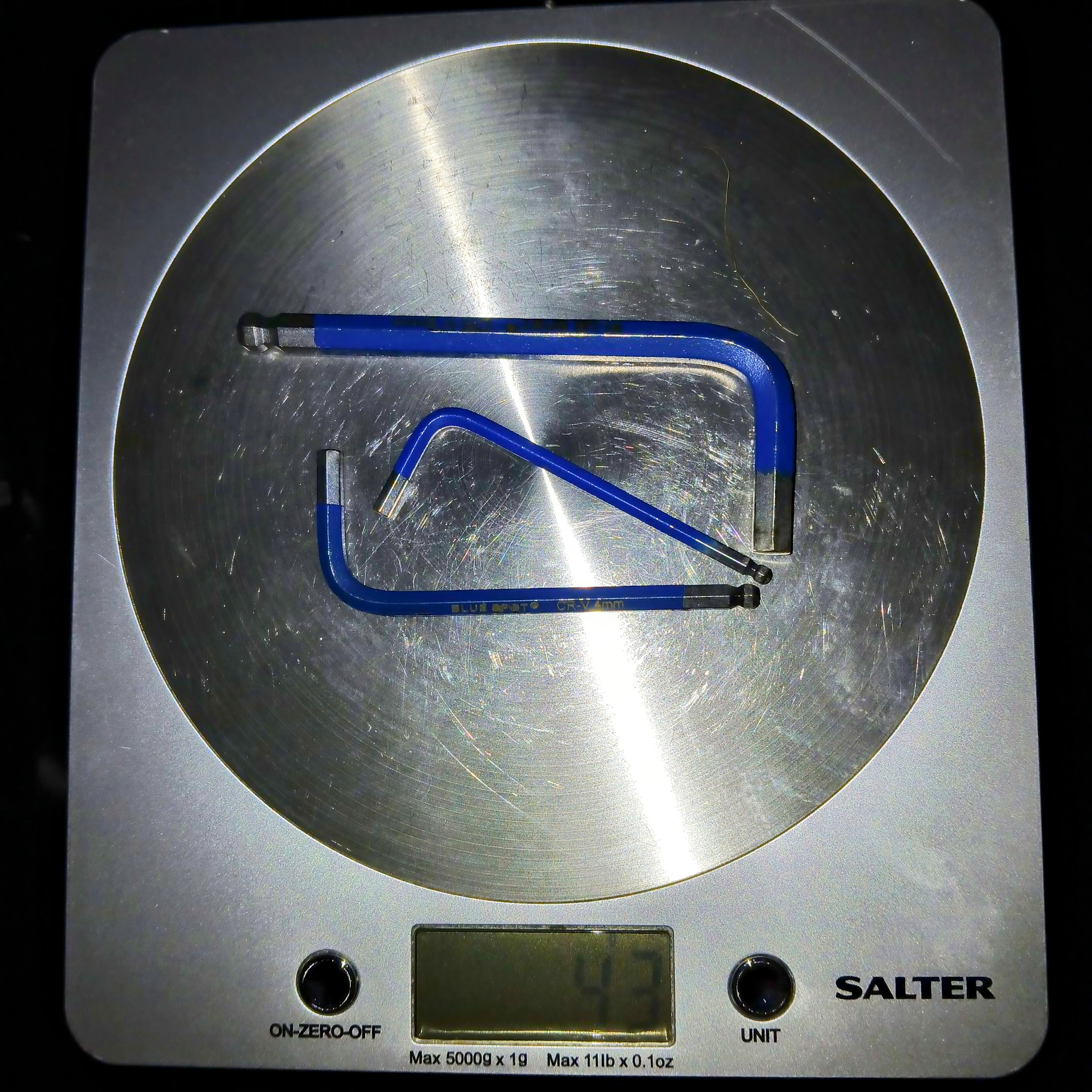
It took 43gm of weight to move the crank, but 40gm would not move it. What the actual lowest weight is that will move the crank is irrelevant. It's somewhere between 40 and 43 gms! That is pretty much non-existent. That is applied to one crank only, it would be half that if applied to both cranks, ie less than 23gms, there is more mud in your cleats than that!

For reference, three £1 coins weigh 26.3gm and one US dollar coin weighs 26.7gm.

For the record here are the pictures: 43gm = a 6, 4 & 3mm Allen key. 40gm = a 6, 4 & 2mm Allen key.

Motor resistance 1.jpg


Motor Resistance 3.jpg
Motor Resistance 2.jpg
 
⚡ EMTB Pro Go Pro — exclusive discounts & ad-free Peaty's 25% off & more · Ad-free browsing · Pro badge See the deals →
Important research Steve, we salute your efforts 🫡
Presumably you could calculate the torque required using those measurements, if you're having a quiet day?
Good question. Simples!

Torque is measured in Newton metres. ie force in Newtons x lever length in meters.

Force is "43grams weight" which in Newtons is 0.043kg x 9.81 m/sec2 = 0.422 Newtons
Lever arm in meters is 0.165m

Torque is 0.422 x 0.165 = 0.07 Nm, measured on one pedal.

Now is that negligible or what? :ROFLMAO:
 
I think the answer is that motor resistance is both real and imagined.

A quick calculation for the moment of force at the crank; M = F x d
  • moment (M) is measured in newton metres (Nm)
  • force (F) is measured in newtons (N)
  • perpendicular distance from pivot (d) is measured in metres (m)
(F) Total Force = 0.422 Newtons (43g)
(d) Crank Length = 0.165 metres
(M) Moment of Force = 0.07 Nm

Not a lot then.

I’ll check my SL1.1 motor (widely regarded as a very low resistance motor) next time I have the chain of, but my crank bearings might be past there best so not sure how comparable it would be.
 
Good question. Simples!

Torque is measured in Newton metres. ie force in Newtons x lever length in meters.

Force is "43grams weight" which in Newtons is 0.043kg x 9.81 m/sec2 = 0.422 Newtons
Lever arm in meters is 0.165m

Torque is 0.422 x 0.165 = 0.07 Nm, measured on one pedal.

Now is that negligible or what? :ROFLMAO:

Is that with a dry unlubricated motor? If not then your not taking into account the static stiction of the lubricants on the rotative internals. 🤣
 
Nice empirical testing there Steve, well done!

I think earlier motors did have a lot more internal resistance, but the idea has lived on as an urban myth. Also as a convenient excuse for the weak-limbed ;)
 
The German magazine BIKE actually measures pedal resistance and reports it along with other data for their motor tests. I didn't find data for all motors, but with the latest Bosch Gen 5 review (11/2024) they reported 9.1 W pedaling resistance for the Gen 5 and 13.8W for the Gen 4. So, not much, but it actually reduced for the Gen5 as Bosch advertised.
 
Torque is measured in Newton metres. ie force in Newtons x lever length in meters.

Was there any doubt regarding the outcome of your experiment?
Is there any doubt the Motor Drag Worriers will cling to their erroneous notions?
But if you've enlightened one misguided soul, you've succeeded.
 
Very interesting read!

I have an e8000 so I'll try and do this experiment. I do find the drag negligible however, even on such an old motor. The weight of the emtb bike in general is a different matter entirely... 😃
 
I may try this on my TQ EXE this weekend. My Rail is still loaned to a mate but could try that as well in a couple of weeks.
 
I may try this on my TQ EXE this weekend. My Rail is still loaned to a mate but could try that as well in a couple of weeks.
No pics but alarmingly high on TQ HPR50. Haven’t ridden the bike for over 2 weeks. Not sure if that makes a difference. No way 40g would move it though.

Shimano ME700 pedals on race face era 165mm carbon cranks.

220g forward and 140g backwards.
 
Last edited:
The German magazine BIKE actually measures pedal resistance and reports it along with other data for their motor tests. I didn't find data for all motors, but with the latest Bosch Gen 5 review (11/2024) they reported 9.1 W pedaling resistance for the Gen 5 and 13.8W for the Gen 4. So, not much, but it actually reduced for the Gen5 as Bosch advertised.
I had not thought to extend my torque findings to power required to overcome the motor resistance torque. Let's assume pedalling at 60 rpm

Power (in Watts) = Torque (in Nm) x rotational speed (in radians per second).

So what does 0.07Nm applied at 60 revs per minute come to in Watts? There are 2Pi radians in one revolution.

One rev = 2Pi radians, so 60 revs per minute = (60 revs x 2Pi)/60 seconds = 2Pi = 2 x 3.142 - 6.284 rads/sec

The power required to overcome a pedal torque of 0.07 Nm at 60 rpm is 0.07 x 6.284 = 0.44 Watts

Looks like the Shimano EP8 motor is a winner! :)

However! (There is always a but!)

I was measuring the motor resistance when the motor was switched off, ie no drive was engaged. If the German magazine BiKE was measuring the resistance on the move, they would probably get a different figure. The clutch would be engaged and the gears are being turned. It is beyond my ability to measure that. They would have to measure it once the motor has disengaged at 25kph.
 
Ha ha.
I had this last weekend and it was like riding a bike in deep sand. Awful.
Right. Its not made to be ridden without power. I have added electronic shifting, which really complicates things. If people did not know, in mechanical shifting mode, you can drain your battery until it is empty. On electronic shifting mode, it goes into white mode so you can still shift, by leaving some reserve juice in battery which reduces range.

My issue was unexpected shut downs, so no shifting. They may have fixed it with the updated rosenburger cable replaced a few days ago for the third time.
 
Its a fact. my EP801 has a lot of resistance and if you run out of juice, and you are not close to the truck, your fkd.
But is that just because you have a big, heavy bike with big, heavy, soft compound tyres?
I mean in the muscle bike days, who the hell would choose to ride a bike that weighed 25kg with tyres like those we use, except for DH?
My last mtb weighed half the above and had 2.2" wide tyres. I chose to use soft compound, low-pressure tyres and I suffered on long climbs vs my mates. They had harder compound and higher pressure. But I enjoyed everywhere else a lot more.
 
But is that just because
No not at all, I could manual this all day long. I did a century on my gravel bike last year.

All Shimano EP801s have a huge amount of drag through the motor. These are not peddle only bikes. I have done quarter mile and half mile in the last year. You cant just gear down and buckle up. Its not like a specialized or a few other brands that do not have the drag we do. No one will climb out of a 1000' canyon climb with no juice on this bike. Id walk it out so i could get home quicker. In 5000 miles last year, I only walked 10 miles when i snapped a chain, and coasted 5 of that. a few 2 mile walks due to pinch flats. So far played my battery range spot on.
 
Not according to the test that I did in post no #1
@steve_sordy I appreciate you being objective and trying to put some actual numbers to this question. It is complicated by the fact that our brains are better at detecting relative change, rather than absolute values. An example of that would be that with some motors, going from the highest boost to the lowest (or even 2nd lowest) setting can almost feel like drag, just due to the contrast, even though you are still demonstrably getting some pedaling aid. Once you get used to that lower setting, the feeling goes away.

On top of that, we overlay our anticipated outcome relative to the experienced outcome, which adds another layer where things can be misinterpreted. As an example of this, everyone I know who has had a brake failure has commented on how, when you squeeze the brakes, and they don't slow you as expected, it can actually feel like you are accelerating, even though your speed remains the same. It's just that the difference between the expectation and outcome are interpreted incorrectly by our brains.

Having said all that, is it possible that the difference between your experiment and @Winford 's experience has to do with the power state of the motor? As you mentioned in a different comment I was measuring the motor resistance when the motor was switched off, ie no drive was engaged. If the German magazine BiKE was measuring the resistance on the move, they would probably get a different figure. The clutch would be engaged and the gears are being turned. It is beyond my ability to measure that. They would have to measure it once the motor has disengaged at 25kph" . I have only run out of power on an EP801 when it was all downhill back to the car so I haven't had much need to mess around with this, but, if the battery still has enough power to keep the electronics on, but not enough to provide assist, is it possible that you could end up in a state where the clutch is engaged, and internal gears are turning, despite the lack of assist?
 
I have only run out of power on an EP801 when it was all downhill back to the car so I haven't had much need to mess around with this, but, if the battery still has enough power to keep the electronics on, but not enough to provide assist, is it possible that you could end up in a state where the clutch is engaged, and internal gears are turning, despite the lack of assist?
This is what I felt when I ran out of juice a couple of weeks ago - it felt like drag. I couldn't even ride up a mild gradient.
It's quite unlike riding a heavy analogue bike.
And it all may be a placebo effect, but it's how it felt...
 
the difference between your experiment and @Winford 's experience has to do with the power state of the motor?
So If you have a standard mechanical shifting it is hard to test properly, even if you turn Etube down. If battery is connected and bike on. As the battery drains you will still get power to the motor and some pull until the battery is depleted. There is no way to do the test accurately. Unless you have bike powered off.

If you have electronic shifting, your bike will go into a white mode, where all power is cut off to the motor, but it leaves power for shifting. Only in this mode can a test be done. "IF" you have Di2

If you have the motor running class 3, per Shimano, when the battery runs low, the bike just shuts off completely when out of power.

Really the proper way to test is with bike powered off, and a manual shifter. Or white mode with electronic shifting

But here is the kicker, if you are coasting downhill at a slow speed, and you are on the largest cassette cog, and you try and peddle, if there is no motor drag, the peddles should spin easy. They do not. End of discussion period. There is drag.
 
I'm hoping the higher resistance in the DJI motor is due to better seals. But I'm guessing. I have no plans to run it out of battery, as I would also lose the ability to shift as well.
 
So If you have a standard mechanical shifting it is hard to test properly, even if you turn Etube down. If battery is connected and bike on. As the battery drains you will still get power to the motor and some pull until the battery is depleted. There is no way to do the test accurately. Unless you have bike powered off.

If you have electronic shifting, your bike will go into a white mode, where all power is cut off to the motor, but it leaves power for shifting. Only in this mode can a test be done. "IF" you have Di2

If you have the motor running class 3, per Shimano, when the battery runs low, the bike just shuts off completely when out of power.


But here is the kicker, if you are coasting downhill at a slow speed, and you are on the largest cassette cog, and you try and peddle, if there is no motor drag, the peddles should spin easy. They do not. End of discussion period. There is drag.
I appreciate all the info you're sharing and, for sure, the EP801 I rode with a dead battery (but with SRAM wireless shifting, not di2) felt draggy as hell on that downhill flow trail. But, I am having a bit of trouble squaring the circle, so to speak, regarding the different motor states you are describing. You said "If you have a standard mechanical shifting it is hard to test properly" but then you also said "Really the proper way to test is with bike powered off, and a manual shifter. Or white mode with electronic shifting", which seems kind of contradictory to the first statement. So are you saying it could be equally effectively tested with what I'll call a "non di2" shifter (because you could be on electronic, but from SRAM), or a di2 shifter in "White Mode"?

All of that mode talk aside, do you have an idea as to why the OPs initial test, that kicked this discussion off, required so little weight on the pedal to get things moving? Asking totally respectfully, not as any sort of gotcha, as you seem to have a lot of real-world experience with these motors in various power states.
 
@steve_sordy I appreciate you being objective and trying to put some actual numbers to this question. It is complicated by the fact that our brains are better at detecting relative change, rather than absolute values. An example of that would be that with some motors, going from the highest boost to the lowest (or even 2nd lowest) setting can almost feel like drag, just due to the contrast, even though you are still demonstrably getting some pedaling aid. Once you get used to that lower setting, the feeling goes away.

On top of that, we overlay our anticipated outcome relative to the experienced outcome, which adds another layer where things can be misinterpreted. As an example of this, everyone I know who has had a brake failure has commented on how, when you squeeze the brakes, and they don't slow you as expected, it can actually feel like you are accelerating, even though your speed remains the same. It's just that the difference between the expectation and outcome are interpreted incorrectly by our brains.

Having said all that, is it possible that the difference between your experiment and @Winford 's experience has to do with the power state of the motor? As you mentioned in a different comment I was measuring the motor resistance when the motor was switched off, ie no drive was engaged. If the German magazine BiKE was measuring the resistance on the move, they would probably get a different figure. The clutch would be engaged and the gears are being turned. It is beyond my ability to measure that. They would have to measure it once the motor has disengaged at 25kph" . I have only run out of power on an EP801 when it was all downhill back to the car so I haven't had much need to mess around with this, but, if the battery still has enough power to keep the electronics on, but not enough to provide assist, is it possible that you could end up in a state where the clutch is engaged, and internal gears are turning, despite the lack of assist?
The short answer to your question "is it possible that you could end up in a state where the clutch is engaged, and internal gears are turning, despite the lack of assist?" is YES.

My comment to which you were responding was to @Winford who said that "All Shimano EP801s have a huge amount of drag through the motor". I have never experienced a huge amount of drag from my EP8 motor. I accept that the EP8 and EP801 are not exactly the same as each other, but I would not expect Shimano to improve their design from EP8 to EP801 and add a huge amount of drag.

I mentioned in my first post that there is a difference between static and dynamic friction. Maybe it works a bit differently on a bike motor, dependent upon drive state. With my Allen keys I was measuring the amount of weight (force) required to make the pedals move a small amount. I had assumed that the force required to keep it moving would be less. That would be true if the motor was disengaged, as it is when it's turned off. But if the motor is turned "on", just not "active", then the pedals would be driving the gears in the motor and the friction would be much greater.

So, if your battery has died, and you have to pedal home, turn off the motor.
It will still feel like you are pedalling uphill, but back to my comment in post #21 " But is that just because you have a big, heavy bike with big, heavy, soft compound tyres? I mean in the muscle bike days, who the hell would choose to ride a bike that weighed 25kg with tyres like those we use, except for DH?
 
Keep reading
    Browse all

    Similar Threads

    Community Stats

    Since 2018
    669K
    Messages
    41,012
    Members
    Join 30,000+ Riders, it's free!
    Back
    Top