X1P
Gobao's e-MTB flagship is a 150 Nm / 1,500 W mid-drive with an Electronically-controlled CVT built in. The gearing lives inside the unit, so there's no rear derailleur and no cassette, just AI ratio control. A 750 Wh pack super-charges from 10 to 80% in about 20 minutes. Shown as a concept at Eurobike 2026, with production due February 2027.
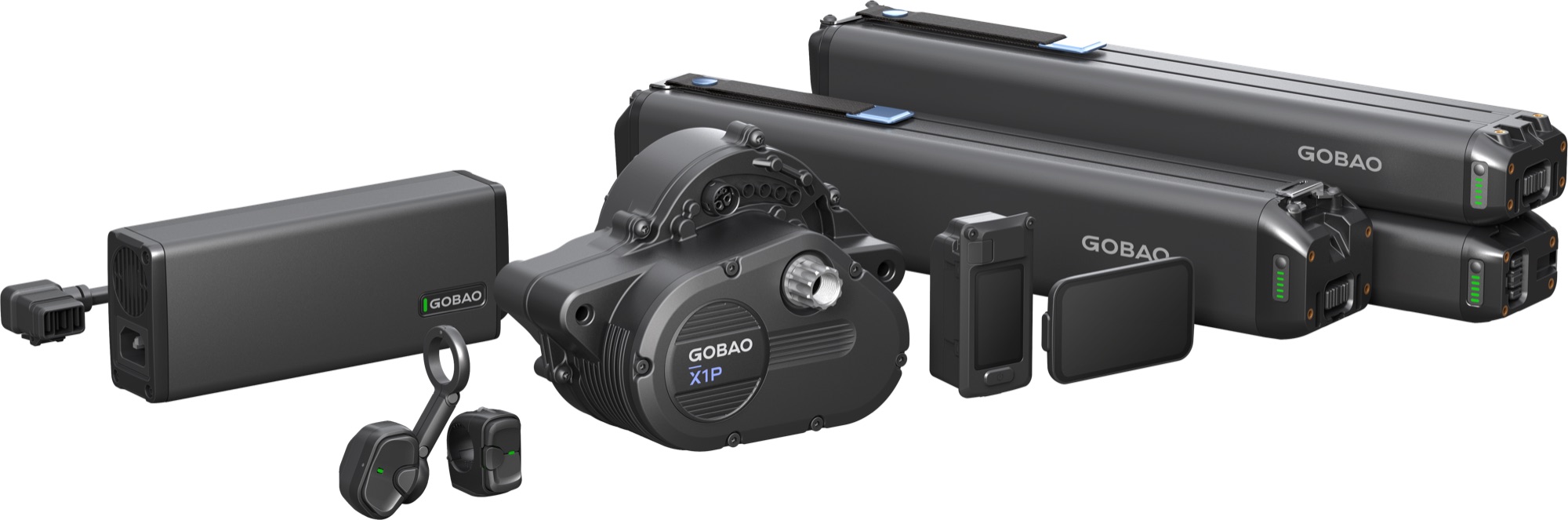
The Gobao X1P is the e-MTB flagship of Project X, the new connected drive platform from Chinese OEM supplier Gobao, shown at Eurobike 2026. It bakes an Electronically-controlled Continuously Variable Transmission straight into the motor. The single mid-drive unit delivers 150 Nm of boost torque and up to 1,500 W peak (250 W EU-rated), weighs 3.85 kg and spans a 500% stepless ratio range (undergear 1:0.8, overgear 1:4), which matches the DJI Avinox M2S on headline numbers. Because all the gearing happens inside the unit, there's no rear derailleur and no cassette, just a single sprocket at the back. Gobao confirms the final drive can be a belt or a chain, whichever the bike maker prefers, so a frame can run a clean, low-maintenance belt or a familiar chain.
Charging is a genuine standout. Gobao pairs the system with a 1.5 kW EC-521FEU super-charger that refills a 750 Wh battery from 10 to 80% in about 20 minutes. That's remarkably fast for a full-power pack, where reaching 80% on a standard charger usually takes a couple of hours.
Gobao isn't a household name, but it isn't a garage start-up either: it says it has built e-bike drive systems for more than 20 years, employs around 1,500 people and holds 650+ patents, and sells to bike brands as an OEM platform rather than direct to riders.
How an eCVT works: ride, don't shift
A normal drivetrain gives you fixed gears, like steps on a staircase: you jump from one set ratio to the next. An eCVT (Electronically-controlled Continuously Variable Transmission) is a ramp instead of a staircase. It has effectively infinite ratios between its lowest and highest, with no fixed steps in between, and there's no rear derailleur or cassette.
What makes it “electronic” is the brain on top of it. The drive unit's controller reads your cadence, pedal torque, speed and the gradient many times a second and continuously slides the transmission ratio to keep both the motor and your legs in their most efficient window, whatever the hill is doing. You pick the cadence you like to spin at, the system holds it for you, and you simply pedal. Because the ratio changes electronically rather than by a chain hopping between sprockets, it can change under full load and even at a standstill, with no chain slap, no missed shifts and no interruption to the power.
It isn't all-or-nothing automation. You can leave it in full AI auto, or step through a set of “virtual gears” in an optional manual mode if you prefer the familiar feel of clicking through ratios. Those steps are just software, mapped onto the stepless hardware underneath.
This is a different animal to a fixed-ratio gearbox MGU like Pinion or the Shimano and SRAM gearbox patents, which still use a set number of discrete internal ratios. An eCVT's ratios are genuinely stepless. The pay-off is no shifting to think about, the right cadence everywhere, less drivetrain wear and a cleaner, quieter back end. The open question, covered below, is efficiency. Continuously variable transmissions have historically given a little back against a good fixed drivetrain, and whether software optimisation fully erases that still needs independent dyno testing.
What we don't know yet
This is a pre-production concept. It had its trade-show debut in June 2026, and Gobao quotes mass production from February 2027, with no production e-MTB using it yet. The headline figures are the manufacturer's own, and there is no independent dyno, efficiency or durability data. The big question reviewers have flagged is efficiency. CVTs have historically been a touch less efficient than a good chain drivetrain, and a 150 Nm / 1,500 W draw makes any penalty matter for range. Treat the numbers as a promising spec sheet, not yet a proven motor.
The sibling Gobao X1 shares the same 3.85 kg chassis and mounting but is tuned for city and trekking: 120 Nm, 1,200 W and a 400% ratio range (undergear 1:1).
Character
The case for and against
Strengths
- 150 Nm / 1,500 W, matching the Avinox M2S on headline numbers
- True stepless eCVT with the 500% gearing internal, so there's no rear derailleur and no cassette (single rear sprocket, run with a chain or a belt)
- AI holds your chosen cadence on every gradient, and shifts under full load and at a standstill
- Full AI auto, with an optional manual-shift mode on top
- Super-charging: a 750 Wh pack goes 10 to 80% in about 20 min (1.5 kW EC-521FEU charger)
- Lower unsprung mass than a derailleur drivetrain (helps the suspension), and low maintenance
- Built-in connectivity: CCU with anti-theft, geo-fencing, digital battery lock, GNSS/4G
Compromises
- Pre-production, with mass production not due until February 2027 and no production e-MTB using it yet
- Efficiency unproven: CVTs historically give a little back, which matters at 1,500 W for range
- No independent dyno, durability or real-world range data
- No published noise figure or price
- New, unproven brand in the premium e-MTB drive space (an OEM supplier, not a consumer name)