GX Ultimate
Panasonic's flagship full-power eMTB motor for the FIT ecosystem: 95 Nm and a measured turn of speed that runs the Sachs RS close on the dyno, paired with a deliberately rider-led 300% support (FIT's published figure) that asks more of your legs than the German mainstream.
Illustrative trace from Velomotion's measured system-output points at a steady 100 W rider input: strong, direct delivery that builds early and holds a broad plateau through 70–75 rpm before tapering as cadence climbs. This is system output (motor + rider) at fixed input, not a swept motor-only power curve.
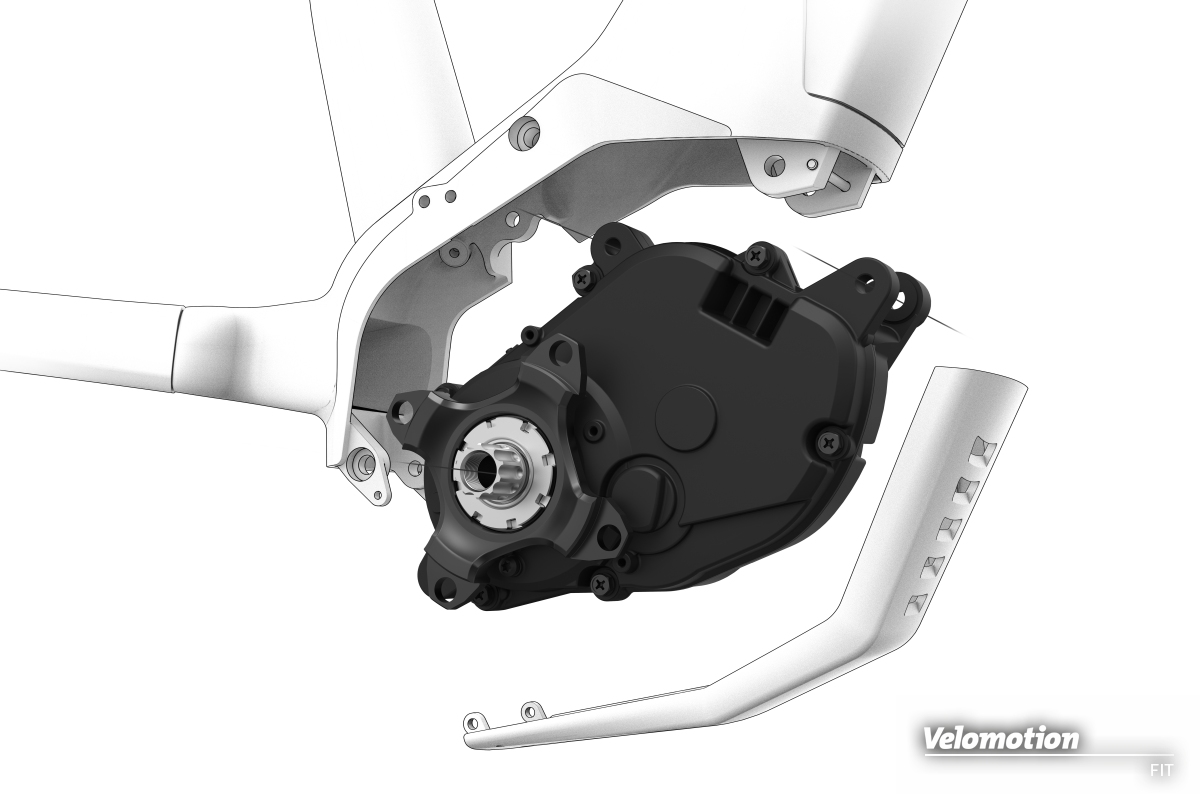
Panasonic GX Ultimate is the in-house Japanese answer to Bosch and Shimano, built for the FIT 2.0 ecosystem and found almost exclusively on German and Swiss OEMs — Flyer, Hercules and Bulls. On paper it is the headline act of its generation: 95 Nm of torque (90 Nm as standard, 95 once the FIT power upgrade is enabled), a 600 W maximum output and a 2.95 kg drive unit running at 36 V. Note that 600 W is FIT's published maximum output figure (fit-ebike.com), not an independently measured motor peak — the two are easy to conflate.
What the lab bench confirms is that the raw output is genuine. On Velomotion's test rig the GX Ultimate Pro produced close to 670 W of system output (motor plus rider) at a steady 100 W rider input, with peak delivery arriving around 70–75 rpm. Push the rider input harder and the system reading climbs to 887 W — separated from the segment-leading Sachs RS (898 W) by only a handful of watts and leaving the rest of the 2022 field well behind. Because these are system outputs measured at a fixed rider input rather than a swept motor-power curve, they are not directly comparable with the 600 W catalogue figure. The catch is consumption: Panasonic was the rig's thirstiest motor on both flat and climb — about 5.9 Wh/km on the flat and 41.6 Wh/km up a 10% grade (versus 40.6 Wh/km for the Sachs RS) — so a big battery is not optional if you ride in High mode.
The character is the real story. Where the Sachs RS slugs you with full power from the first pedal stroke, the Panasonic is more measured. FIT publishes its maximum support as 300% — markedly lower than the 340–400%+ on offer from Bosch, Shimano and the newer Avinox units, and a deliberate philosophy that prizes direct, low-cadence response over a big multiplier. (One spec aggregator lists 600% support, but that appears to conflate the 600 W output figure; FIT's own 300% is the authoritative number.) Lean on the pedals and it answers instantly and constantly; freewheel and it goes quiet. It rewards a rider who pedals, and it climbs steep technical pitches with an honesty the high-assist motors blur over.
Character
The case for and against
Strengths
- Genuine top-tier measured output — 887 W system on Velomotion's rig, near Sachs RS pace
- Light for the power at 2.95 kg
- Direct, instant low-cadence response (peak ~70-75 rpm) — superb for steep tech climbs
- Strong 95 Nm torque (90 Nm base + FIT power upgrade)
- Narrow 165.8 mm Q-factor; compact 205x94x129 mm casing
- Mature, proven FIT-ecosystem reliability record
Compromises
- Highest energy consumption in test (~41.6 Wh/km climbing) — demands a 630-750 Wh battery
- 300% support is lower than Bosch/Shimano/Avinox rivals
- Locked to the FIT ecosystem (Flyer, Hercules, Bulls)
- No published dBA noise figure; thin UK / North American spare-parts support