M40
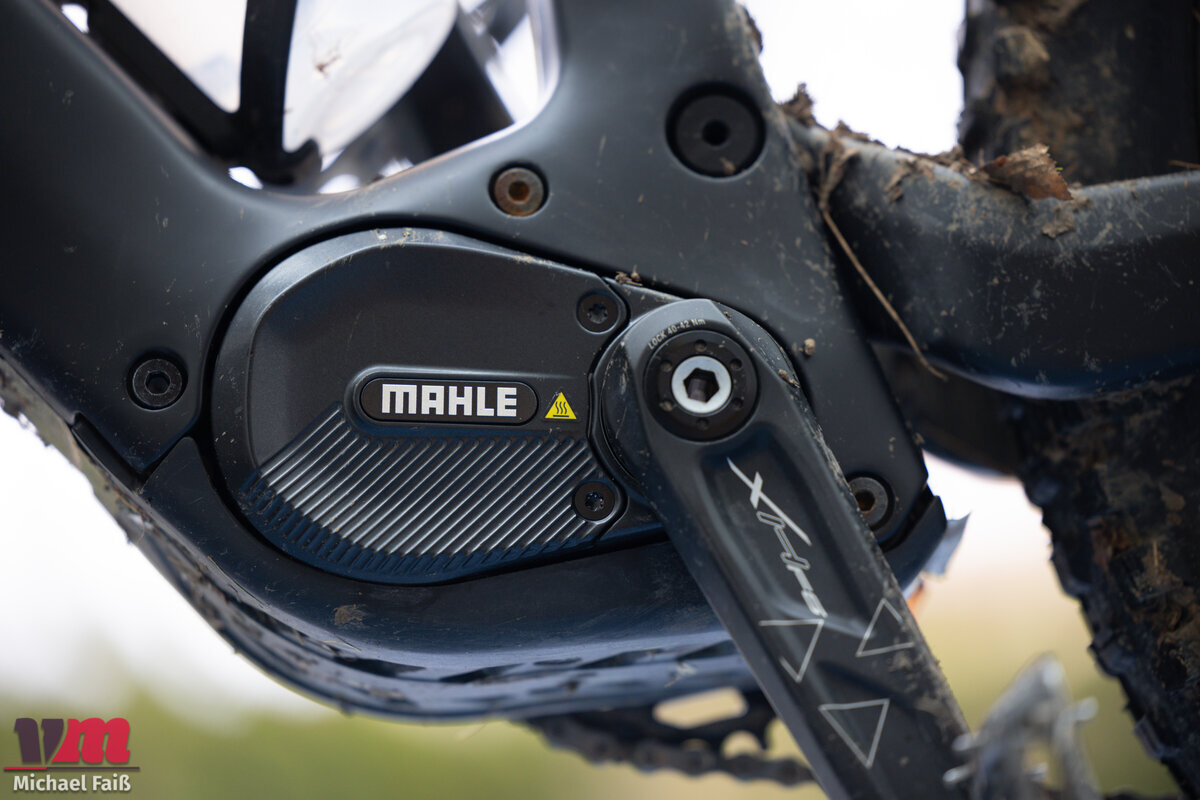
Mahle's first full-power mid-drive is a featherweight heavyweight: a claimed 105 Nm and 850 W from a 2.5 kg, 48-volt unit that undercuts almost every rival on the scales while matching them for grunt — and an independent dyno measured 795 W of that.
Strong and remarkably flat from below 50 rpm, holding power right up to 125 rpm before tailing off, with the absolute peak arriving high at 90-95 rpm.
Mahle M40 is the Spanish-German brand's break from its featherweight hub-motor past, and it arrives swinging. On Velomotion's dyno it produced 795 W at peak, a shade below the manufacturer-claimed 850 W, with the strongest pull arriving high in the rev range at roughly 90-95 rpm. In the standardised 250 W rider-input test it returned just over 700 W, putting it third in a strong field behind the DJI Avinox and TQ's HPR120s.
What sets it apart is the packaging. At 2.5 kg it is fractionally lighter than the Avinox M1 and dramatically lighter than a Bosch CX, yet the 48 V architecture lets it run cooler under load: housing temperatures settle around 80 C and meaningful de-rating only begins after roughly 15-20 minutes of sustained full effort, after which it settles to around 700 W rather than falling off a cliff. For a motor this small, that thermal headroom is genuinely impressive and beats the much larger Bosch CX Gen 5.
The compromises are honest ones. The delivery is linear across the three modes rather than the input-reactive surge Bosch fans love, you need a fair shove (around 220 W) to unlock the full 700 W, the display feels dated, and it is audibly louder than an Avinox or a CX Gen 5. But for riders who want full-fat torque without the weight penalty, the M40 is one of the most compelling motors on the market.
Sustained power & heat
How long the headline number actually lasts under sustained climbing load.
De-rating begins around 15-20 min of continuous full load and sets in gently, settling to ~700 W sustained.
Character
The case for and against
Strengths
- Class-leading 2.5 kg weight for a full-power unit
- 105 Nm peak torque, 795 W measured peak (850 W claimed)
- Excellent thermal headroom for its size
- Efficient 48 V architecture
- Natural, predictable delivery
Compromises
- Audibly louder than Avinox and Bosch CX Gen 5
- Needs strong rider input for full output
- Linear assist lacks Bosch's reactive eMTB feel
- Display feels dated